The Sky Today on Sunday, July 19: An oval-shaped nebula
Planetary nebula 6563 is a worthy challenge for larger scopes, floating near the base of the Teapot asterism in Sagittarius late tonight.
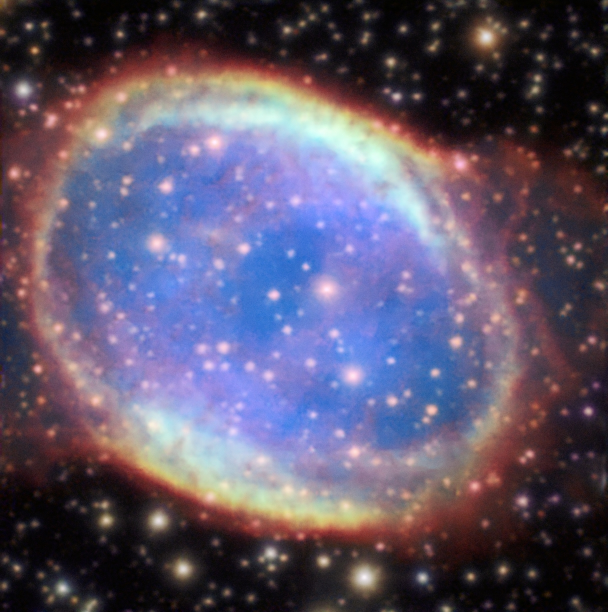
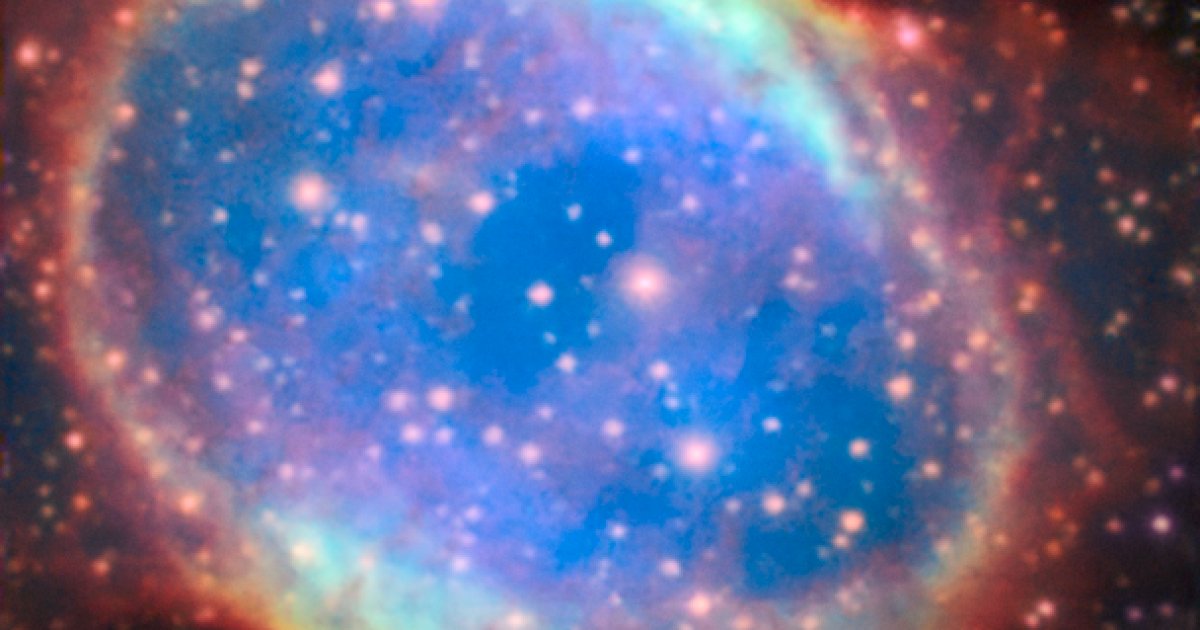
Planetary nebula NGC 6563 is faint but attainable in larger amateur scopes, located in the southern sky late tonight. Credit: ESO/P. Weilbacher
Looking for a sky event this week? Check out our full Sky This Week column.
July 18: Comet Tempel’s knife-edge tail
Right as the Moon is setting this evening, the planetary nebula NGC 6563 in Sagittarius is reaching the highest point in its path across the sky. This oval-shaped bubble of gas, generated as well as lit up by a dying Sun-like star in its center, is best viewed through larger scopes, so this is a great target if you’ve got access to an aperture of 8 inches or more.
Glowing around 11th magnitude, NGC 6563 is located in the south around 11 P.M. local daylight time. To find it, first identify the Teapot asterism in Sagittarius. The nebula sits just 2.5° west of magnitude 1.8 Kaus Australis (Epsilon Sagittarii), which marks the righthand corner of the Teapot’s base, where the bottom of its spout meets the body. This region is just to the upper left of the curving base of Scorpius’ tail, which lies closer to the horizon.
If you have one, use an Oxygen-III filter to help enhance the nebula’s visibility. NGC 6563 is pretty compact, just 48” across. Through most modestly large scopes, it will look like a featureless disk; if you’ve got a bigger scope of 14 inches or more, you will start to notice the outer edge is a bit brighter than the inner regions.
Sunrise: 5:47 A.M.
Sunset: 8:25 P.M.
Moonrise: 11:48 A.M.
Moonset: 11:21 P.M.
Moon Phase: Waxing crescent (37%)
*Times for sunrise, sunset, moonrise, and moonset are given in local time from 40° N 90° W. The Moon’s illumination is given at 10 P.M. local time from the same location.
Alison Klesman is senior editor of Astronomy magazine. She holds a Ph.D. in astronomy and has studied a variety of topics, from minor planets to supermassive black holes.