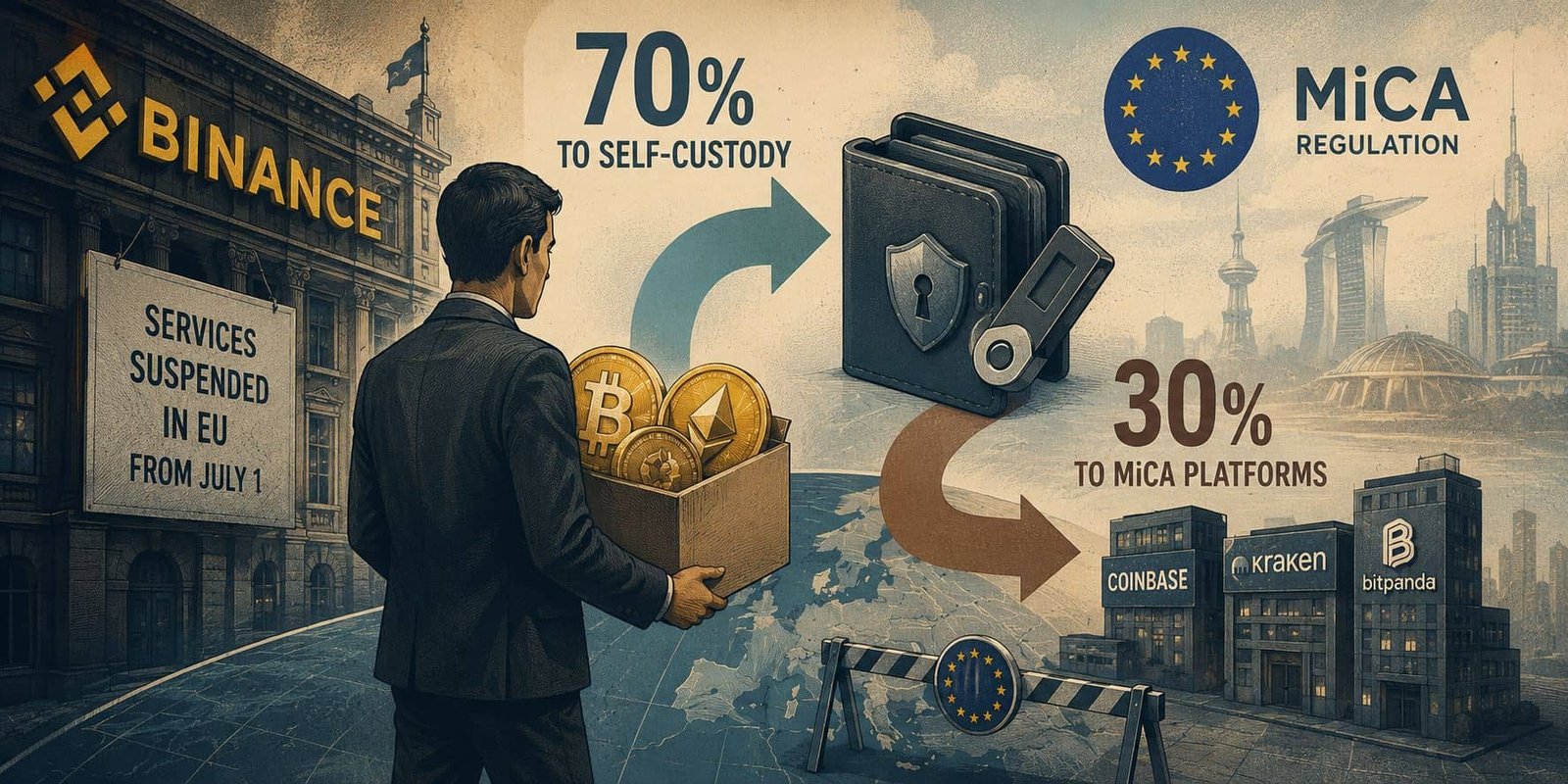
Binance Co-CEO Richard Teng Says 70% of EU Users Chose Self-Custody Over MiCA Platforms
European cryptocurrency users who withdrew funds from Binance after the exchange suspended services across the European Union largely opted for self-custody rather than transferring their assets to competing regulated exchanges, according to Binance Co-CEO Richard Teng.
Speaking at the Reuters NEXT Asia conference in Singapore, Teng said that roughly 70% of withdrawn customer assets were moved to self-custody wallets, while only 30% flowed to exchanges operating under the European Union’s Markets in Crypto-Assets (MiCA) framework. The figures followed Binance’s withdrawal of its MiCA license application in Greece and the company’s suspension of most services for EU users from July 1.
The migration pattern has reignited debate over whether stricter crypto regulation is encouraging users to remain within regulated markets or pushing them toward alternatives that sit outside the direct oversight of financial authorities.
Teng Questions MiCA’s Practical Impact
Teng argued that the migration of assets into self-custody wallets raises important questions about the practical outcomes of MiCA, the EU’s landmark crypto regulatory framework.

Binance Co-CEO Richard Teng said 70% of EU user funds withdrawn after the exchange’s MiCA-related exit moved to self-custody wallets, while 30% transferred to other MiCA-regulated platforms. Source: @BSCNews via X
“Users simply move their activity to other channels,” Teng said, adding that many appear to be operating “outside the regulated perimeter,” where authorities have less visibility and consumer protections may differ.
Unlike centralized exchanges, self-custody wallets allow users to control their own private keys without relying on an intermediary. While advocates view self-custody as a core principle of cryptocurrency ownership, these wallets generally fall outside the compliance systems that regulated exchanges use to conduct anti-money laundering (AML) and know-your-customer (KYC) checks.
According to Teng, this means regulators may lose transactional visibility when users migrate away from licensed platforms, potentially making it more difficult to monitor financial crime while reducing the effectiveness of rules designed to improve market oversight.
Binance Saw $1.23 Billion in EU Outflows
The shift in user behavior came during one of Binance’s largest periods of European withdrawals in recent years.
Around the week of the MiCA transition, the exchange recorded approximately $1.23 billion in net outflows from affected European customers, marking its heaviest weekly withdrawals in more than three years, according to figures discussed by Teng.

A post by @CryptoBlockto described the figures as evidence that “the market has spoken,” highlighting what it sees as a user preference for self-custody over regulated centralized platforms. Source: @CryptoBlockto via X
The outflows followed Binance’s decision to withdraw its MiCA application in Greece after regulatory approval did not materialize before the July 1 compliance deadline. Under MiCA, crypto asset service providers must obtain authorization from one EU member state to passport their services across the bloc. Without that approval, Binance suspended services for affected European users.
Teng said the exchange had expected a different outcome after working with regulators throughout the licensing process, adding that delays created uncertainty for customers and prompted Binance to pursue an orderly transition.
Binance Continues Pursuing EU Authorization
Despite its setback in Europe, Teng emphasized that Binance has not abandoned the region.
According to him, regulators in several EU member states have invited the exchange to submit new licensing applications, although he declined to identify the jurisdictions. “We are in close talk with regulators that invited us to apply (to) their regime,” Teng said, adding that it was still too early to disclose further details.
Binance previously confirmed that it intends to seek authorization in another EU member state while continuing discussions with European regulators.
Asia Expansion Continues Alongside Global Growth
While pursuing another route back into the European market, Binance is accelerating its expansion across Asia.
Teng said the company is seeking additional licenses throughout the region and recently entered the Philippine market through a local partnership. He also noted that Binance now serves approximately 323 million users worldwide, underscoring the exchange’s continued global growth despite regulatory challenges in Europe.
The contrasting strategies highlight Binance’s effort to maintain its international footprint while navigating evolving regulatory requirements across different jurisdictions. Although MiCA aims to establish a unified regulatory framework for digital assets within the European Union, Teng’s latest comments suggest the debate over its real-world impact on user behavior is likely to continue as the new regime matures.