AI rocket engine startup LegendSpace raises $29.5 million angel round
HELSINKI — A six-month-old Chinese startup aiming to use artificial intelligence to compress rocket engine development cycles has raised $29.5 million in angel funding.
LegendSpace, full name Linjie Hangtian (Beijing) Intelligent Technology Co., Ltd., announced the 200 million yuan round July 16, with investors including Vitalbridge, Yuanma Lüdong, Shangshi Capital, Crystal Stream Capital and Oriental Fortune Capital, with Gaohu Capital acting as financial advisor.
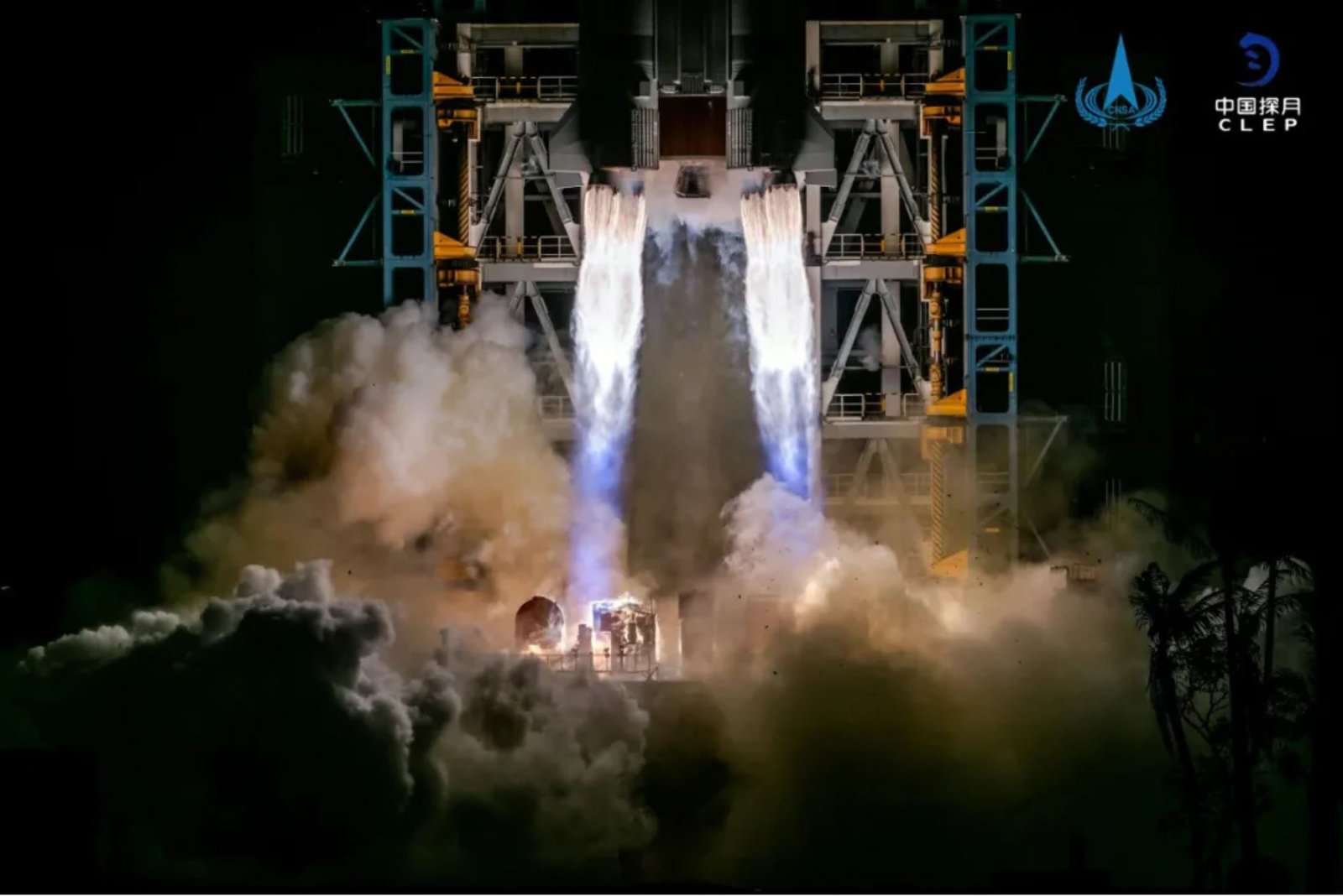
The angel round is notably as large as some early stage rounds for launch vehicle startups, and follows the company’s appearance in People’s Daily reports and the recent successful capture and recovery of the first stage of the Long March 10B rocket.
The funding will be used in three main ways, according to the statement. These are to put multiple liquid rocket engines with various levels of thrust through approval, ground testing, and hot-state verification, iterative upgrades to the company’s “Prime” intelligent research platform to enhance its AI simulation and metal additive manufacturing capabilities, and establish an industrial chain support and production testing system as a step towards large-scale production capabilities.
The company describes itself as an “AI-native” developer and manufacturer of liquid rocket engines rather than a software firm. Its pitch centers on its “Prime” agent-based engine development platform launched with the Beijing Institute for AI for Science (AISI) at the Zhongguancun Forum in March. The platform links AI-driven design generation, multiphysics simulation, additive manufacturing and cold- and hot-fire testing into a closed loop, which the company claims can compress engine iteration cycles from years to around two weeks. LegendSpace says it has completed one full validation loop from AI-assisted design through simulation to cold and hot testing.
LegendSpace described the validated loop as a single completed case with cold-flow simulation covering components such as injectors, and hot-fire simulation addressing matters such as thermal load. The company has not specified what hardware the loop was validated on. The platform builds on DeepFlame, an open-source, GPU-native reacting flow simulation code developed by Chen’s group at Peking University, with Mao Runze, Chen’s first doctoral graduate, as lead author of its foundational 2023 paper.
A 2.5-ton-thrust liquid engine is currently in 3D-printed trial production, according to the announcement. The company has not disclosed the engine’s propellant combination or cycle, nor named prospective customers. It has begun construction of a rocket engine test facility to eventually be capable of accommodating static fire tests of engines across a range of thrust capabilities.
The company was founded in January 2026 in Beijing’s Zhongguancun by Chen Zhi, born in 1991 and an assistant professor of aerospace engineering at Peking University and academic vice dean of AISI. Chen received the Combustion Institute’s Bernard Lewis Fellowship in 2020 and previously worked on combustion instability in Mitsubishi Heavy Industries gas turbines and as a visiting researcher at Sandia National Laboratories and the German Aerospace Center DLR.
A June 12 People’s Daily online article dedicated to the platform, framing it as a joint AISI-Peking University achievement, reported the two-week iteration figure along with computational efficiency gains of roughly 1,000 times, and quoted Chen on closing the loop “from drawing board to ignition test.” Coverage of the round in Chinese media also often made comparisons with SpaceX’s use of AI tools in development of its Raptor engines. LegendSpace’s platform also placed third overall among 1,803 projects at a global startup competition final held in Suzhou in early July.
The round comes amid a surge of momentum in China’s commercial space industry, with new reusable rockets reaching the pad, a wave of launch and satellite firms pressing towards IPOs, and clear support in the country’s 15th Five Year Plan, approved in March. The development also follows a growing trend of academic spinouts entering the dynamic Chinese space sector, such as in space-based computing and satellite operations.
LegendSpace is entering a crowded field, however. China already hosts dedicated commercial engine makers, including Jiuzhou Yunjian, alongside vertically integrated launch startups such as Landspace, Space Pioneer and iSpace which develop propulsion in-house. Successful entry likely depends on proving AI-driven development can deliver demonstrably faster and cheaper engines at relevant levels of thrust.