BrainCo demonstrates brain-controlled robot AI platform

BrainCo has spent over a decade developing its brain control interface and medical rehabilitation technology. | Source: BrainCo
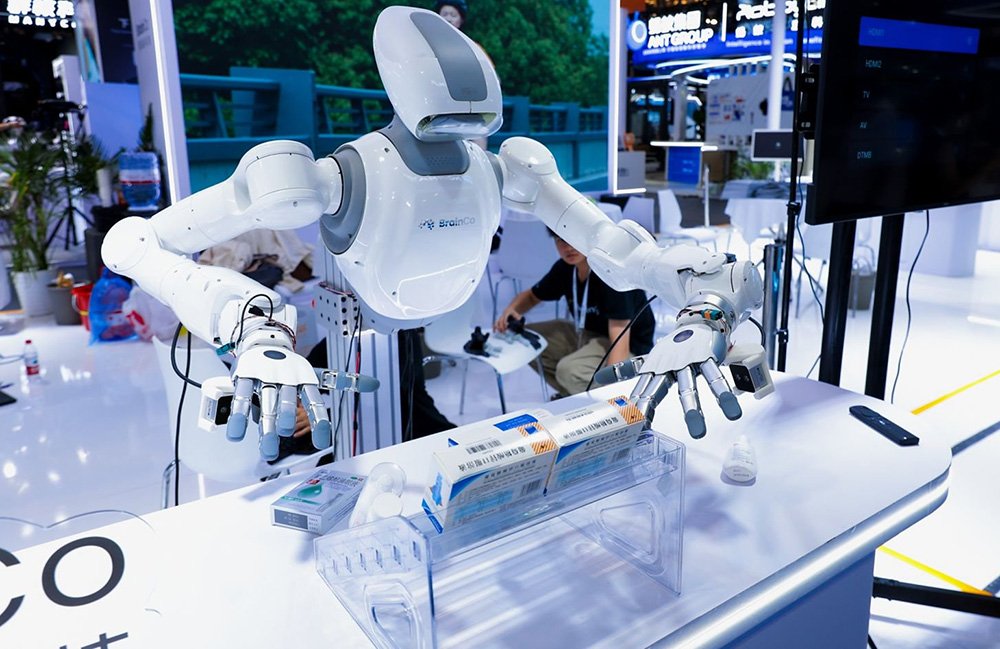
BrainCo, a brain-computer interface, or BCI, developer this week showcased a platform that allows users to direct a robot through neural signals. At the 2026 World Artificial Intelligence Conference, a person wearing a lightweight EEG headset and BrainCo’s BCI thought about grabbing a cap, and a robotic arm reached out and performed the action.
The technology works in three steps: The user puts on an EEG (electroencephalograph) headset that picks up the wearer’s brain signals. AI algorithms decode those signals to identify motor or control intent, and then that intent gets converted into commands for the robot. The entire process takes under 200 milliseconds.
“A decade of BCI research has given us the ability to decode what a person intends to do and translate that into machine action,” said Nyx He, partner and senior vice president of BrainCo. “By integrating brain-computer interfaces, AI, and embodied AI, we believe it will define the next chapter of human-machine collaboration.”
During the demonstration in Shanghai, the mind-controlled robotic arm completed tasks that require precision, such as grasping a cup or picking up an apple. BrainCo designed its platform to work with a wide range of commercially available robots, from humanoids machines to robotic arms and legged robots, enabling it to slot into research and development pipelines without needing proprietary hardware.
The Somerville, Mass.-based company described its underlying framework as “neuro-embodied-AI.” BCI decodes intent, and the AI layer refines that intent by decoding and figuring out how to break down complex intent into actionable steps. Then the robot’s own systems can handle physical execution.
BrainCo hopes to help close the robot training data gap
At the World Artificial Intelligence Conference (WAIC), BrainCo also debuted its Embodied AI Data Collection Solution. The company said this offering addresses the lack of high-quality, real-world training data to teach robots complex, dexterous tasks.
Teaching a robot to perform a complex physical task, such as folding laundry, assembling components, and handling fragile objects requires enormous amounts of high-quality training data, said BrainCo. Collecting that data has been one of the field’s most persistent technical challenges, the company noted.
BrainCo has built its Embodied AI Data Collection Solution on proprietary hardware including a dual-arm wheeled data-collection platform and a high-precision glove, which records data corpus spanning robot execution, human demonstration, and virtual simulation.
In addition, the system captures EEG data from the human operator. This means it records not just what a person’s hands are doing, but what their brain is telling those hands to do. The result combines the execution quality of real-robot data with the scalability of human-centric demonstration, enabling continuous, high-volume data supply grounded in real-world tasks, BrainCo asserted.
Founded in 2015, BrainCo already offers three robotic products. These are the Revo 3 Dexterous Hand, a 21-degree-of-freedom robotic end effector; the Intelligent Bionic Hand, a five-fingered prosthetic hand; and the Intelligent Bionic Leg, a smart prosthetic knee joint.
 Save the date for RoboBusiness 2026