STEM education evolves for AI era
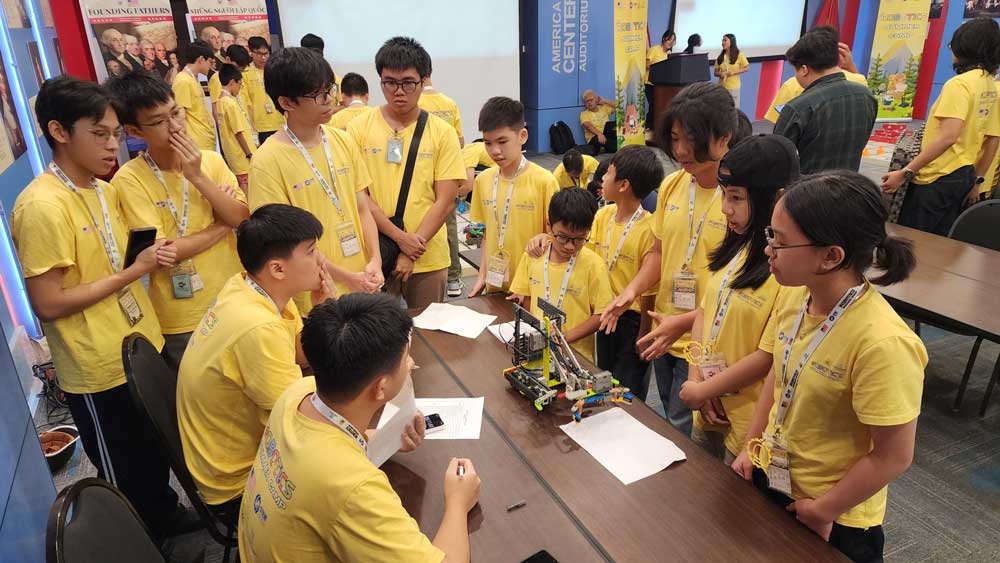 |
| STEM education is taking on a broader role in preparing the skilled workforce needed to support the country’s innovation ambitions. Photo: Hoang Dan |
According to the Organization for Economic Cooperation and Development’s AI and Skills: What We Know So Far report, released in June, AI is changing the skills required across the labour market.
While most workers are unlikely to become AI specialists, the report says they will increasingly need digital literacy, analytical thinking, problem-solving abilities and the capacity to work alongside AI. The OECD reinforced that message in its Skills in the AI Age report, published on July 8, arguing that education systems should move beyond knowledge transfer to foster lifelong learning, adaptability and innovative thinking to meet the needs of the AI economy.
The shift is also reflected in the Vietnam STEM, AI and Robotics Championship (VSAR) 2025–2026, whose national finals brought together 2,930 students from 29 cities and provinces at the National Innovation Centre in Hanoi. Beyond technical performance, the competition encourages students to combine STEM, AI and robotics knowledge with teamwork and practical problem-solving.
According to Dr. Nguyen Huu Phat, head of the Faculty of Electronics at the School of Electrical and Electronic Engineering under Hanoi University of Science and Technology and chairman of the VSAR 2025–2026 Professional Council, many student projects demonstrated the practical application of STEM, AI and robotics. However, he cautioned that while AI has become an increasingly common learning tool, students still need stronger analytical thinking and solid foundations in mathematics and physics.
“Creative thinking, analytical ability, and problem-solving skills are the core competencies students need to develop in the AI era. These are also the capabilities that technology can hardly replace,” Phat said, adding that STEM activities and AI applications should be integrated more closely into classroom teaching, practical sessions and real-world projects to help students develop technological thinking from an early age and build sustainable innovation capacity.
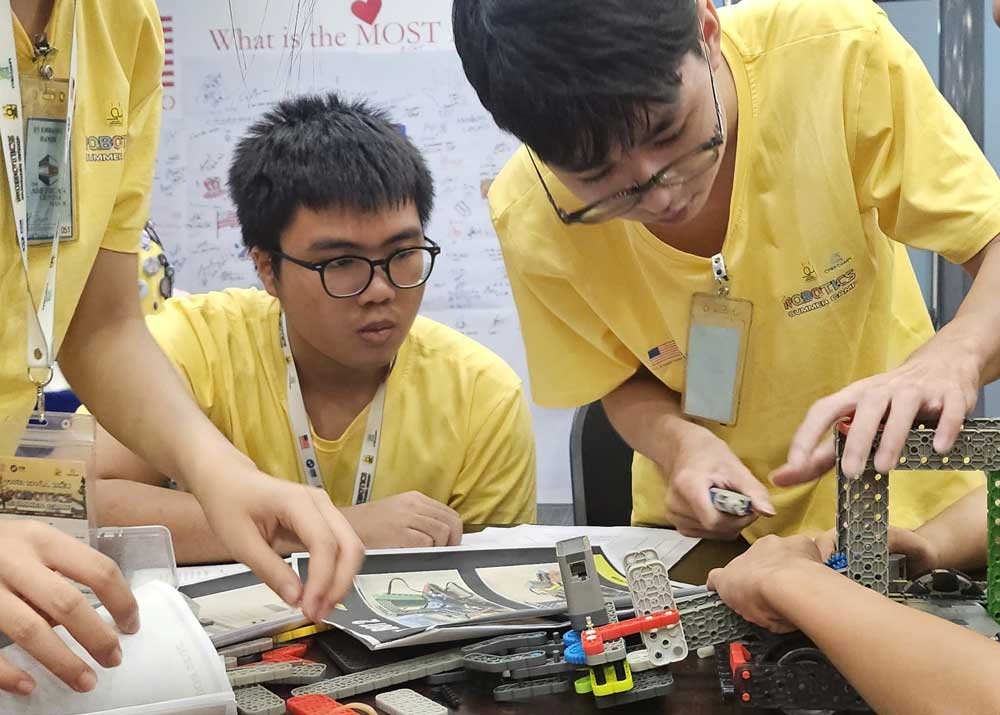 |
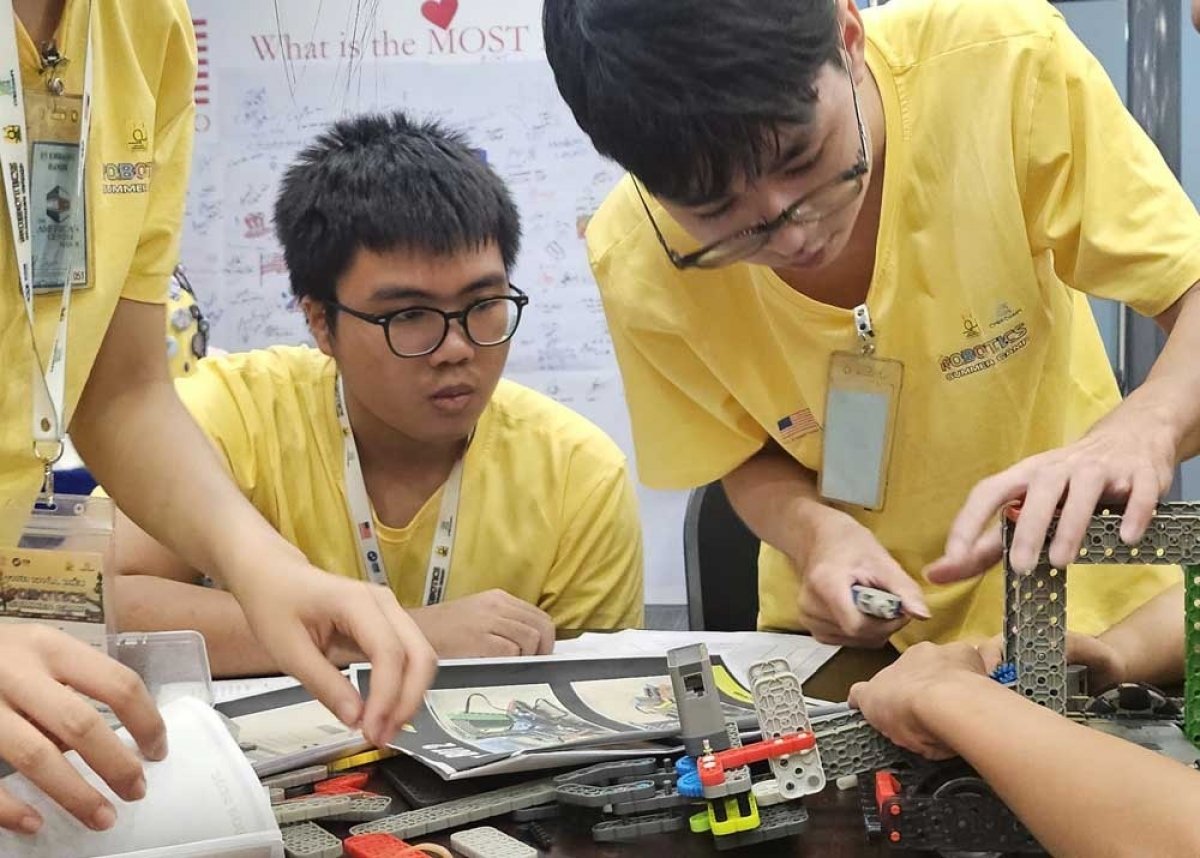
| At the Robotics Summer Camp students can work in teams to develop an entire project – from generating ideas and building robots to managing communications, fundraising and presenting their work. Photo: Hoang Dan |
According to Cao Quoc Khanh, co-founder of Cyber Champs, the same philosophy underpins the organisation’s STEM programmes.
“Our goal is not simply to teach students how to programme or build robots. We hope that, after completing the programme, every participant will have the confidence to establish a robotics club or team at their own school. That is why we include communications, fundraising, project planning and team operations alongside technical training. Understanding how an entire robotics team functions is just as important as learning how to build a robot,” Khanh said.
Khanh believes AI is making technical skills more accessible, while increasing the value of capabilities that remain uniquely human. “AI will increasingly take over repetitive tasks. But creativity, independent thinking and emotional intelligence remain difficult to replace. Those are the capabilities students should develop if they want to succeed in an AI-driven future,” he said.
That view is shared by Pham Lam Anh, a 17-year-old student currently studying in Singapore and a programming mentor at Robotics Summer Camp 2026.
According to her, AI can help students write code or identify programming errors, but it cannot replace practical experience or strategic thinking.
“AI can be an effective programming assistant, but the most challenging aspect of robotics is not writing code. It is developing strategies, testing ideas and learning from real-world experience. Those are skills that still depend heavily on human interaction, which is why mentors continue to play an important role,” she said.
She added that hands-on learning also helps students engage with STEM more effectively than classroom instruction alone. “Robotics involves many technical concepts, and relying solely on theory can make the subject difficult to approach. Practical learning enables students to understand concepts more quickly while also developing a genuine interest in STEM,” she added.
The same project-based approach is increasingly being adopted by community STEM programmes across Vietnam.
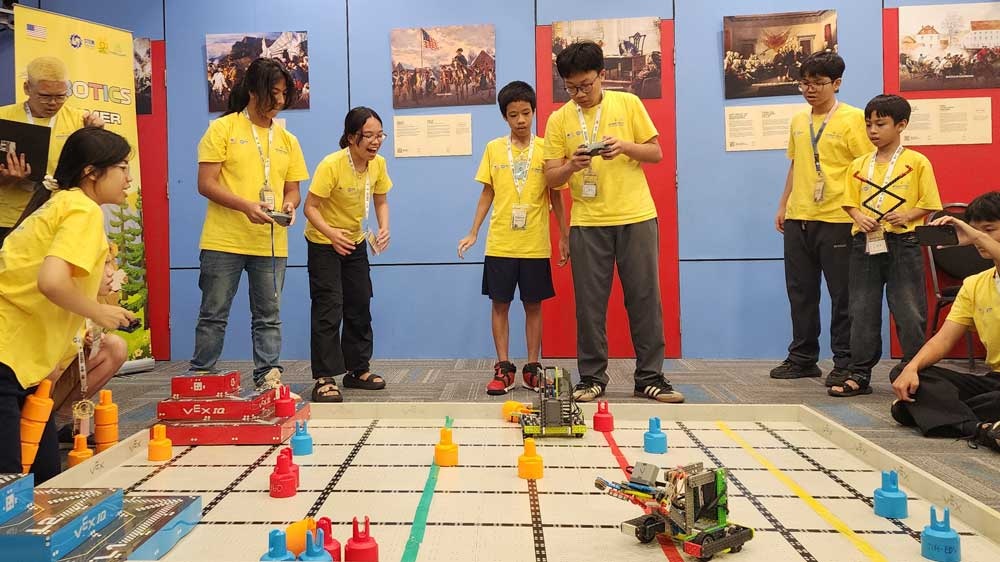 |
| Beyond policy initiatives, technology competitions are giving students greater opportunities to apply STEM knowledge in practice. Photo: Hoang Dan |
Le Minh Quy, another mentor at Robotics Summer Camp 2026, said what impressed him most was not only how quickly students absorbed new knowledge, but also their curiosity and willingness to support one another.
“What surprised me most was how quickly the students learned. They were constantly asking questions, eager to understand more, and always willing to explore new ideas. Those qualities are what help young learners grow, especially at this age,” he said.
Quy also highlighted the learning environment as one of the programme’s strengths. Besides the mentors, he credited the supervisors for providing continuous support to every team throughout the camp.
Rather than completing isolated technical tasks, students work in teams to develop an entire project – from generating ideas and building robots to managing communications, fundraising and presenting their work. The process exposes participants to technology while helping them strengthen collaboration, time management and problem-solving skills in settings that resemble real working environments.
Parents are also placing growing importance on practical STEM experiences. For Nguyen Phuong Lan, whose child participated in a robotics summer programme, expanding access to hands-on STEM education is just as important as teaching technical knowledge.
“Opportunities to experience practical STEM education in public schools remain limited, with most activities taking place through extracurricular clubs. Families often have to look outside school if they want more structured programmes. I hope children can explore different career pathways from an early age so they have a better understanding of where their interests and strengths lie,” Lan said.
Lan said that in the AI era, parents are increasingly concerned about their children’s ability to continue learning rather than simply acquiring knowledge.
“The most important skill is the ability to learn independently and adapt. AI will continue to transform the way we live and work, so children need to know how to use AI effectively while continuing to think creatively and develop ideas of their own. More importantly, they need the initiative to set goals, explore, and keep learning throughout their lives,” she added.