Roundtable: Summer After Summer · VC 3.0
“In 2026, the tides of the venture capital circle surge once again: AI has moved from a technical concept into the deep waters of industry, hard-tech entrepreneurship has evolved from a “niche track” to a “mainstream consensus”, and young entrepreneurs are using code and their own hands to redefine the future coordinates of China’s innovation.
Every year, the WAVES conference hosted by 36Kr · Undercurrent serves as the annual vane of China’s venture capital circle. This year’s WAVES 2026, themed “This Midsummer”, will be held at Liangcang Xinzao Creative Park in Panyu, Guangzhou. Over the course of two days, we have gathered top investors, industry leaders, and emerging entrepreneurs to unpack the underlying logic of core tracks such as AI, hard technology, global expansion, and healthcare through 14 in-depth roundtables and dozens of independent speeches, witnessing how the perseverance of those “few people” converges into a wave that transforms the industry.”
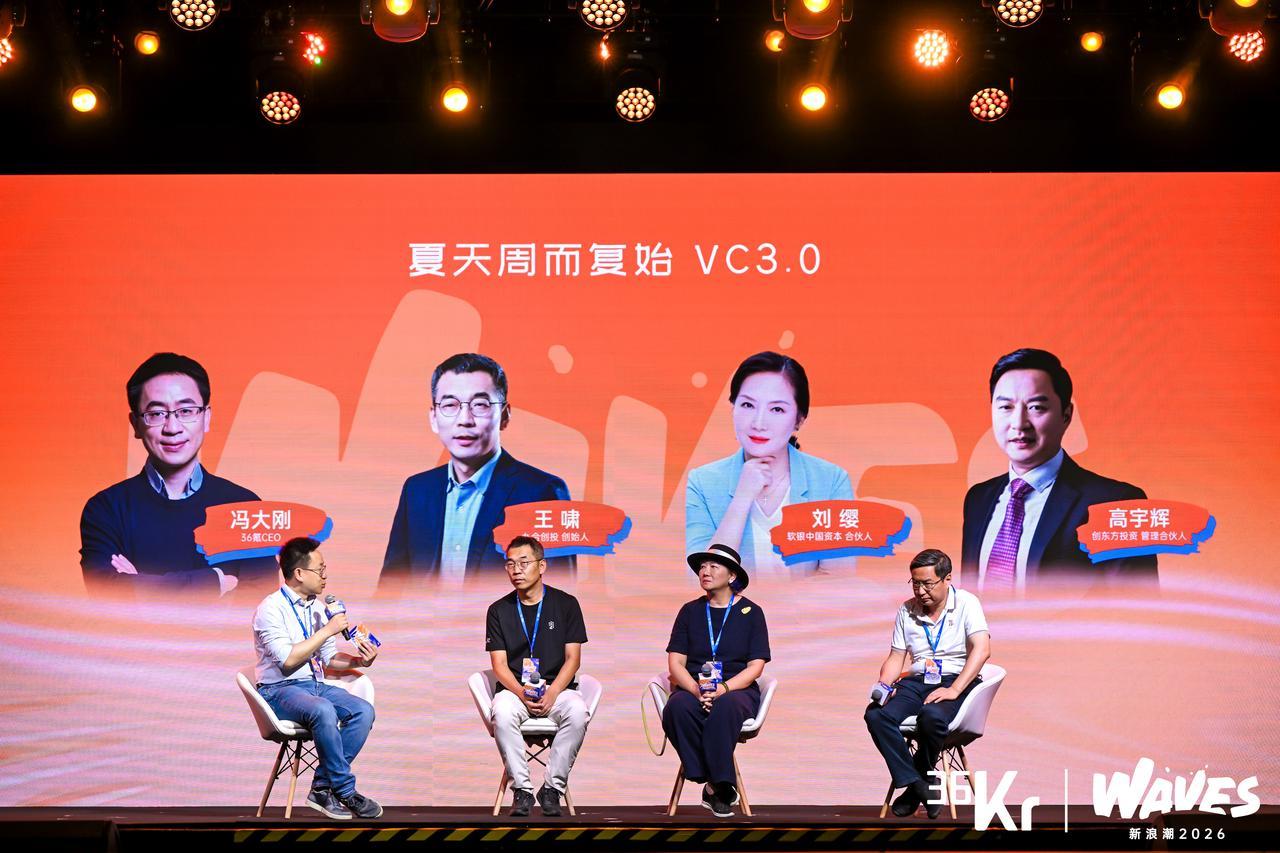
FENG Dagang | CEO of 36Kr (Roundtable Host)
WANG Xiao | Founder of Unity Ventures
LIU Ying | Partner of SoftBank China Capital
GAO Yuhui | Managing Partner of CDH Investments
FENG Dagang: To the three guests on the stage, I’d like to start with a short story: What year was the term “AI” first proposed? It was 1956. Up to now, the term “AI” is already 70 years old. Compared to AI, we are all still young people, 20 years younger than AI. As young people, today we are here to discuss the changes taking place in this industry. The industry is now in a summer. Summer means everything has already happened, but we don’t know what the outcome will be. In this process, I feel that many changes are taking place in this industry accordingly. Today we mainly have several questions: First, is the cycle the same as before? Second, is entrepreneurship the same as before? Is investment the same as before? And finally, some of our judgments and choices.
Let’s start the discussion with the first question about the cycle. Today we call it VC 3.0. Everyone present is a battle-tested veteran, and we have all gone through many cycles. Is this cycle different from the previous ones?
Some people say that this AI wave is so massive that this cycle may be different from the past. We have jumped out of a certain cycle and entered a new loop. Others say that they have seen many cycles, and in fact this one is similar to the past. Every time there is a rise, boom, prosperity, and then a decline. So is this time the same?
Let’s go in order, and start with Wang Xiao. Wang Xiao was the earliest angel investor of 36Kr. It was around 2011, 15 years ago, and he was one of the first people to invest in 36Kr. Today we also especially thank him, because he was our earliest angel investor.
WANG Xiao: Right, 36Kr is 16 years old this year, and we have been in the investment business for almost 15 years. So we started from scratch together with 36Kr.
FENG Dagang: Then you can start talking first.
WANG Xiao: The first cycle I experienced was the Internet, and the second was the mobile Internet. Now, we have entered the era of great navigation in technology. I think artificial intelligence is part of it, or it can be said to be the third cycle.
I believe that the essence of cycles is the same. They are all large structural opportunities brought about by the development and changes of technology and society, and some new large companies will eventually emerge. This wave is no exception. Of course, there are differences. The driving force is different. It comes from the significant leap in AI capabilities after the continuous improvement of GPU computing power. We can see that its intelligence has a certain emergence, which brings structural changes to all walks of life, including robots, daily office work, and various application scenarios. In the past, the essence was to connect people with information, but now artificial intelligence directly generates a lot of information content and service capabilities. So I think this wave may be more intense than before.
There is another difference this time. Essentially, this cycle is a large structural opportunity that emerged under the general environment of China-US game. Therefore, we not only look at technology, but also at policies, China-US relations, and the opportunities brought by various blockades. So I think the dimension of this cycle is much higher, which is why everyone thinks it is different from past cycles. But I still think the essence is the same. Ultimately, we must meet people’s needs and seize the big opportunities brought by changes in the technological structure.
FENG Dagang: I’d like to add two questions. In the cycles we saw in the past, they often seemed to be cycles of computers and the Internet, but eventually they turned into opportunities for thousands of industries. However, there is a voice in this wave that this may only be an opportunity for AI. In the future, there may be no thousands of industries, only the AI industry. This is the first question I added: Is this round really an opportunity for thousands of industries? Second, you just mentioned “replacement”. Is this wave of opportunities not very related to “people” because we have all been replaced? I also want to ask these two questions to the two guests behind.
WANG Xiao: I think people will definitely find their own way of survival. Every industrial revolution in the past has replaced workers, but with the development of the times, we can still find our own way of existence. Even if silicon-based life becomes more and more intelligent, people can find their own value and still feel the beauty of the world.
So I think artificial intelligence will not really replace humans, but it will inevitably have an impact on certain types of work and certain jobs. So far, the group most affected by this wave is programmers. Because the capabilities of robots will be significantly improved, but what remains unchanged is that people can adapt. Human learning ability and social adaptability still exist. So after many years, you will find that it is still creating a better world. Just like the industrial revolution brought a huge leap in productivity, the quality of human life has also been improved.
I think artificial intelligence is likely to be further improved. It is actually an important node leading to an intelligent society after the industrial revolution and the information revolution. In the future, the productivity of the whole society may be greatly enriched: factories are all unmanned, and the cost of things is extremely low, because these factories do not require human input. All of them rely on electricity, and nuclear fusion will bring cheap electricity. Biotechnology will also improve our quality of life. So in another ten or twenty years, I think the whole society will have a qualitative leap, which will bring us a huge improvement in happiness.
FENG Dagang: Let’s welcome Ms. Liu.
LIU Ying: SoftBank China entered China in 2000 and has been investing for more than 20 years. I myself joined SoftBank China in 2009 to start investing. Because SoftBank China basically focuses on hard technology investment, we have experienced many ups and downs in the wave of technological progress. But I also fully agree with Mr. Wang’s point of view: No matter how this cycle changes, the essence will not change. The essence is the same, because all technological progress is to make people live better, reduce the cost of people’s lives, and improve social efficiency.
But what makes this cycle different? From the Internet to the mobile Internet, SoftBank has invested in countless projects, including Taobao and others. Regarding this AI cycle, I am more certain that it is a technological transformation of traditional industries. Therefore, the replacement of people has actually happened long ago, not after the emergence of AI. The company Coolwa we invested in back then focuses on autonomous driving, sweeping robots and other directions, and entered the lights-out factory very early.
So I agree with Mr. Wang’s statement: Human adaptability is very strong. No matter how things change, the emergence of new industries will not make people unable to survive. With the improvement of social efficiency and the reduction of people’s living costs, I think “whether people can survive” is not a problem. A large number of people may be liberated from the jobs they are unwilling to do and go to do the jobs they are willing to do. So let’s not talk about technological progress first. This is actually a transformation of social structure and labor structure. I think this is more conducive to the happy survival of human beings.
This wave may bring some adjustments to the industry, and more importantly, improve the efficiency of traditional industries. This point is very important. So when we consider whether a project is worth looking at, we still look at whether it improves the efficiency and brings essential changes to people’s basic needs of daily life. I think this point will not change.
FENG Dagang: What you said reminds me of a book written by a historian, called *The End of History*. So I think the two of you actually share the same view. At no time would you agree to write a book about the end of technology or the end of history. History has no end, and history will repeat itself again and again.
Mr. Gao, what do you think is the same and what is different this time?
GAO Yuhui: Let me briefly introduce first. CDH Investments is a veteran venture capital institution with a history of 19 years. We used to focus on early-stage investment, small-scale investment, and hard technology investment, mainly in the manufacturing industry. So far, we have invested in more than 40 listed companies.
Based on the characteristics of our company, I will talk about my feelings about cycles and AI replacement. I very much agree with what Mr. Wang and Ms. Liu said earlier: The essence of the cycle will not change. It always goes through stages of initiation, prosperity, overheating, bubble, then bubble burst, and then the second round begins. The big process remains unchanged. But what may change? Under this AI wave, the inflection point of the cycle is more difficult to judge than before. In the past, it was linear, and we could roughly judge where the inflection point was through various factors. But besides AI, the implementation of the “9+6” industrial policy in the 15th Five-Year Plan is also affecting the trend of the entire cycle. AI is really penetrating into thousands of industries and changing many original development trajectories. For example, AI is applied to the research of protein folding. In the past, it took a long time and a lot of energy, but AI has greatly accelerated this process. Another example is AI in the field of new material development. There was a report in 2024 about researching how to use Mars soil samples to produce oxygen to solve the lack of oxygen for Mars immigration proposed by Musk. Without AI in the past, this R&D might take 1200 years. But with the help of AI, the time is shortened to only one month. In fact, AI For Science has produced preliminary results in about two weeks. In short, the impact of AI on every industry is enormous. When we make investments, we embed all the investment projects into the curves of the macro situation, industrial situation, and sub-sectors. The way of drawing these curves is the same. So there are both changes and constants.
When it comes to the impact on talents, this impact is very huge. Take India as an example. In the past, graduates most wanted to work in several large software companies, and entering these companies meant a leap in social status. Every year, these large software companies recruit at least tens of thousands or even hundreds of thousands of software developers, but this year the number is very small. In the first half of the year, these companies recruited very few people, and it is said that the goal is to lay off 30% of their staff this year. Why? Because European and American countries no longer need these basic coders. For example, the entire financial industry in Australia has begun to gradually eliminate Indian outsourcing. The work that used to require hundreds of people to develop can now be replaced by several work teams plus AI. This impact is extremely far-reaching.
AI also brings a very big opportunity for China, which is “AI + Robot”. “AI + Robot” can completely offset the demographic dividend. It may block the leap path of industrialized countries in Southeast Asia, including India. They not only missed industrialization in the past ten years, but may also miss it in the next few decades. But for China, “AI + Robot” is precisely an important way to solve the aging society. Many changes brought by AI may exceed our imagination, and overall I think this wave is very beneficial to China.
FENG Dagang: Let’s reverse the order and start with Mr. Gao this time. We just talked about the cycle, and all three of you think that the essence of the cycle is a loop that has not been broken. The next question is: Is VC different now? I also came from an investment background, and I can clearly feel that it seems different. For example, in the past, as long as you found the right people and the right team, invested money in them, and then waited for the IPO. But today it’s different. Today we ourselves have to learn AI, build various capabilities, and help our clients secure orders. They ask you, can you help me get 100 million yuan a year? The 100 million yuan they mentioned is not financing, but to help my products land in the market. We also have to face various domestic and international regulations. These things are different from the past. So what do you think about the differences in VC?
GAO Yuhui: The whole era is different, so VC must evolve. The most different points are what we call fundraising, investment, management, and exit. First of all, there have been huge changes on the fundraising side. More than ten years ago, when CDH Investments was just established, there was almost no state-owned capital, and all the capital structure was social capital. But according to the latest figures, no matter which statistical caliber you use, the proportion of state-owned capital in the total social fundraising last year was no lower than 80% to 90%. What is the biggest difference between state-owned capital and social fundraising? It carries the demands of local governments, such as counter-investment and investment attraction. These are huge changes. It requires GPs to adapt to such changes. To adapt to these changes, GPs must have the ability to attract investment and make counter-investment. In other words, you have to deeply engage in the industry. It is not that you can invest in a project just because you think it is good from a single dimension. Instead, you need to “meet multiple requirements at the same time” and possibly “take into account the demands of all parties”. This is from the perspective of fundraising.
The same is true for changes on the investment side. The industry is increasingly developing in a more professional and segmented direction. This requires all VC institutions to have stronger research capabilities and forward-looking judgment capabilities than in the past. The more hotspots there are now, the higher the requirements for research capabilities and forward-looking judgment capabilities.
Third, the organizational structure will change. Now a partner leads several team members to work. Maybe three to five years later, a partner will lead several Agents to work. Simple analysis will be handed over to AI. Will there be a high degree of homogeneity in the industry? Everyone uses the same model, then what can these venture capital institutions do? What is the value of our existence? The value of existence lies in the ability to make judgments beyond AI, build a unique set of venture capital strategies and analysis models. This is a real challenge. Whether you can keep up with this wave and make new changes and innovations will determine the future position of venture capital institutions in the market and whether they can move from past success to new glory.
FENG Dagang: So AI gives a standard answer, and if we want to do well, we have to go beyond the standard answer.
GAO Yuhui: AI does not give standard answers. The biggest problem with AI at present is that it can only score 70 or 80 points for a task. If you want 90 points, manual intervention is necessary, which will lead to a high degree of differentiation in the market in the future. I have several personal views: AI is definitely not here to equalize opportunities, nor to break information and knowledge barriers. AI will create a larger echo chamber, making the Pareto principle (80/20 rule) evolve into the 90/10 rule. This means that on the basis of AI’s work, the value of those who can raise the score from 70-80 points to 90-100 points will be more prominent. But on the other hand, if a person’s work ability can only reach 50-60 points, these people will be ruthlessly eliminated, because AI Agents can replace them. As mentioned earlier, the current work state is that several leaders lead the middle layer and even some auxiliary layers to complete the work. The simple labor of the middle layer and auxiliary layers, from programmers to the final bottom-level assistants, is likely to be gradually replaced by robots and AI. But on the other hand, the top people will