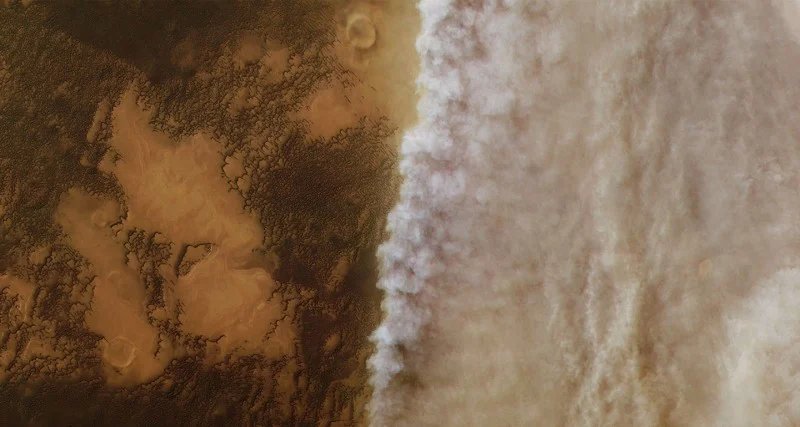
Electrically Charged Mars Storms Threaten Future Exploration
Martian dust storms are some of the most fascinating and mysterious planetary surface processes ever observed, as Earth, Mars, and Saturn’s moon Titan are the only known planetary bodies to have active dust storms. However, the major difference for Mars is its dust storms can blanket the entire planet at once, resulting in the surface becoming completely unobservable and blocking out sunlight, with the scientific community concerned this might hinder robotic, and even human, space exploration. But what if covering the surface and blocking sunlight wasn’t the only issue Martian global dust storms pose for future missions?
Now, a trio of researchers from the University of Alabama in Huntsville (UAH) and the NASA Marshall Space Flight Center have proposed that Martian dust storms could cause the lower atmosphere to become electrically charged. In a recent study published in The Planetary Science Journal, the researchers analyzed data for Martian Year 34 obtained from Mars Climate Database v.6.1, which is a publicly available high-resolution weather dataset of Mars using data from the Mars General Circulation Models (GCM) simulations.
For context, one Martian Year is equivalent to 687 Earth days, and tracking of Martian Years began in the year 2000 with a starting point of April 11, 1955, which coincided with right before a global dust storm was observed on Mars in 1956. For this study, Martian Year 34 was between May 5, 2017 to March 23, 2019, and specifically focused on a global dust storm that occurred in mid-2018.
In the end, the researchers found that electric fields were produced in the lower atmosphere of Mars, known as breakdown-favorable conditions. The team notes this could have implications for future spacecraft on Mars beyond just the dusty conditions reducing visibility and sunlight. Specifically, the team emphasized how electrical conditions are produced from the physical environment and the implications for potential impacting future exploration of the surface of Mars.
“For future Mars exploration, our study suggests that major dust storms should be evaluated not only as atmospheric, thermal and visibility hazards, but also as structured electrostatic environments,” said Chali Idosa Uga, who is a third-year PhD student in the Department of Space Science at UAH and lead author of the study. “We do not quantify risk to a specific spacecraft, habitat, instrument or communication system. What we show is that during the Martian Year 34 global dust storm, the lower atmosphere developed localized and altitude-dependent regions where charge separation could persist, and modeled electric fields approached breakdown-favorable conditions.”
The mid-2018 global dust storm on Mars was especially relevant since it was not only tracked by NASA’s Curiosity rover from Gale Crater, but this storm was responsible for ultimately bringing NASA’s long-serving Opportunity (aka Oppy) rover mission to an unfortunate end. This is because while Oppy survived far beyond its estimated lifetime due to dust devils cleaning its solar panels, allowing it to recharge its batteries, this global dust storm completely prevented the rover from recharging its batteries due to the drastically diminished sunlight. Simultaneously, orbiting spacecraft, specifically NASA’s MRO (Mars Reconnaissance Orbiter), MAVEN, and ESA’s Trace Gas Orbiter monitored how the global dust storm influenced global wind patterns, atmospheric water vapor, and solar heating across the Red Planet.
This study comes as NASA has its sights set on eventually sending humans to the Red Planet sometime in the next decade or so. Therefore, studies like this demonstrate the environmental hurdles that future astronauts will have to cope with to live and work on the surface of Mars. But this study is also useful in developing methods for surviving harsh conditions like global dust storms, along with the lack of oxygen, air pressure, and water.
What new insights into electrically charged Martian dust storms will researchers make in the coming years and decades? Only time will tell, and this is why we science!
As always, keep doing science & keep looking up!