Experts sound the alarm over AI facial recognition trial scanning more than 130,000 Australians in just one week
A new AI-powered facial recognition system is scanning thousands of Australians in public every day, raising fresh questions about privacy, accuracy and police surveillance.
The technology, currently being trialled in Western Australia, has already scanned more than 130,000 people in its first week, resulting in 19 arrests and two incorrect alerts as debate intensifies over how artificial intelligence should be used in policing.
WATCH THE VIDEO ABOVE: WA trials live facial recognition cameras in public
Know the news with the 7NEWS app: Download today
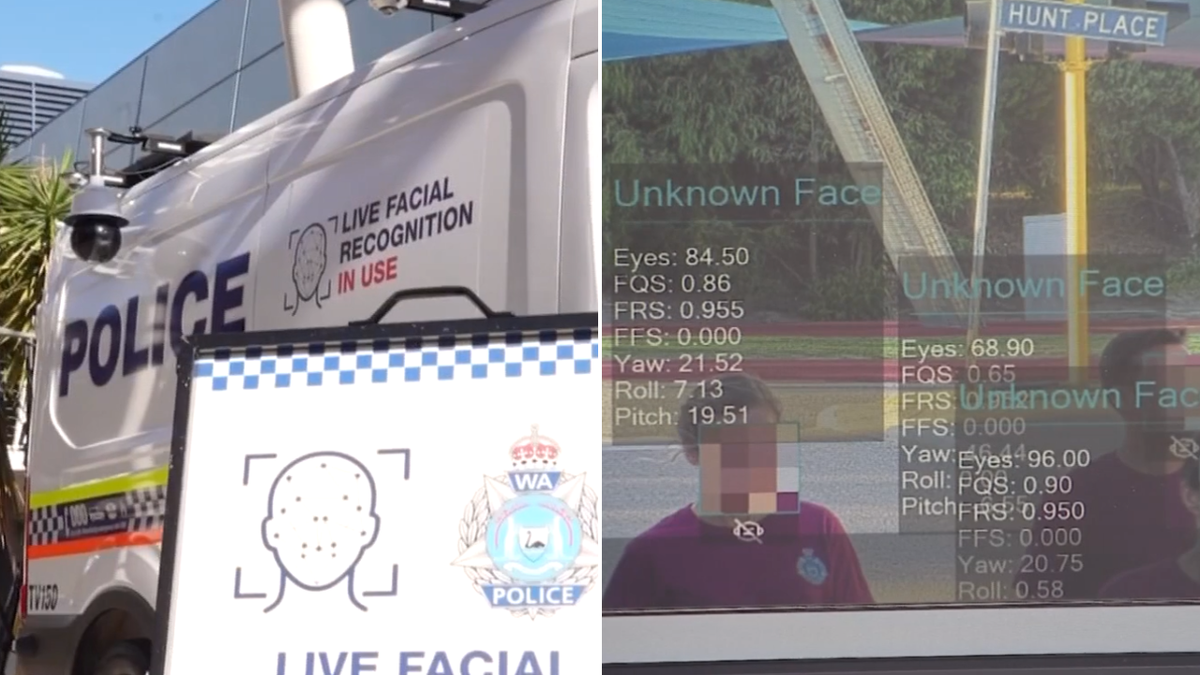
The system operates from clearly marked police vans, using AI to scan the faces of people in public in real time and compare them against a database of criminal photographs taken at police stations.
If a potential match is identified, a police officer manually verifies the result before any action is taken.
Former ASIO officer and Cybertrace CEO Dan Halpert explained the technology only compares faces against images already held by police.
“That information, the criminal photographs, are then scanned against everyday people walking past in real time,” Halpert said.
“If there is a hit, then an individual or an officer will validate that result before anything is done.”
He said if no match is found, the image is automatically deleted.

Former NSW Police superintendent Robert Critchlow said the technology could become a valuable tool for officers, allowing police to identify people wanted for serious offences while making better use of limited resources.
“There’s only so many police that can cover so much ground so this sort of thing would pick up people of serious concern, the people with warrants wanted for various offences,” Critchlow said.
While supporters say the AI system could improve public safety, Halpert warned its use in public spaces raises significant privacy concerns because it captures images of innocent people, including children, as they go about their daily lives.
“With the existing system where individuals are photographed within a police station, they’ve committed an offence or alleged offence and have had their image taken,” he said.
“Should that apply to innocent individuals in the public space where there is a feeling of freedom in those public spaces?”
Halpert said stronger laws would be essential if facial recognition technology became more widely adopted.
“I think whatever happens from here on in will need to be covered by a very strong legislation,” he said.
The technology rollout comes as One Nation leader Pauline Hanson calls for an ICE-style crackdown on illegal immigrants, prompting questions about whether the technology could eventually be used to identify people living in Australia unlawfully.
Critchlow said that would be an “inappropriate” expansion of the system’s purpose and would be a “misuse of technology”.
He argued facial recognition should remain focused on locating people wanted on outstanding warrants or those appearing on terrorist watch lists, rather than being used for broader immigration enforcement.
Halpert agreed the technology could technically be used to locate people in the country illegally but warned that possibility highlighted one of the biggest risks associated with AI-powered surveillance.
He said the potential for the technology to expand beyond its original purpose was one of his key concerns about facial recognition being used to scan members of the public.