The Sky Today on Wednesday, July 22: Dione passes north of Saturn
The 10th-magnitude moon Dione skims above Saturn’s north pole early this morning, accompanied by its shadow on the cloud tops
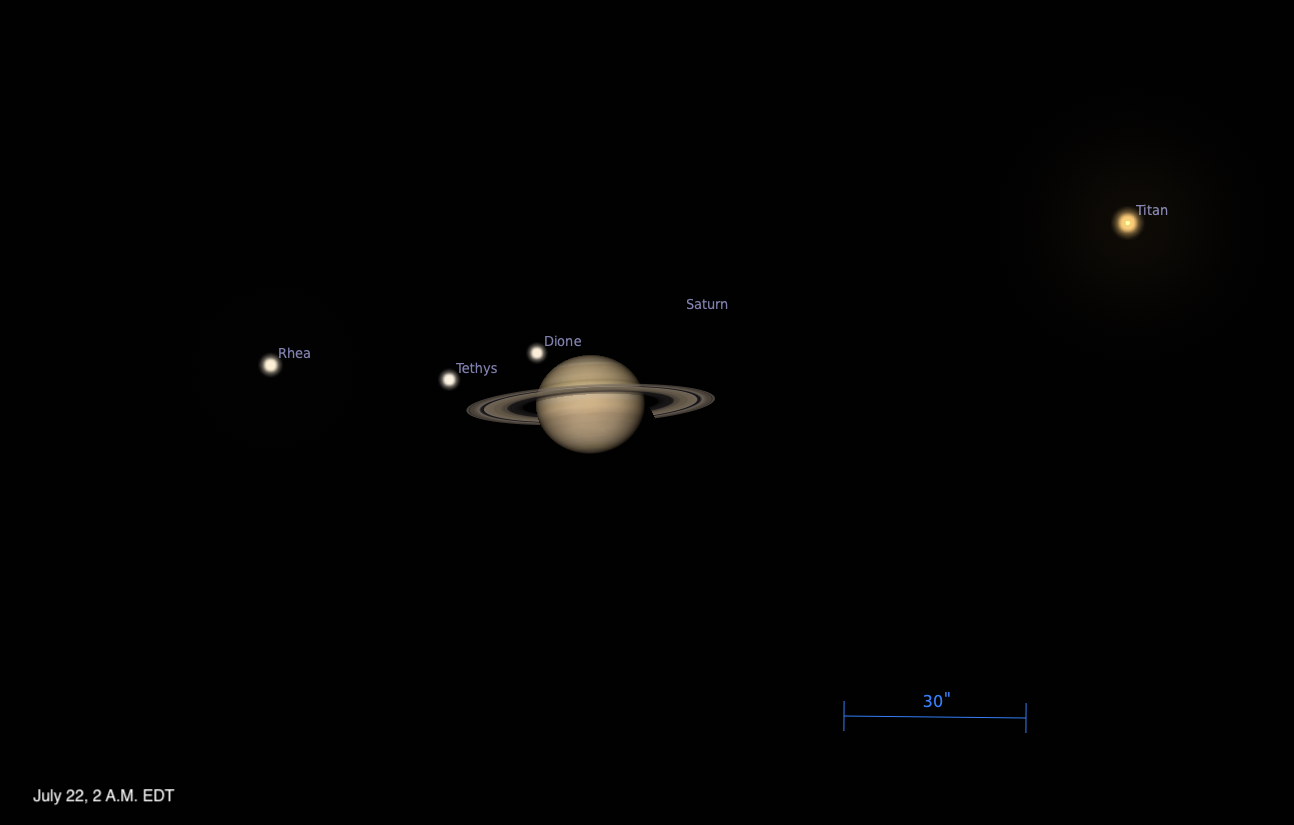
Early this morning, several moons cluster close to Saturn: Dione is preparing to skim north of the planet’s pole, while Tethys will transit the disk. This chart only shows satellites brighter than 11th magnitude. North is up and east is left. Credit: Stellarium/Oleg Pluton
Looking for a sky event this week? Check out our full Sky This Week column.
July 21: Catch Titan near Saturn
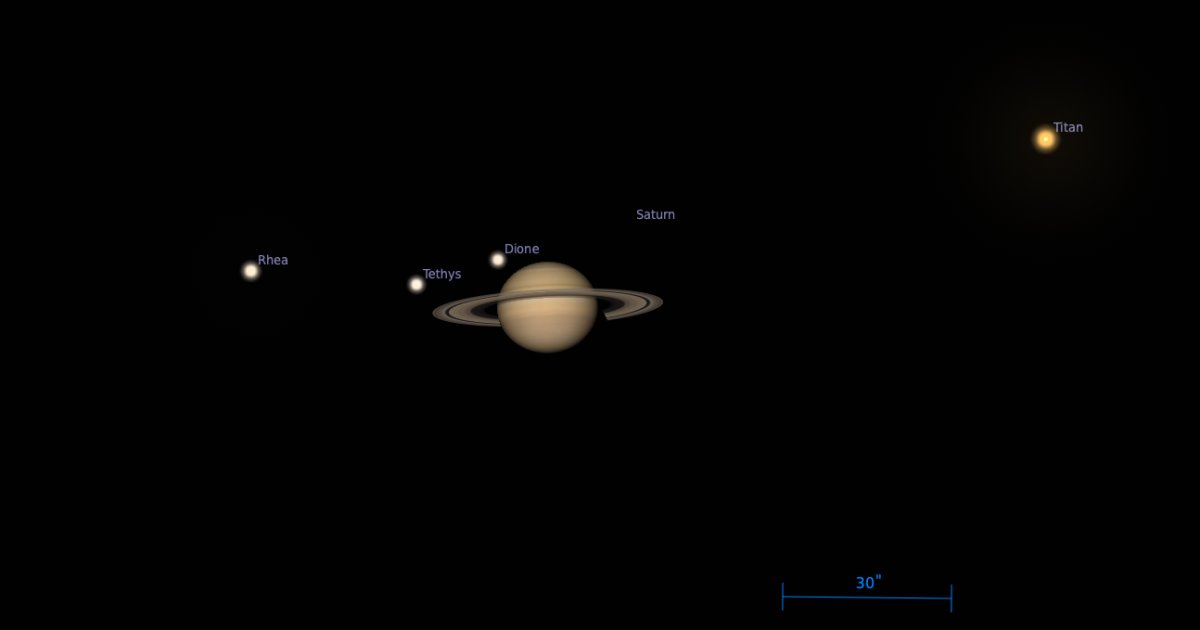
Let’s look to Saturn this morning to catch the 10th-magnitude moon Dione skimming north of the planet’s pole from about 3 A.M. to 4 A.M. EDT. Point your telescope toward the ringed planet as soon as it’s readily visible above your horizon to see how the view has changed since yesterday: Titan is now far (nearly 2’) to the planet’s northwest, while Rhea is quite far to the east. Around 2 A.M. EDT, Tethys is just north of the rings also to the east of the planet, and Dione is closing in from the northeast.
Over the next few hours, Dione will pass north of Saturn but won’t transit, leaving a sliver of dark space between the world’s limb and the moon. However, its tiny shadow will transit — if you’re an experienced planetary imager, particularly with video capture, this is for you. (If not, you’re not likely to see the shadow by eye.) The shadow leads the moon, appearing at the northeastern limb just after 1:30 A.M. EDT and taking two hours to complete its transit. It disappears from the northwestern limb just as Dione is roughly due north of Saturn’s pole.
Imagers, stay alert — next up is Tethys’ shadow, which appears at the eastern limb just above the rings around 4 A.M. EDT. Tethys itself then begins a transit around 4 A.M. CDT (note the time zone change). Again, only imagers will likely see this event, as the small moon will be hard to make out against the bright cloud tops. Tethys’ shadow transit ends around 4:30 A.M. MDT (again, note the time zone change), while Tethys slips away from the disk about 30 minutes later.
Sunrise: 5:50 A.M.
Sunset: 8:23 P.M.
Moonrise: 3:00 P.M.
Moonset: 12:09 A.M.
Moon Phase: Waxing gibbous (66%)
*Times for sunrise, sunset, moonrise, and moonset are given in local time from 40° N 90° W. The Moon’s illumination is given at 10 P.M. local time from the same location.
The planet Mercury comes to a standstill tomorrow. Located in the constellation Gemini, the tiny world is now rising before the Sun, visible for a short time in the east before sunrise. However, it’s quite faint — magnitude 2.2 — and is best seen with binoculars or a telescope, to the far lower left of Betelgeuse in Orion, which itself stands left of the three star asterism Orion’s Belt. High above, magnitude 1.3 Mars is brighter and easier to spot, to the left of Taurus’ brightest star, Aldebaran.
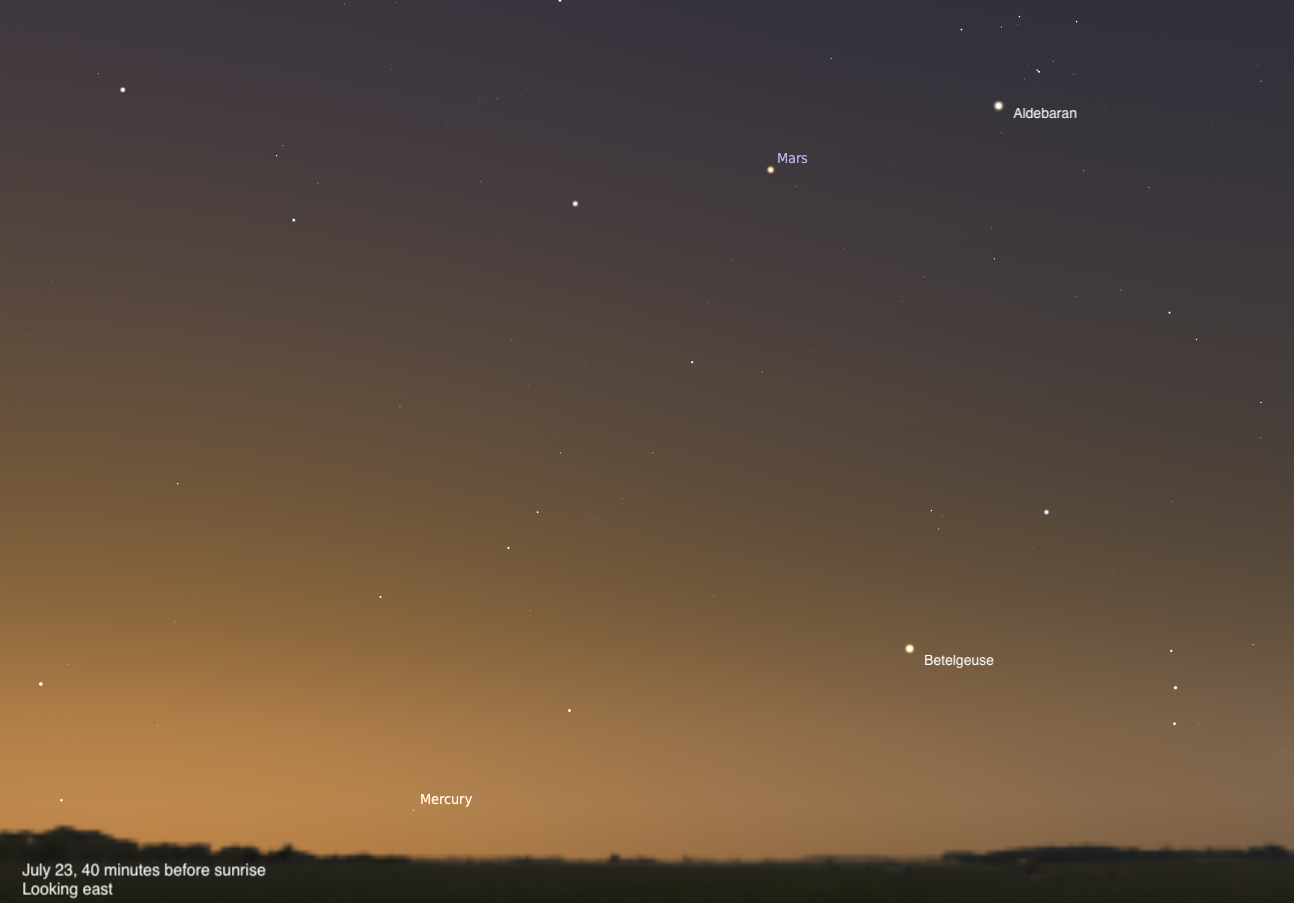
Mercury is just 2° above the horizon around 5:10 A.M. local daylight time, although it’s rising. However, the sky is also brightening, so the earlier you can catch it, the better. A clear, flat horizon with no trees or buildings is best. Try using some optical aid to spot it, once you know you’re in the right area (or simply use the go-to function on your scope if you have it). Through a telescope, Mercury is just 12% lit, which is why it’s so faint despite its diameter of 10”.
Now that Mercury has paused its motion in our sky, it will stop moving westward, or retrograde, and begin moving eastward, or prograde. In the coming weeks, it will head for the eastern border of Gemini and cross into Cancer around midday on August 8.
Alison Klesman is senior editor of Astronomy magazine. She holds a Ph.D. in astronomy and has studied a variety of topics, from minor planets to supermassive black holes.