From Unscrewing Bolts to Running Tasks, OYMotion Technologies Aims to Train “Robot Engineers”
Gasgoo Munich-OYMotion Technologies has officially launched its “Embodied Intelligence Education Product Matrix” during the 2026 World Artificial Intelligence Conference (WAIC2026). Designed specifically for vocational colleges and applied universities, the suite spans four critical stages—hardware disassembly, algorithm development, data acquisition, and scenario training. The goal is to address a looming talent shortage as the embodied intelligence industry approaches its breakout moment.
The system emphasizes “hardware white-boxing,” exposing everything from individual screws to internal wiring layouts to give students a complete grasp of a robot’s underlying architecture. Beyond the hardware, students can run “full-scenario drills” in real-world environments built by Aoyi, getting hands-on experience making robots execute specific tasks.

Image Credit: OYMotion Technologies
Structurally, the matrix features a range of hardware, including the full ROHand dexterous hand series, the OpenArm open-source dual-arm robot, and small humanoid robots—all on display at this year’s WAIC. The ROHand series, designed for embodied intelligence and industrial automation, has already served more than 200 clients, including Zhipingfang, Yuanliwuxian, Keenon Robotics, and Jiahao Shijie.
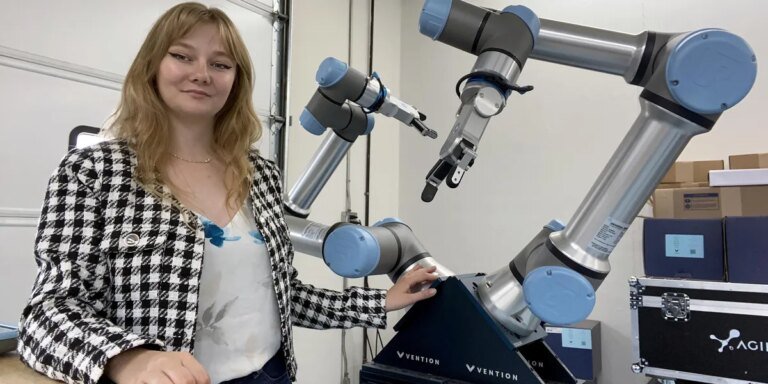
Specifically for hardware installation and tuning, Aoyi places dexterous hands, OpenArm dual-arm units, and small humanoid robots directly on training benches with their casings removed. This “white-box” approach lays bare the arrangement of motors, wiring, and structural components, allowing students to repeatedly disassemble and reassemble the units while building an intuitive understanding of mechanical structure and motion principles.
In the training and development phase, the system integrates vision, motion capture, control systems, and large model frameworks. It creates a “hand-eye-arm coordination” and “hierarchical brain” development environment, guiding students to master core skills from perception to decision-making—essentially learning how to bring robots to life and complete tasks.
Addressing industry pain points like data scarcity and limited computing power, the data collection and model development module offers a full-stack toolchain. This covers everything from real-world teleoperation data collection and high-fidelity simulation training to large-scale model inference deployment. Students learn to “feed data” to robots and optimize their operational capabilities through modeling.
Finally, for scenario application, Aoyi has constructed three real-world commercial settings—industrial, retail, and home environments—to ensure robots can adapt to complex conditions. Students face head-on challenging engineering problems like flexible grasping and dynamic sorting.
This integrated software-hardware training solution has already made its way into several vocational and undergraduate universities across the Yangtze River Delta. Driven by hands-on experience that directly addresses industry needs, the business line is expanding rapidly and is projected to generate tens of millions of yuan in revenue this year.