NASA’s Psyche Flyby Captures “Rarely Seen Views of the Red Planet” as Mars Appears as a Thin Red Crescent
On its way to the Psyche asteroid between Mars and Jupiter, NASA’s Psyche mission spacecraft tested its instruments as it flew by the Red Planet on May 15, 2026, and the results are stunning.
After launching in 2023, the Psyche mission is on course to reach its namesake by 2029, where it will conduct a series of experiments to explore the metal-rich asteroid, which is believed to be the exposed core of a former planet. During its flyby, Psyche captured detailed images of Mars’ surface, provided supporting evidence for previous research on Mars, and tested some of its instruments for the first time.
“The mission’s imager, magnetometer, and gamma-ray and neutron spectrometer teams worked overtime to make full use of this planetary encounter, and all instruments delivered great results,” said Lindy Elkins-Tanton, principal investigator for Psyche at the University of California, Berkeley, in a press release. “We didn’t anticipate big discoveries, given how extensively the planet has been studied, but we did complement Mars science with the data we collected through Psyche’s unique perspective.”
Flyby of Mars, Next Stop: Asteroid Psyche

Mars as seen from Psyche on May 3, 2026, about 3 million miles away from the planet.
(Image credit: NASA/JPL-Caltech/ASU)
In May, the Psyche spacecraft used Mars’ gravity to speed up and change its trajectory. While flying by the planet, the craft tested its instruments, including its magnetometer — a device used to measure the strength and direction of a magnetic field — its gamma-ray and neutron spectrometer — which is used to measure a planet or asteroid’s surface composition — and its imager.
Overall, the spacecraft’s instruments worked just as they were designed to, and, according to NASA, the data they collected were impressive.
Read More: NASA’s Viking I Landed on Mars 50 Years Ago and Transformed the Search for Life
How Psyche Measures Gamma-Rays and Neutrons and Tests Magnetic Fields

An enhanced-color mosaic created from four individual images acquired on May 15, 2026, during the spacecraft’s flyby of Mars.
(Image Credit: NASA/JPL-Caltech/ASU)
As the craft approached Mars, the mission team was excited to test out its instruments. According to NASA, the gamma-ray neutron spectrometer got quite the workout. Mars is continuously bombarded by high-energy cosmic rays. Elements on the planet’s surface then absorb that energy and emit neutrons and gamma rays at varying levels.
With that data, researchers can then match those properties to other known elements to determine what the planetary body is made of. Because the craft flew by Mars at an altitude of 2,864 miles, it was too far away to measure gamma rays; still, mission experts hoped that it could detect neutrons that escaped the Red Planet’s atmosphere.
“Around the time of Mars closest approach, the neutron spectrometer detected a count-rate enhancement close to what we anticipated. It was very gratifying to see,” said David Lawrence, the science lead for Psyche’s spectrometer at the Johns Hopkins Applied Physics Laboratory in Laurel, Maryland, in a press release. “As expected, we didn’t detect gamma rays from Mars, but we put the instrument through its paces, and it performed excellently.”
Along with the gamma-ray and neutron spectrometer, Psyche’s magnetometer also performed well. According to NASA, the magnetometer has been collecting data since it launched. So far, it has measured the solar wind’s magnetic field, including coronal mass ejections. However, thanks to the Mars flyby, it has now measured a celestial body’s magnetic field for the first time.
“As the spacecraft passed close to Mars, the magnetometer saw an intense uptick in magnetic field corresponding to the bow shock region, where the solar wind slams into the planet’s magnetic field,” said Ben Weiss, Psyche’s deputy principal investigator and the magnetometry investigation lead at the Massachusetts Institute of Technology in Cambridge, in a press release. “This flyby calibration effort validated the instrument’s performance under dynamic conditions while also revealing the fascinating physics of planetary magnetism.”
Psyche’s Stunning Images of Mars

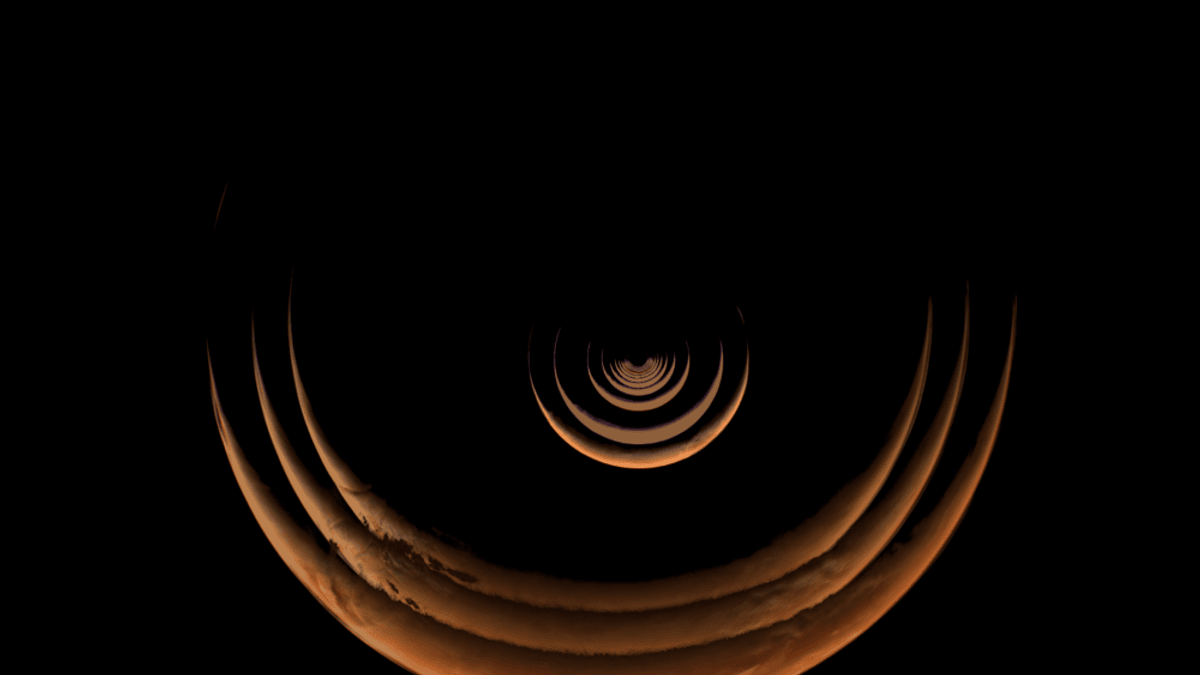
Crescent of Mars captured by Psyche
(Image Credits: NASA/JPL-Caltech/ASU)
The craft is also equipped with a multispectral imager, two identical cameras that photograph the surface of a celestial body in different wavelengths of light. As Psyche approached Mars, the angle made the planet appear like a red crescent moon. The images were later compiled into a single image, showing off a unique angle of Mars.
The imager also captured a view of Mars’ surface and detected the large Huygens crater, the south polar ice cap, and other windblown craters.
“The imager performed brilliantly, delivering some rarely seen views of the Red Planet,” said Jim Bell, the Psyche imager instrument lead at Arizona State University in Tempe, in the press release. “Besides the obvious beauty of the photos, we were also able to fully test its calibration and sensitivity to scattered light, including picking out the Martian moons Phobos and Deimos from very far away as a part of a practice for the satellite search that we’ll use at the asteroid Psyche to look for any moonlets there.”
Psyche is using Mars’ gravity to help propel it towards its goal, and soon, thanks to successful instrument testing, we’ll know more about this asteroid.
Read More: Potential Biosignatures on Mars May Reflect Ancient Life in Mineral-Rich Rocks
Article Sources
Our writers at Discovermagazine.com use peer-reviewed studies and high-quality sources for our articles, and our editors review for scientific accuracy and editorial standards. Review the sources used below for this article: