Japan Bets Big on AI-Powered Robots
Artificial Intelligence & Machine Learning
,
Next-Generation Technologies & Secure Development
Physical AI Plays to Decades of Industrial Manufacturing Strength
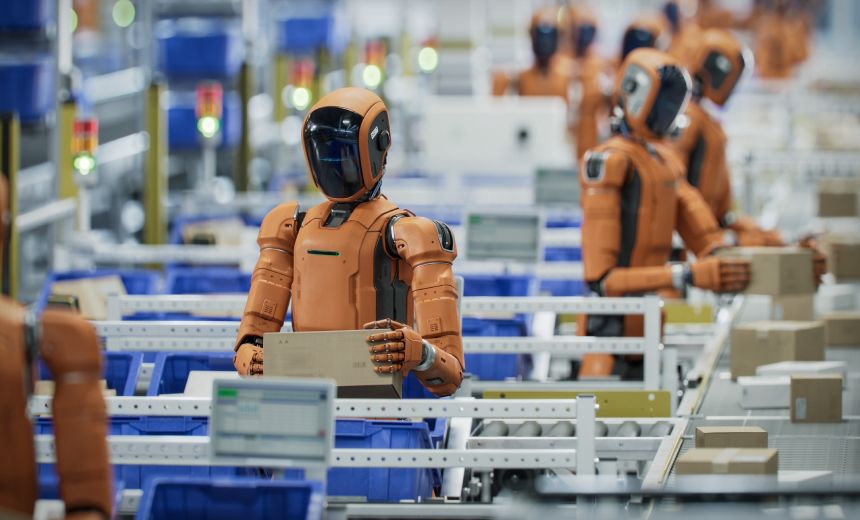
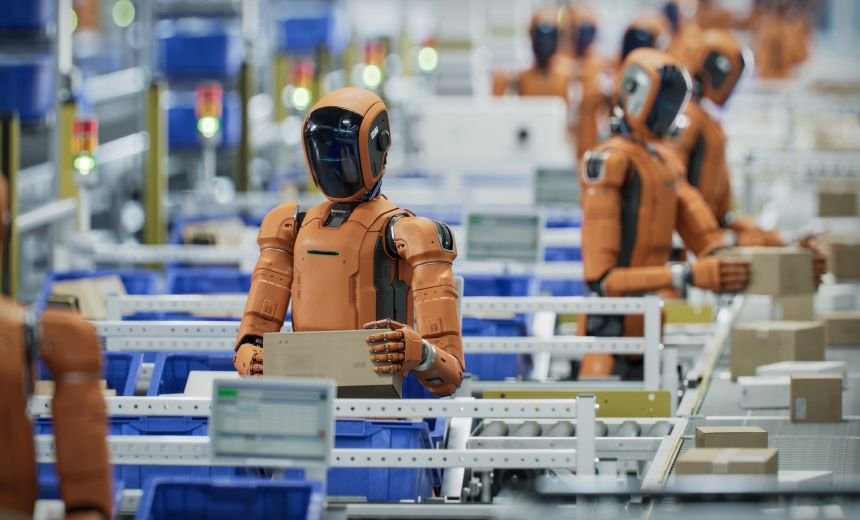
Robot obsessed Japan is betting on “physical artificial intelligence” to lift it out of its AI doldrums.
See Also: OnDemand | Security Operations in the Age of AI
A revised national AI strategy calls for a stronger domestic AI sector and identifies applications that escape the confines of computer screens including robot-run factories, construction sites and even hospitals and caregiving settings. The strategy came weeks after Japan’s top technology official sounded a worried alarm that the nation is on track to “end up becoming an ‘AI colony.'”
A series of announcements underpin the strategy, including a government-backed AI infrastructure project and robotics partnerships between chip giant Nvidia and Japanese manufacturers including Fanuc, Yaskawa and Kawasaki. Tokyo also announced Noetra, a consortium backed by dozens of Japanese companies, which is launching “full-scale R&D” for a Japanese foundation model to power AI-enabled robots.
Japan’s approach depends on a broad industrial ecosystem that spans robotics manufacturers, semiconductor companies, telecommunications providers and infrastructure operators. Noetra is the flagship effort, but it is only one part of a wider attempt to translate the country’s industrial expertise into AI capabilities. SoftBank, Sony, NEC and Honda are its core member companies and investors, alongside about 40 others including Fanuc, Yaskawa Electric, Kawasaki Heavy Industries and Fujitsu.
The Noetra roadmap begins with a reasoning foundation model followed by an “omnimodal” model capable of processing language, images, video and audio targeted for 2028.
By then, it aims to develop “real-world native AI,” designed to understand spatial relationships and operate in real-world settings. To support that work, Noetra plans to begin constructing a computing facility next April equipped with 27,500 Nvidia Rubin graphics processors, with operations scheduled to start in June 2028. Nvidia says the system will be capable of training physical AI models at trillion-parameter scale. The models, facility and delivery dates are plans rather than demonstrated capabilities.
Systems that control machines must learn how objects move, how equipment responds to changing conditions and how actions affect the physical environment. Japan believes the telemetry, production records and engineering knowledge accumulated by its manufacturers could provide valuable training and deployment data. The Ministry of Economy, Trade and Industry has said that Japan’s manufacturing base and operational data generated in factories could become a source of competitive advantage in physical AI. Noetra’s core investors similarly said that Japanese companies’ manufacturing expertise and industrial data can help develop AI models for robotics.
Some of the technical challenges are obvious. Data needed for training may be scattered across incompatible systems, generated by older machines or retained in the experience of engineers rather than formal records. Companies may be reluctant to share proprietary production data with partners that are suppliers, customers or competitors. Competitors could erode Japan’s data riches through simulation and synthetic data that boost limited operational datasets and shorten development cycles.
Japan is not the only country pursuing physical AI. China is similarly investing aggressively in embodied AI, robotics and industrial automation and benefits from the world’s largest manufacturing base and operational robot fleet. American companies lead the development of many of the world’s most capable general-purpose AI models and are looking into robotic applications.
Noetra itself is as much an experiment in coordination as model development. Its 44 investors bring together manufacturing knowledge, computing infrastructure, capital and potential users. That breadth could spread development costs and give the models access to multiple industries. It could also create disputes over the data companies contribute, the applications that receive priority and how the resulting technology is commercialized. Noetra intends to provide or publish the models it develops, but it has not detailed the terms governing access, licensing or the use of data contributed by participating companies.
Japan already possesses the factories, robotics companies and industrial expertise on which its wager rests. The unanswered question is whether it can turn those assets into usable data, competitive models and a coherent ecosystem before rivals with greater computing, software or manufacturing scale do the same.

![Altera returns to growth as AI, robotics fuel demand], ETCIO](https://jobssz.com/wp-content/uploads/2026/07/altera-returns-to-growth-as-ai-robotics-fuel-demand-768x402.jpg)