Jensen Huang Turns to Japan’s Robots for Nvidia’s Next Growth Engine

Nvidia built its empire on chips powering generative A.I., and that engine is still surging. The company posted a record $81.6 billion in quarterly revenue, up 85 percent year over year. But with a $5 trillion valuation that prices in years of growth, CEO Jensen Huang is under pressure to prove expansion can extend beyond the U.S. data-center boom. His latest pitch centers on Japan, where the government and major industrial players are gearing up to deploy A.I. in robots and factories.
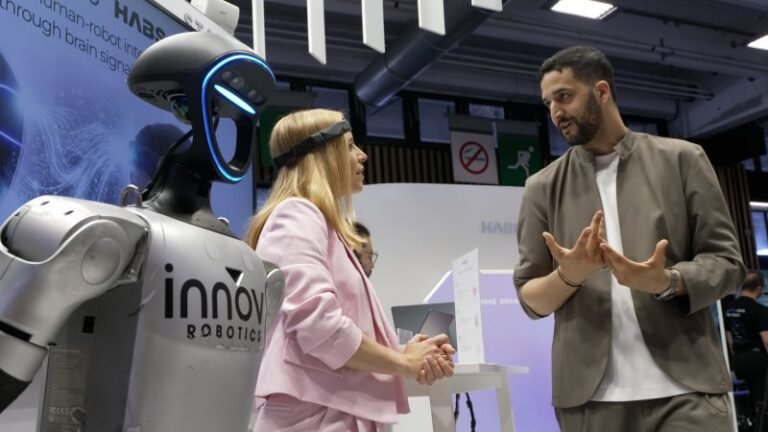
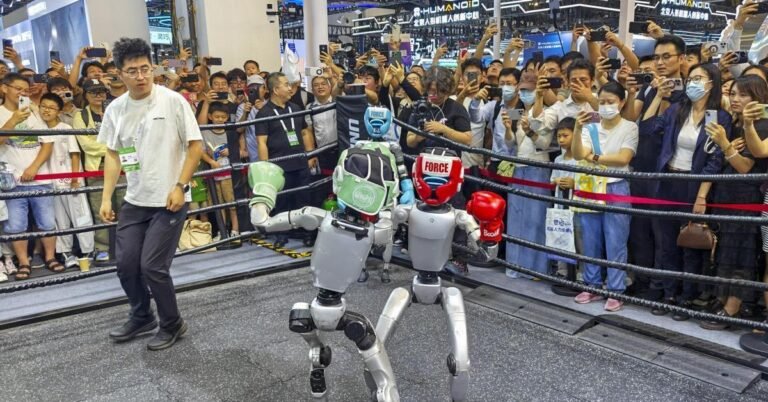
During a two-day visit to Tokyo last week, Huang rallied Japan’s manufacturing giants, robotics innovators and software developers behind “physical A.I.,” the technology that allows robots and other machines to perceive their surroundings, make decisions and act in the real world. Japan, Huang argued, holds a natural advantage for such a shift. “Japan has historically been very good at precision manufacturing and very large-scale manufacturing, but now we have A.I. You can combine the two technologies and create robotics,” he told reporters during a July 15 event.
Japan has strong incentives to embrace the partnership. It boasts world-class industrial hardware but faces a worsening labor shortage. Prime Minister Sanae Takaichi, who has made semiconductors and A.I. central to her growth agenda, is pushing to pair that hardware strength with more advanced software. Japan accounts for about 70 percent of the global industrial robot market but just over 10 percent of the service robot market, according to government data. Its updated strategy targets more than 30 percent of the emerging A.I.-robotics market by 2040, representing $133 billion in business.
During his Tokyo visit, he pitched his vision to the country’s industrial elite. At a pub in Tokyo’s Kanda district, Huang gathered more than 30 executives from 16 major firms—including Tokyo Electron, Panasonic and Mitsubishi Electric, among others—to discuss how Japan’s semiconductor supply chain could support an A.I.-led expansion. Over lunch, he also met with executives from Fujitsu, Kawasaki Heavy Industries, Fanuc and Yaskawa. According to Nvidia, all four companies are now developing physical-A.I. systems on its platform.
Tokyo’s reception contrasts with Nvidia’s experience in China. Huang visited the country in January and returned in May as part of President Trump’s delegation, trying to rebuild Nvidia’s position in a market squeezed by U.S. export controls and Beijing’s support for domestic chipmakers.
Japan, by comparison, is putting government support behind infrastructure built around Nvidia’s technology. On the second day of his trip, Huang appeared alongside Japanese Industry Minister Ryosei Akazawa to launch the nation’s new government-backed physical A.I. initiative. As part of that kickoff, Huang announced that Nvidia is partnering with Noetra Corp, a Japanese A.I. consortium backed by Sony, SoftBank, Honda and roughly 40 other companies, to build what the chipmaker calls “the world’s first national A.I. infrastructure for physical A.I.”
“Japan must own, improve, secure and deploy Japan A.I.,” Huang said during keynote remarks. “After 15 years of work, physical A.I. is here, the foundation of the next industrial revolution, and it should be made in Japan.”
The project centers on an “A.I. factory” powered by 13,750 Nvidia Vera CPUs and 27,500 next-generation Rubin GPUs. Expected to deliver 140 megawatts of data center capacity, the facility will supply the compute required to train complex physical A.I. models. Construction is scheduled to start in April 2027, with operations coming online in June 2028.
The infrastructure will serve as the computing backbone for FRONTia, a government project supporting multimodal models for physical A.I. Noetra will lead the development of the domestic models running on the network. According to Noetra’s roadmap, the group will prioritize Japanese-language understanding and reasoning before expanding into text, image, video and audio capabilities in 2028. By 2030, it aims to deploy “real-world native A.I.” for robotics and autonomous machinery.
This week, Nvidia brought that same message to SIGGRAPH, the annual computer graphics conference underway in Los Angeles. During Monday’s keynote, Huang linked Nvidia’s roots in computer graphics directly to its physical A.I. ambitions. “Whether for games, cinema, robotics or factory digital twins, the goal is the same: to create virtual worlds that behave with the fidelity and realism of the physical world,” he said in a prerecorded video.
Before a robot can navigate its surroundings, it needs a model of how the physical world behaves. At SIGGRAPH, Nvidia released Cosmos 3 Edge, a compact version of its Cosmos world model designed to run directly on hardware inside robots, vehicles and edge devices. By processing data locally rather than routing queries to a remote data center, edge models enable real-time decision-making. Companies currently evaluating the framework include Agile Robots, Doosan Robotics, Siemens and Skild AI.
Not all training, however, needs to occur in physical space. During the keynote, Ming-Yu Liu, Nvidia’s vice president of Cosmos Lab, unveiled Cosmos-Dreams, a suite of virtual testing environments for physical A.I. In one demonstration, the software generated a complete driving scene from a single video frame.
Cosmos was trained to interpret a scene, predict outcomes, simulate consequences and choose an action, Liu said. These capabilities can be applied to machines ranging from humanoid robots to mechanical arms and self-driving vehicles. “Every embodiment speaks a different language,” Liu said. “Our solution is to build a common vocabulary.”