Meet Carnegie Mellon computer science PhD Yang Zhilin, who left US to build Chinese AI model shaking Silicon Valley
Moonshot AI unveiled Kimi K3 late last week, a 2.8 trillion-parameter open-weight large language model designed for complex reasoning, software coding and analyzing long documents. It said it will release the model weights on July 27, allowing developers to download, fine-tune and build on it.
Its coding and AI agent capabilities rival leading models from U.S. companies including OpenAI and Anthropic while operating at substantially lower cost, marking another milestone for China’s AI industry, according to Business Insider.
The launch quickly elevated both Moonshot AI and its founder onto the global stage.
“This may be the single biggest release of the year,” and marks a moment when open-source Chinese models are surpassing closed U.S. models, said Anastasios Angelopoulos, co-founder and CEO of Arena, a platform for evaluating AI systems, as quoted by Fortune magazine.
On Chinese social media, Yang, 34, has become a celebrity. The hashtag “Post-90s Tsinghua University genius crashed U.S. stocks” ranked as the third most popular topic in Weibo’s technology section on Wednesday, celebrating the Tsinghua graduate after Kimi K3’s debut.
“We once chased after Silicon Valley’s AI, but now a post-90s Tsinghua entrepreneur has unveiled a cutting-edge open-source model, directly shaking Wall Street,” a Weibo user wrote.
 |
|
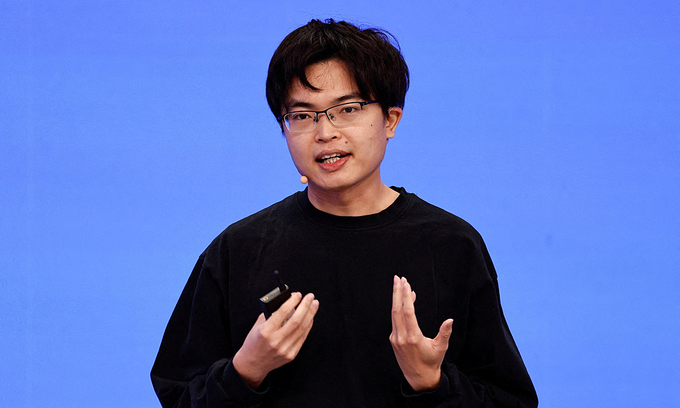
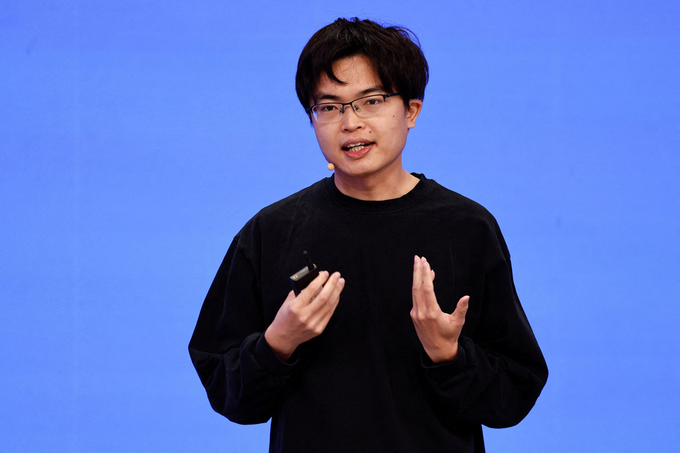
Founder of Moonshot AIYangZhilindelivers a speech at a conference of 2026 Zhongguancun forum, in Beijing, China March 25, 2026. Photo by Reuters |
Leaving U.S. for China
Born in Shantou, Guangdong province, southern China, Yang showed an early talent for computing by winning a provincial informatics Olympiad prize while in high school.
He later studied at Tsinghua University before earning a Ph.D. at Carnegie Mellon University in Pennsylvania, U.S., where he worked under prominent AI researchers William Cohen and Ruslan Salakhutdinov. Carnegie Mellon ranks third globally for computer science in the QS World University Rankings by Subject 2026.
During his doctoral studies, Yang interned at Google Brain and Meta and co-authored research papers with leading AI scientists, including Meta chief AI scientist Yann LeCun, Google researcher Quoc V. Le and Canadian computer scientist Yoshua Bengio.
Those achievements established him as one of the leading young researchers in large language models.
“He is absolutely brilliant,” Salakhutdinov wrote in an X post on July 17, adding that many major U.S. technology companies sought to recruit Yang after graduation but that he remained determined to return to China to build his own company.
After returning to China, Yang contributed to several major AI projects, including Huawei’s PanGu model and the Wu Dao multimodal model developed by the Beijing Academy of Artificial Intelligence. He also co-founded Recurrent AI, a startup that uses AI to analyze sales conversations and improve business performance.
In a 2024 interview with Chinese technology journalist Xiaojun Zhang, Yang said his ambition extended beyond launching another AI product. He described his goal as an effort to “change the world over the next 10 to 20 years”.
Soon after ChatGPT was launched, Yang traveled to the U.S. in December 2022 to study the emerging generative AI industry and recruit talent for a future venture. He then told Chinese media that it was time to “ride the wave” of generative AI, the South China Morning Post reported.
Building Moonshot AI
In March 2023, Yang co-founded Moonshot AI with two former Tsinghua classmates, Zhou Xinyu and Wu Yuxin. The startup raised $60 million and assembled a team of around 40 AI specialists within its first three months.
Moonshot first attracted attention by developing Kimi models with exceptionally long context windows, enabling them to process lengthy documents more effectively. The company later expanded into AI coding, research and autonomous agents while securing backing from Alibaba, Tencent and other major Chinese investors.
Yang has repeatedly emphasized that he aims to build a company capable of leading the next era of artificial intelligence. “The ultimate AGI company will dwarf today’s giants — double, triple the scale. Not necessarily OpenAI, but such a company will exist,” Yang said in his interview with Zhang.
Vercel CEO Guillermo Rauch said Kimi K3 marked “the first time that an open model is ahead of all proprietary ones for this comprehensive web engineering benchmark,” in a post on X. Ethan Mollick, associate professor at the Wharton School of the University of Pennsylvania, described it as “closest to the frontier yet.”
The release also triggered a sell-off, knocking hundreds of billions of dollars in major U.S. technology stocks including Google and Nvidia, drawing comparisons with the market disruption caused by Chinese AI startup DeepSeek last year.
Days after Kimi K3 debuted, Moonshot AI announced Monday that it had suspended new subscriptions after demand overwhelmed its computing infrastructure. Despite the disruption, the company is still expected to pursue a Hong Kong stock market listing by the end of the year. Some estimates value Moonshot at around $30 billion, giving Yang a multibillion-dollar stake, according to The Telegraph.
Yang’s success has also fueled debate in the U.S. over retaining top AI talent. Prominent investor Vinod Khosla argued that restrictive immigration policies were driving talented researchers away.
“Even bigger issue is the brilliant talent we are scaring away from other countries with our immigration policies for great talent,” he said in response to the news of Kimi K3’s success.
Salakhutdinov, however, said Yang’s decision had little to do with U.S. immigration challenges. While acknowledging that the immigration process can be intimidating and “uncertain,” he said Yang had always intended to return to China and build his own startup.
“I remember him telling me that if he didn’t at least try starting his own company, he would regret it for the rest of his life. I respect that, and he was right,” Salakhutdinov wrote on X.