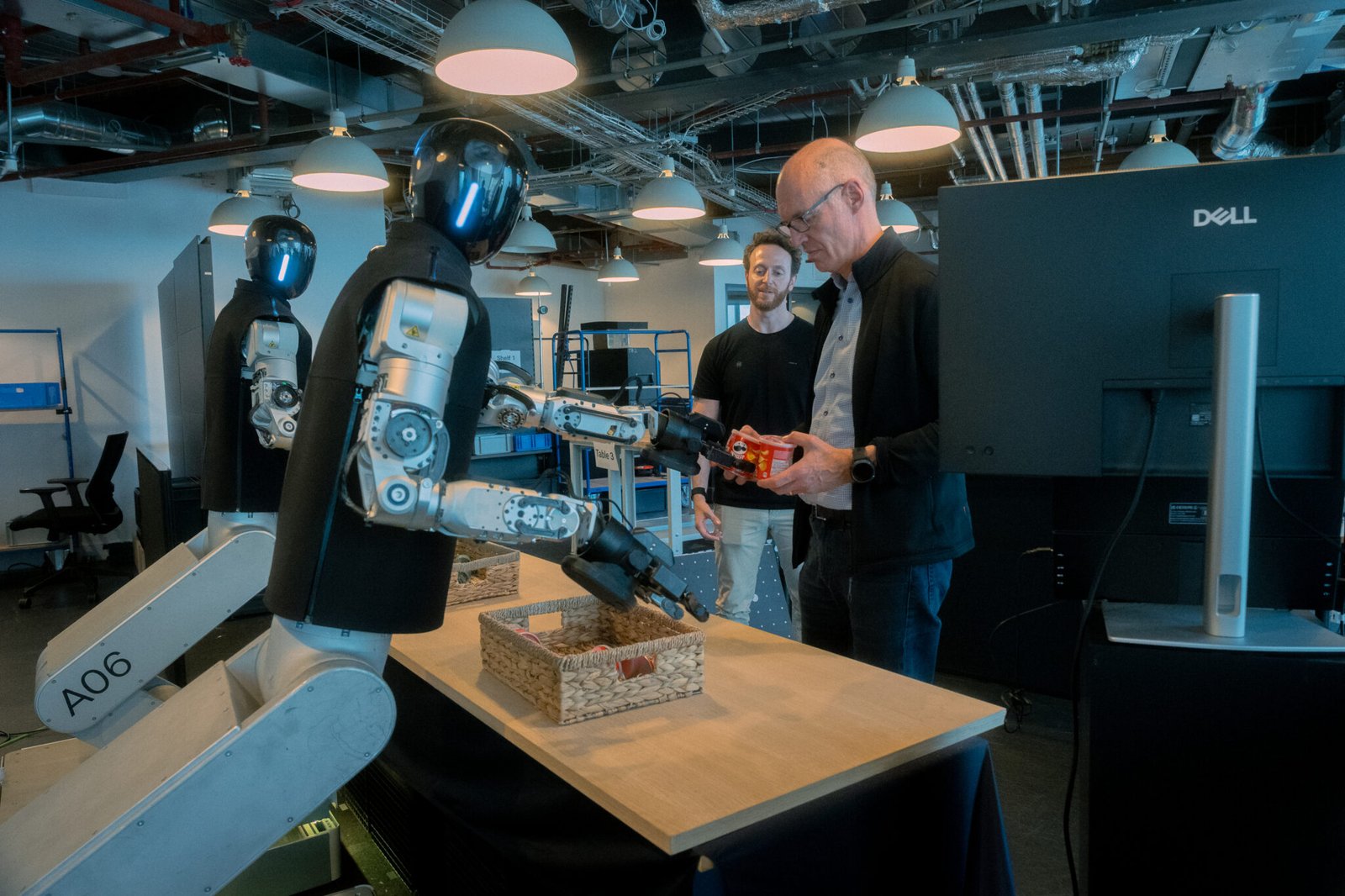
New Unicorn: UK Robotics Startup Humanoid Raises €133 Million at €1.1 Billion Valuation
London-based AI and robotics company Humanoid has closed a Series A financing round of €133 million ($152 million), valuing the company at €1.1 billion ($1.35 billion) post-money. This makes Humanoid a unicorn roughly two years after its founding. The round was led by Prime Movers Lab, the investor that previously backed Figure AI, among others. Also participating were industrial groups Schaeffler and Bosch, Taiwan’s Fubon Financial Holding Venture Capital, and Aglaé Ventures, the investment vehicle of LVMH chief Bernard Arnault.
With the new round, the company’s total capital raised rises to $270 million (around €236 million). According to the company, this is the largest Series A to date for a humanoid-focused robotics company in Europe.
Wheels Instead of Two Legs
Humanoid — legally operating as SKL Robotics Ltd. — was founded in London in 2024 and is led by Artem Sokolov. Unlike US competitors such as Figure or Apptronik, the company is initially betting on a wheeled robot, the HMND 01 model, which is intended to allow faster European certification compared with bipedal systems. At its core is the company’s proprietary AI platform, KinetIQ, which is designed to enable the machines to understand and carry out physical tasks in industrial environments.
The company says it has collected 34,000 robot pre-orders worth $2.4 billion — before a single commercial unit has been delivered. It has an offtake agreement with Schaeffler for thousands of robots, while Bosch is providing production capacity for up to 100,000 units over the coming five years. The first beta robots are expected to be deployed at customers in logistics, manufacturing, and retail starting in the fourth quarter of 2026. Humanoid also names SAP, NVIDIA, and Siemens as partners.
The “First Unicorn” Claim Is Contested
Humanoid describes itself as Europe’s first “pure-play” humanoid unicorn. That claim is contested, however: Germany’s Neura Robotics closed a round of more than one billion dollars back in June 2026, at a valuation of around seven billion dollars. The difference lies in the definition — Humanoid bases its claim on the qualifier “humanoid-first” or “pure-play.”
Europe’s Robotics Boom at a Glance
Humanoid’s financing fits into a broad wave of capital flowing into physical AI and industrial robotics in Europe:
- Neura Robotics (Metzingen): Founded in 2019, the company raised a Series C of up to $1.4 billion — the largest round ever recorded for a full-stack robotics company in Europe, at a valuation of around $7 billion. It was led by Tether Investments, with participation from Qualcomm, Amazon, and NVIDIA.
- Sereact (Stuttgart): The AI robotics software specialist raised a Series B of $110 million (around €93 million) in April 2026, led by Headline, to drive its US expansion and its AI model.
- THEKER (Barcelona): The company, which builds AI-native industrial robots, secured a Series A of €73 million ($85 million) in June 2026, led by CRV, with participation from Samsung and LVMH.
- Generative Bionics (Genoa): The spin-off from the Italian Institute of Technology (IIT) raised €70 million ($81 million) from investors including AMD Ventures and Tether. Founded in 2024 by Daniele Pucci and other former IIT researchers, the company builds on more than two decades of humanoid research at IIT — including projects such as iCub. On 21 July 2026, the startup unveiled Gene.01, its humanoid platform for industrial use; a first deployment is planned in shipbuilding through a collaboration with shipbuilder Fincantieri.
- RobCo (Germany): €100 million for modular, AI-driven manufacturing systems.
- Trener Robotics (Norway/USA): €26 million Series A for industrial automation.
The context behind it: according to Dealroom, robotics companies raised $55.8 billion so far in 2026 — a record figure that nearly doubles the previous high. Europe’s robotics startups together raised around €1.6 billion in 2025, up 110 percent from the €761 million of 2024. The bulk of the capital still flows to the US and China — but rounds like those of Humanoid, Neura, and Generative Bionics show that Europe is increasingly building its own contenders in the race for physical AI.