AGV market will grow to $12.8 billion in 2035
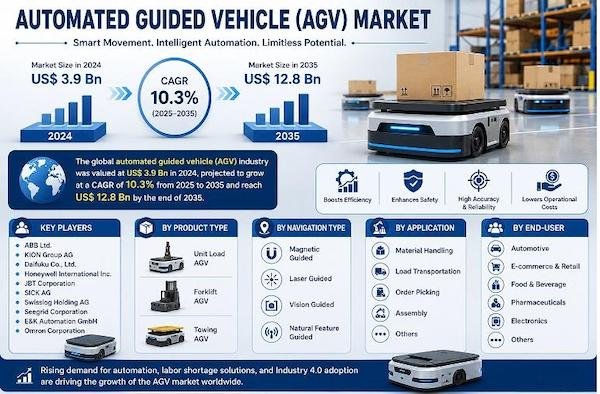
The Automated Guided Vehicle (AGV) Market reached $3.9 billion in 2024 and is projected to grow to $12.8 billion by 2035, expanding at a CAGR of 10.3% during the forecast period from 2026 to 2036, according to a new report form Transparency Market Research. Market growth is being driven by the increasing adoption of warehouse automation, the rapid expansion of e-commerce and logistics operations, and rising demand for efficient material handling solutions across manufacturing, automotive, healthcare, and retail industries.
According to the report, automation has become a strategic priority for organizations aiming to remain competitive in an increasingly dynamic business environment. AGVs play a crucial role in automating repetitive transportation tasks, enabling companies to achieve higher productivity while maintaining consistent operational quality.
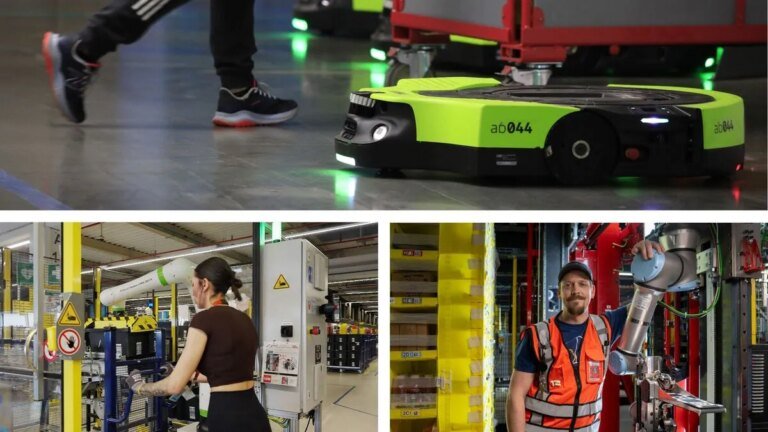
Modern AGVs are equipped with advanced navigation systems, artificial intelligence (AI), LiDAR sensors, machine vision, and IoT connectivity, allowing them to operate safely alongside human workers. These intelligent systems continuously collect operational data, enabling predictive maintenance, fleet optimization, and real-time decision-making. Growing labor shortages, increasing warehouse complexities, and rising operational costs are encouraging enterprises to replace conventional forklifts and manual transportation methods with automated guided vehicles.
Key Market Drivers
Growing Adoption of Warehouse Automation: The booming e-commerce industry has significantly increased the demand for highly efficient warehouses and fulfillment centers. Companies require faster order processing, improved inventory accuracy, and uninterrupted material movement, making AGVs an ideal automation solution. Automated guided vehicles reduce picking errors, improve storage efficiency, and ensure continuous operations even during peak demand periods.
Rising Demand for Industry 4.0 Solutions: Manufacturing facilities are rapidly embracing Industry 4.0 technologies to create connected, intelligent production environments. AGVs seamlessly integrate with Manufacturing Execution Systems (MES), Enterprise Resource Planning (ERP), and Warehouse Management Systems (WMS), enabling synchronized production and material flow. The integration of AI, IoT, cloud computing, and digital twins further enhances AGV capabilities through real-time monitoring and autonomous decision-making.
Labor Shortages and Increasing Labor Costs: Many industries face ongoing workforce shortages, particularly in logistics and manufacturing sectors. AGVs reduce dependency on manual labor while ensuring continuous productivity. Automation also minimizes workplace injuries associated with repetitive material handling, helping organizations improve employee safety and comply with occupational safety regulations.
Expansion of E-commerce: The rapid growth of online retail has created enormous pressure on logistics providers to fulfill orders quickly and accurately. AGVs enable faster transportation of goods between storage, picking, packaging, and shipping areas, supporting high-volume warehouse operations.
Market Challenges
Despite strong growth prospects, several challenges continue to affect AGV adoption.
High initial investment costs remain one of the primary barriers, particularly for small and medium-sized enterprises. Implementing AGV systems requires infrastructure upgrades, navigation systems, software integration, and employee training. Integration with legacy manufacturing equipment and warehouse management systems may also present technical complexities.
Cybersecurity concerns surrounding connected automation platforms continue to gain attention as industrial networks become increasingly digitalized.
According to the study, the future of the Automated Guided Vehicle Market appears highly promising as industries accelerate their digital transformation initiatives. The convergence of artificial intelligence, machine learning, robotics, 5G connectivity, and Industrial Internet of Things (IIoT) technologies will significantly improve AGV intelligence and operational efficiency. Growing investments in smart factories, automated warehouses, and autonomous logistics networks are expected to create substantial opportunities for market participants over the coming years.
You can request a sample report here.