Today’s Warehouse Robotics Landscape | RoboticsTomorrow
Robots are now more applicable for a wider range of warehouse tasks than ever before. Keep these trends and considerations in mind to make the right investments, achieve effective implementations, and realize the full business value of today’s robotic systems

Today’s Warehouse Robotics Landscape
Today’s Warehouse Robotics Landscape
Geoff Schreiber, Director, Product Management | Toyota Automated Logistics
Few sectors are marked by more real-world applications of pure robotics innovation than materials handling operations in today’s manufacturing facilities, warehouses and distribution centers. The breadth and depth of robotic deployments reflects not only what is becoming the ubiquitous adoption of robots, but also their applicability in diverse materials handling settings. This new reality, one shaped by the mainstream adoption of robotics within supply chain and fulfillment operations, is immediately apparent.
Such advancements, and the growing democratization of warehouse robotics we are seeing as a result, reflect a number of important technological breakthroughs in recent years. The most important of these is the singular shift away from robots as distinct, standalone or machine-specific solutions. A decade ago a single palletizing robot, for example, would be designed and deployed for use with a specific case or box, and that single capacity and role would be considered a complete solution.
Today, when warehouse operations must carefully consider what robots may need to do in one, five or ten years from now, leaders are rightfully more circumspect and less impressed with the actual robot. Instead, as innovation has increased, warehouse leaders are more focused on how any robot integrates not only with the Warehouse Management or Execution System, but also other robots and the many connected devices and systems used in warehouses today. In short, robots are rightfully now viewed as integrated solutions.
What can reasonably be considered a robotic solution has been blurred, with the robot now only being one part. Other crucial components include the software or orchestration layer, the physical AI layer enabling robots to safely operate in the dynamic, highly-variable environments, and all of the technologies that not only make today’s robots more interconnected, but also faster and more capable. Some of these advancements include:
- Vision Software and Capabilities: In recent years the vision software used in warehouse robots has improved dramatically. Multimodal sensing that includes multiple cameras, LiDAR – Light Detection and Ranging – and a growing variety of sensors not only enable robots to “see” much more effectively, but also to significantly increase their utility. Through their outputs they can make the corresponding physical AI layer more effective – enabling them to adapt to machines moving in their vicinity, and other continually-changing variables. This is important because the many systems within warehouses are always in motion.
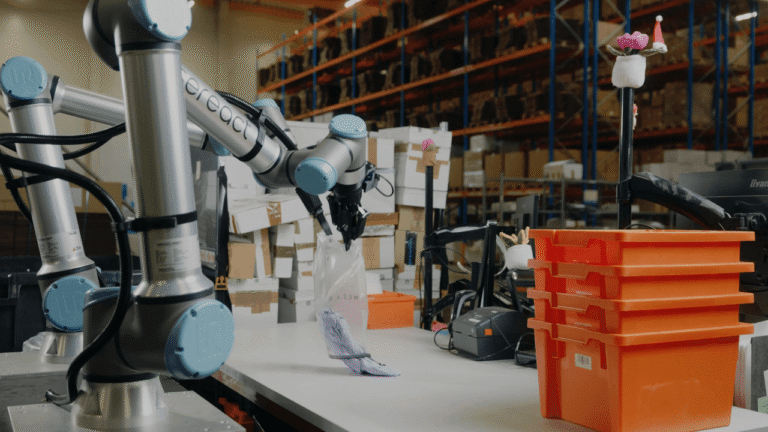
- End effectors: Advancements in end effectors have resulted in greater accuracy and speed in picking operations, enabling single robots to process a much wider range of SKUs. This is a particularly significant advantage for e-commerce companies and omnichannel retailers that sell many different kinds of products, and use many different types of packages, from poly-bags to boxes of varying sizes. These advancements include the use of flexible materials, shape-shifting surfaces and integrated sensors – which allows items of different sizes and weights to be picked up quickly – and performance improvements in linear actuators and magnetic tooling for quicker transitions.
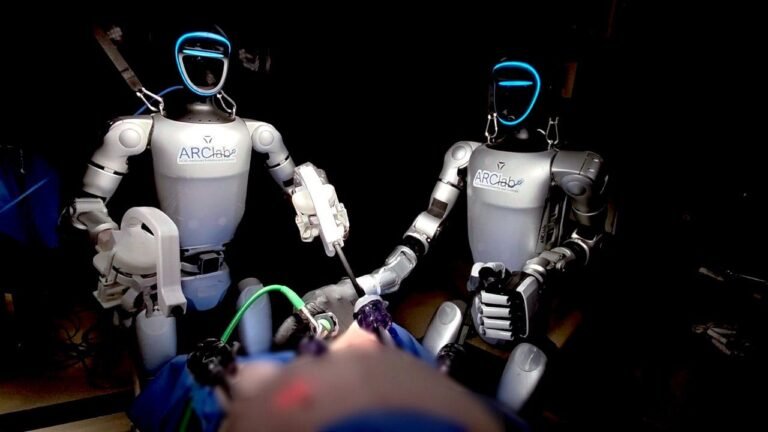
- Humanoid robots: For certain use cases, humanoid-type robots offer the advantage of being configured like the people they augment in warehouse work. With advancements in vision software and end effectors they are more effective now than ever before. Even so, the market for materials handling robotics has moved more towards practical automation even as humanoid-like machines evolve and improve.
- Automated Storage & Retrieval Systems (AS/RS): Although many in the industry overlook that they are robots, today’s grid and shuttle-based AS/RS systems are not only robotic solutions, but are also capable of achieving the highest order accuracy, throughput and storage density of any warehouse system, particularly when teamed with robotic pickers, AMRs and other robotic assets. Now mobile AS/RS systems are providing even more flexibility and versatility for organizations that may not have need or resources for a full, fixed position AS/RS.
- AMRs: The previously-mentioned use of AMRs has increased dramatically. Easy to deploy in their most fundamental form, they mark for many warehouses their first foray into robotics. Perhaps most importantly, they are also increasingly capable of tasks that are inherently variable in nature, and which were for many years considered outside of the predictability and uniformity associated with the ideal tasks for robots. Today, tasks like the unloading and loading of trailers is not only possible, but proven and effective.
As a result of these developments and more, the market for warehouse robots continues to grow. But as with all technologies, the ability to effectively design and deploy advanced solutions requires a holistic approach. More specifically, it is imperative to keep the following considerations in mind to ensure that robotic assets deliver the business value they are capable of when properly deployed.
- Focus on the business challenge or constraint you are hoping to solve: While it is tempting to just put automation where you think you need to put it, take the time to identify and thoroughly explore the bottleneck that needs to be addressed, whether its throughput, order accuracy, employee safety, etc. Is the underlying process flawed? Are robots the answer or is another technology just as applicable? Remember that automating the wrong process or methodology simply does the wrong thing faster.
- Design for integration from the beginning: A robot only creates value when it’s connected to the broader execution flow, so if you don’t design for integration you will never realize the performance gains or solve the bottleneck you set out to address. You can put the robot in, but you may now have a constraint upstream or downstream, and you’ll never realize it.
- Pressure test system variability early: Ideal conditions are just that. The exceptions, including peak seasons when volumes and throughput requirements increase, are crucially important factors to consider in any robotics implementation. What does seasonality do to your business? What product or SKU variations may you see in the future? What are the extreme ranges of case or tote sizes you may encounter? Addressing such questions is imperative to select the right robotic systems and solutions. It’s also an area where a strong integrator partner, one familiar with the robots now available, can provide valuable guidance.
- Evaluate automation as a long-term operating model: Short-term gains are crucial to justify the initial CapEx warehousing projects require, but the best investments in automation improve scalability, resilience, and decision-making capabilities over time. For this reason, it is crucial to complete a detailed business case before any implementation. Explore numerous options in this analysis, not just ones that are expected. For example, don’t limit the business case to the modernization of a brownfield facility with robotics because it is assumed that a new distribution center is out of reach.
- Never forget the impact on people: Employees and leaders from the warehouse floor should be included in robotics projects, and ergonomics should be a key consideration not only in the design of robotic systems, but in the determination of which processes can be best automated or modified to keep employees healthier and happier.
With these five considerations, supply chain and fulfillment leaders can embrace innovations in robotics that increase the efficiency of materials handling operations and distribution centers, offset the longstanding and endemic shortage of labor for warehouse roles, and address the need for solutions and systems that automate tasks that are difficult or unsafe for people. In the process, they can demonstrate the exceptional value of robots today – a point made clear by warehousing operations that buy outcomes, not novelties or technology for technology’s sake.
 Geoff Schreiber is director, product management, at Toyota Automated Logistics, where he leads teams that design and build robotic warehouse systems that address the unique needs of each customer and prospective customers. Now in his second decade of warehouse robotics roles, Geoff previously served as senior manager, engineering – robotics at Bastian Solutions, which he initially joined more than 13 years ago as controls engineer before being named engineering manager less than three years later.
The content & opinions in this article are the author’s and do not necessarily represent the views of RoboticsTomorrow
Featured Product

Midwest Motion Products is a leading provider of robust and reliable Motion Control Products.
MMP specializes in supplying high-quality Brushed & Brushless DC Motors & Gearmotors for Robotics and Automation Equipment with a wide range of motor windings and gear ratios. With an impressive track record of more than 8,000 released DC Gearmotors designs and over 2,000,000 individual part numbers, we are renowned for our ability to handle large-scale orders. Due to our huge on-hand inventory, we are also well known for lightning-fast delivery of our standard products. We take pride in our dedicated customer service and our team of knowledgeable sales and engineering experts who are ready to assist you with custom design solutions tailored to your specific application. Additionally, we also offer a wide range of complimentary products, such as DC Motor Controls, DC Linear Actuators, AC-DC power Supplies, and DC Servo Amplifiers and others.