Inner Logic Raises $11.5M to Build the Simulation Platform Autonomous Surgery Has Been Missing
A Baltimore startup has raised $11.5 million to build the piece of infrastructure that the autonomous surgery industry has been missing — not a smarter robot, but the simulation platform that lets device makers prove a smarter robot works before it ever touches a patient. Inner Logic, formerly known as Semaphor, closed the seed round on July 22, 2026, co-led by General Catalyst and Bison Ventures, with additional participation from J2VP, Defined, PTX, Valia Ventures, Page One, Alumni Ventures, and Flare.
The timing reflects a structural shift in how the medical device industry and its regulators think about evidence. The FDA’s 2023 final guidance on computational modeling and simulation in device submissions, and a January 2025 draft guidance on AI-enabled device software functions that further extended the regulatory pathway for simulation-based and digital twin evidence, have opened a regulatory pathway for simulation-based evidence to support device clearance. For Inner Logic, that regulatory shift is not backdrop — it is the mechanism that makes the business model viable.
Why Cadaver Labs Can’t Get Autonomous Surgery to the Clinic
Every medical device that reaches a patient first travels a long physical road: prototypes built, cadaver labs booked, animal studies completed, data gathered on a narrow slice of anatomies, lessons slowly transferred to the next iteration. For a heart valve or a catheter, that cycle is expensive and slow. For an autonomous surgical system, it is a fundamental barrier.
The range of anatomical variation, imaging conditions, tissue behavior, and edge-case failure modes an autonomous surgical robot must handle is simply too wide for physical testing alone to cover at any reasonable speed or cost. A cadaver lab offers one anatomy per session. Autonomous surgery demands validated performance across thousands.
Inner Logic’s platform moves that exploratory work into simulation. Device teams can run overnight experiments on thousands of virtual patients generated from real clinical and procedural data, covering anatomical edge cases that no cadaver program could feasibly reach. The key engineering claim — the one that distinguishes the platform from generic simulation tooling — is that those virtual patients are grounded in actual procedural data, so what teams learn in simulation transfers to real anatomy.
The company has demonstrated this transfer end-to-end. In orthopedic trauma, Inner Logic trained AI algorithms entirely in simulation and then deployed them on real hardware and real patient anatomy without additional modification. The team also completed the critical steps of a gallbladder removal on a live animal with no surgeon intervention.
A Founding Team Built in Published Evidence
Inner Logic is the rare startup where the founding story runs through one of the world’s most credentialed surgical robotics labs, not a garage.
CEO Tito Porras, MD, left a Johns Hopkins neurosurgery residency to co-found the company alongside CTO Mathias Unberath, PhD, a computer vision and simulation researcher at the Johns Hopkins Whiting School of Engineering, and Chief Robotics Officer Axel Krieger, PhD, an associate professor at the Whiting School whose lab has published two of the most significant autonomous surgery milestones in recent years. Together, the three founders have authored more than 400 peer-reviewed publications and are named inventors on more than 40 patents.
Krieger’s track record is the clearest signal of the founding team’s technical standing. In 2022, his Smart Tissue Autonomous Robot — STAR — became the first robotic system to perform laparoscopic surgery on a live animal without human guidance, completing a complex intestinal reconnection in four live pigs with results that outperformed human surgeons performing the same procedure. That milestone demonstrated that a robot could adapt in real time to the unpredictability of soft tissue without predetermined mapping.
Three years later, Krieger’s lab published a follow-on result in Science Robotics describing the Surgical Robot Transformer-Hierarchy, or SRT-H — a hierarchical transformer architecture, sharing its design lineage with large language models, trained on videos of surgeons performing gallbladder removals. In a controlled study on ex vivo models, SRT-H completed eight separate gallbladder removal procedures — each involving 17 distinct tasks requiring identification and isolation of specific ducts and arteries — with 100 percent accuracy and no surgeon intervention. The robot responded to voice commands and self-corrected when its starting position was altered or the organs were disguised with blood-like dyes.
“This advancement moves us from robots that can execute specific surgical tasks to robots that truly understand surgical procedures,” Krieger said at the time of the SRT-H publication.
It is that body of evidence — peer-reviewed, published, and independently reproducible — that Inner Logic is now commercializing as a platform.
How the Technical Architecture Works
Inner Logic’s platform has two core components, per the company’s announcement: physics-based simulation and digital twins, and autonomous guidance capabilities.
The physics-based layer uses foundational perception models, computer vision, and three-dimensional digital twins built from real clinical and procedural data. Rather than generating synthetic anatomy from first principles alone, the platform grounds its virtual patients in actual procedure recordings and imaging, which is what makes the sim-to-real transfer hold when a device trained in simulation encounters a real patient.
That distinction matters because soft tissue simulation presents a unique challenge that rigid-body robotics largely avoids. A warehouse robot trained in simulation encounters tables, boxes, and predictable surfaces. An autonomous surgical system encounters tissue that deforms unpredictably, bleeds, and adheres in ways that differ across patients, imaging conditions, and surgical techniques. The sim-to-real gap is substantially wider in surgery than in most other robotics domains. Inner Logic’s claim — and its key technical differentiation — is that anchoring virtual patient generation in real procedural data narrows that gap enough for the transfer to hold under real operating conditions.
The autonomous guidance component provides device makers with the capability layer needed to train and evaluate intelligent systems, not just simulate passive device behavior. For conventional device makers (heart valves, catheters, orthopedic implants), that means iterating across a broader patient population than any physical program could reach. For autonomous surgical system developers, the same infrastructure provides the training substrate and evidence base that a fully autonomous device would need to clear regulatory scrutiny.
What the FDA Shift Means for Regulatory Evidence
The broader significance of Inner Logic’s platform is not just development speed — it is the regulatory pathway that simulation-based evidence now occupies.
In November 2023, the FDA finalized guidance establishing a framework for assessing computational modeling and simulation in medical device regulatory submissions, based on the American Society of Mechanical Engineers’ V&V 40 standard for Verification, Validation, and Uncertainty Quantification. In January 2025, the agency issued a draft guidance on AI-enabled device software functions that further extended the regulatory framework for simulation-based and digital twin evidence in regulatory submissions and clinical trial design. A landmark collaborative exercise between the FDA and industry — applying the V&V 40 standard to a spinal pedicle screw system — served as a proof-of-concept blueprint for how computational evidence can substitute for physical testing in a device submission.
These guidelines mean that Inner Logic’s simulation output is not just a development aid — it can, under the right conditions, constitute primary regulatory evidence supporting a device’s safety and effectiveness case. That is the regulatory mechanism the autonomous driving analogy in Inner Logic’s own pitch points toward without quite naming: Waymo’s simulation infrastructure didn’t just make autonomous vehicle development faster — it produced evidence that regulators and customers came to treat as meaningful proof of system safety.
General Catalyst partner Reva Nohria framed the investment in exactly these terms: “Getting to procedural autonomy requires a fundamental shift: moving development, testing, and evidence generation in silico. We believe the team’s thought leadership at the intersection of AI, medicine, and robotics makes them the right ones to build that infrastructure for the industry.”
A Market Primed for Infrastructure Investment
The timing of the raise reflects broader momentum in a market where hardware improvement is decelerating and intelligence is the next competitive frontier.
The surgical simulation market was valued at approximately $457 million in 2024 and is projected to grow at a compound annual rate of around 16 percent through 2030, driven by demand for minimally invasive procedures and increased hospital investment in surgical AI, according to a Grand View Research report. The broader AI-enabled surgical robotics market is substantially larger, and competition among robot manufacturers is intensifying as multiple systems pursue FDA clearance.
Bison Ventures partner Caleb Appleton put the competitive dynamic plainly: “Hardware advancements enabled non-incremental improvements in surgery over the last two decades yet hardware improvement is becoming incremental. Embedded intelligence will bring the next wave of fundamental improvements and Inner Logic is leading the way in procedural intelligence.”
The autonomous surgery field’s regulatory gap underscores why infrastructure matters. A 2024 systematic review in npj Digital Medicine found that most FDA-cleared surgical robots remain at Level 1 autonomy — requiring direct, continuous surgeon control — and that regulatory frameworks have not kept pace with the autonomous capabilities researchers have demonstrated in the lab. Krieger’s team noted in their Science Robotics research that “regulatory frameworks by the FDA have not progressed at the same rate to match autonomous capability advancements.” The liability question — when an autonomous surgical robot operating without surgeon guidance causes harm, who is responsible — remains structurally unresolved.
For device makers developing autonomous systems, those gaps make the case for early investment in simulation-grounded evidence generation. A company that can demonstrate safety and efficacy across thousands of virtual patients under the FDA’s V&V 40 framework arrives at the regulatory conversation with a materially stronger argument than one that has run a hundred cadaver sessions.
What Inner Logic Does Not Yet Claim
Two constraints are worth naming that the company’s launch materials do not foreground.
First, the sim-to-real transfer Inner Logic has demonstrated — in orthopedic trauma and in the gallbladder ex vivo setting — involves comparatively structured anatomy. Orthopedic implant positioning involves bone, a rigid substrate; ex vivo gallbladder procedures involve cadaveric tissue in a controlled lab. The challenge of soft-tissue sim-to-real transfer in live, variable surgical environments — where unexpected bleeding, unusual adhesions, and real-time anatomical surprises appear — represents the harder, still-unvalidated frontier.
Second, Inner Logic’s platform produces evidence; it does not replace the regulatory process. The FDA’s computational modeling guidance provides a framework for how simulation evidence can be assessed for credibility — it does not guarantee that simulation evidence alone will be sufficient for autonomous surgical device clearance. The agency’s own reviewers have noted that global harmonization of computational evidence standards is unresolved: evidence accepted under the V&V 40 framework by FDA reviewers has not always been accepted by counterpart regulators in other jurisdictions, as documented in the FDA/MDIC symposium on computational modeling.
Those constraints do not undercut the thesis — they define where the thesis still has work to do.
From Semaphor to Inner Logic
The rebranding from Semaphor Surgical to Inner Logic is itself a signal of scope. Semaphor was the research vehicle; Inner Logic is the infrastructure company. The $11.5 million seed round funds expansion of the platform and deeper commercial partnerships with medical device manufacturers at various stages of the autonomy spectrum — from conventional device makers seeking faster iteration cycles to those building the next generation of fully autonomous procedural systems.
The company’s near-term focus is widening the platform’s coverage across device categories and anatomy types, and establishing that the simulation-to-real transfer it has demonstrated in orthopedic and abdominal contexts generalizes to a broader procedural medicine footprint.
Whether that ambition fully materializes, the seed round reflects an investor conviction that is already supported by peer-reviewed evidence from two milestone studies: simulation-first development can produce autonomous surgical systems that work in the real world. Inner Logic’s founders built that proof before they built the company.
Frequently Asked Questions
What is sim-to-real transfer in surgical robotics, and why is it hard?
Sim-to-real transfer is the process of training an AI system in a simulated environment and deploying it in the real world without performance degradation. In surgical robotics, the challenge is especially difficult because soft tissue is not a rigid object — it deforms, bleeds, and varies across patients in ways that are hard to model accurately in simulation. Inner Logic addresses this by grounding its virtual patient generation in real clinical and procedural data, rather than purely synthetic physics, to narrow the gap between what a device learns in simulation and what it encounters in an actual operating room.
What has the FDA actually said about using simulation for surgical device clearance?
The FDA finalized guidance in November 2023 establishing a risk-informed framework — based on the ASME V&V 40 verification and validation standard — for including computational modeling and simulation evidence in medical device submissions. A January 2025 draft guidance on AI-enabled device software functions further extended the regulatory framework for simulation-based and digital twin evidence in regulatory submissions and clinical trial design. These documents mean that simulation-based evidence can, under the right conditions, support a device’s regulatory case. They do not guarantee clearance and do not substitute for all physical testing, but they represent a significant regulatory opening for platforms like Inner Logic’s.
What is the difference between robot-assisted surgery and autonomous surgery?
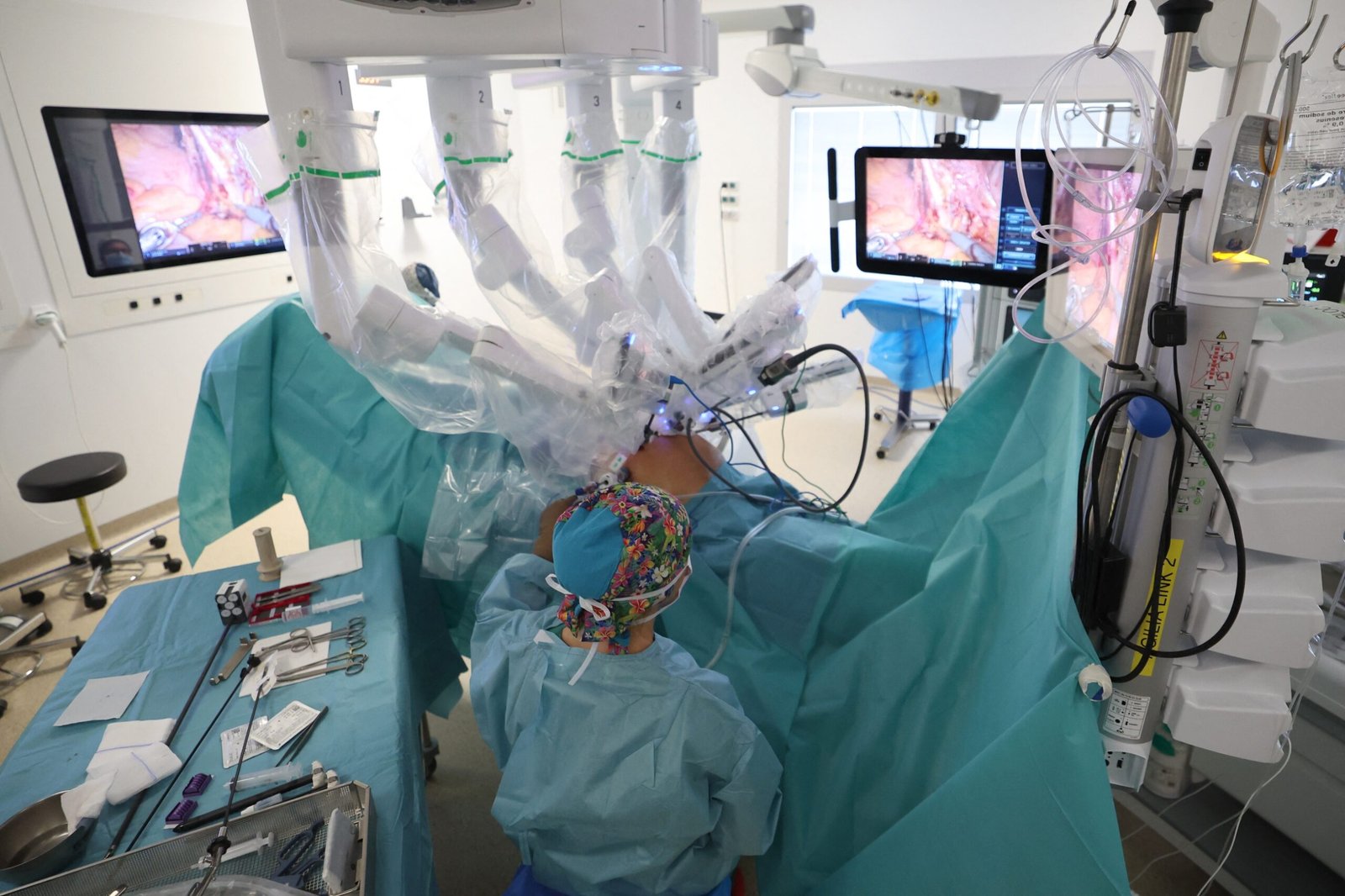
Robot-assisted surgery — the kind used in most current surgical systems including da Vinci — requires a surgeon to control every motion of the robot in real time. The robot extends the surgeon’s capabilities (precision, reach, tremor filtering) but makes no independent decisions. Autonomous surgery refers to systems that perceive the surgical environment, plan their actions, and execute procedures without continuous surgeon guidance. Most FDA-cleared surgical robots remain at Level 1 autonomy (direct surgeon control); the field’s research frontier — where Krieger’s STAR and SRT-H systems operate — is at Levels 2 through 4, with full autonomy still uncleared and the regulatory framework still catching up to the technical capability.
What are the unresolved risks before autonomous surgical devices can operate on human patients?
Three categories of risk remain open. First, soft-tissue sim-to-real transfer at the full complexity of live surgery — variable anatomy, unexpected bleeding, real-time surprises — has not yet been validated in live human procedures. Second, the regulatory framework for fully autonomous devices (likely requiring Class III Premarket Approval, the FDA’s most stringent pathway) is still developing, and global harmonization of computational evidence standards is unresolved. Third, liability: if an autonomous surgical system operating without surgeon guidance causes patient harm, the legal responsibility — divided among the device manufacturer, the software developer, the hospital, and the supervising clinician — is not yet settled by courts or regulation.