The RTX 5080 is the first 80-class GPU in Nvidia’s history that couldn’t beat the last-gen flagship, and that says a lot
I recently wrote about how the RTX 4090 may age better than the GTX 1080 Ti, and one of our readers pointed out something in the comments that I couldn’t stop thinking about. It’s that the RTX 5080 is the first 80-class GPU in Nvidia’s history to fail to beat the previous-generation flagship. When someone puts it that way, you realize just how exceptional the RTX 4090 really was. Either way, it sums up why this generation of Nvidia GPUs feels so strange.
This isn’t really about whether the RTX 5080 is a bad graphics card, because it isn’t. If you’re upgrading from something like the RTX 3080, you’ll still see a massive jump in performance across the board. But that’s not my point. The 80-class cards used to be the ones most gamers were excited about because they offered last generation’s flagship performance at a reasonable price. The RTX 5080 breaks that pattern and shows where Nvidia is heading with its product stack.
The 80-class cards used to be the obvious choice
Yesterday’s flagship performance on a newer architecture at a compelling price
If you look at Nvidia’s GPU lineup over the past nearly two decades, you’ll notice that its 80-class GPUs have one thing in common. They usually beat, or at least matched, the flagships that came before them. Even the GTX 480 from 2010 was faster than the GTX 295 just a year earlier. Until the RTX 5080 launched, the RTX 2080 was arguably the least impressive 80-class GPU, barely edging out the legendary GTX 1080 Ti. But at least in the RTX 2080’s favor, you could argue that it introduced hardware-accelerated ray tracing and DLSS for the same MSRP, two features that are still relevant today.
This meant that buying an 80-class GPU was money well spent, especially if you wanted high-end performance without splurging on a flagship product. You got a newer GPU that supported all the latest Nvidia features at the time, with performance that made last generation’s flagship feel old. But the RTX 5080 simply failed to do that job. Despite launching two and a half years later, it couldn’t even match the RTX 4090’s raw performance. For $999, you’d expect more from an 80-class GPU, which is why I’ve always found it hard to recommend.
The RTX 5080 feels more like a 4080 Ti
Because it was closer in performance to the RTX 4080 than the 4090

It wasn’t just that the RTX 5080 couldn’t match the RTX 4090’s performance. If that were the case, I’m sure many of you wouldn’t have batted an eye. According to various benchmarks, it’s still about 20% slower than the last-gen flagship at 4K, while offering a modest improvement over the RTX 4080 that launched in 2022. Sure, you could argue that the RTX 4080 cost $200 more at launch, but let’s not forget that Nvidia launched the RTX 4080 Super almost a year and a half later for $999.
So in 2025, we were asked to pay the same price for an 80-class GPU that was only about 10-15% over the previous card in the same class. That’s not a generational improvement, since it’s pretty much a 4080 Ti with architectural enhancements. The only thing the RTX 5080 had going for it over the 4090 was Multi-Frame Generation. But be honest with me for a minute. How many of you actually use this feature despite knowing its drawbacks? It makes sense in AAA single-player titles when your base performance is decent, but it’s a no-go in online multiplayer.
Maybe the RTX 4090 was just too good
We’ve had outliers before, but that didn’t stop the next 80-class card

If there’s one reason to defend the RTX 5080 at this point, it’s that the RTX 4090 wasn’t your average flagship GPU. It was arguably one of Nvidia’s biggest generational leaps, delivering roughly 70% more performance than the RTX 3090 at 4K. In fact, that’s exactly why I didn’t hesitate to splurge nearly $2,000 on a liquid-cooled 4090 when it launched, despite having an RTX 3090. To put things into perspective, the RTX 3090 was about 35% faster than the RTX 2080 Ti, which was itself about 35% faster than the GTX 1080 Ti.
But as much as you want to think the RTX 4090 is an anomaly, we’ve had multiple GPUs deliver roughly a 70% uplift. The GTX 1080 Ti was 70% faster than the 980 Ti, but the RTX 2080 Ti still edged it and offered ray tracing and DLSS on top for the same price. The GTX 980 Ti was also about 70% faster than the 780Ti, and the GTX 1080 still outperformed it by roughly 30%. So, the RTX 4090 being too good isn’t really an excuse for the 5080. If anything, it just shows how modest Blackwell’s generational gains have been as a whole. Even the RTX 5090 struggles to be 30% faster than the last-gen flagship.
Nvidia lowering the bar isn’t a good sign
With the RTX 5090 being only about 30% faster than the last-gen flagship, it should be easier for the next 80-class GPU to outperform it. But the 80-class already has a lot of catching up to do, considering the 5080 is still about 20% slower than the 4090. And I don’t think Nvidia actually wants a $1000 card to outperform its $2000 flagship from a couple of years ago. If that’s the direction the company is heading, I believe the 80-class will never be what it used to be. It’s almost like there’s room for a 5080 Ti at this point. The last thing I want is the RTX 5080 to be remembered as the GPU that changed what the 80-class stood for.

- Shader Units
-
10,752
- Ray Accelerators/Cores
-
84
- AI Accelerators/Cores
-
336
- Base Clock Speed
-
2,295 MHz
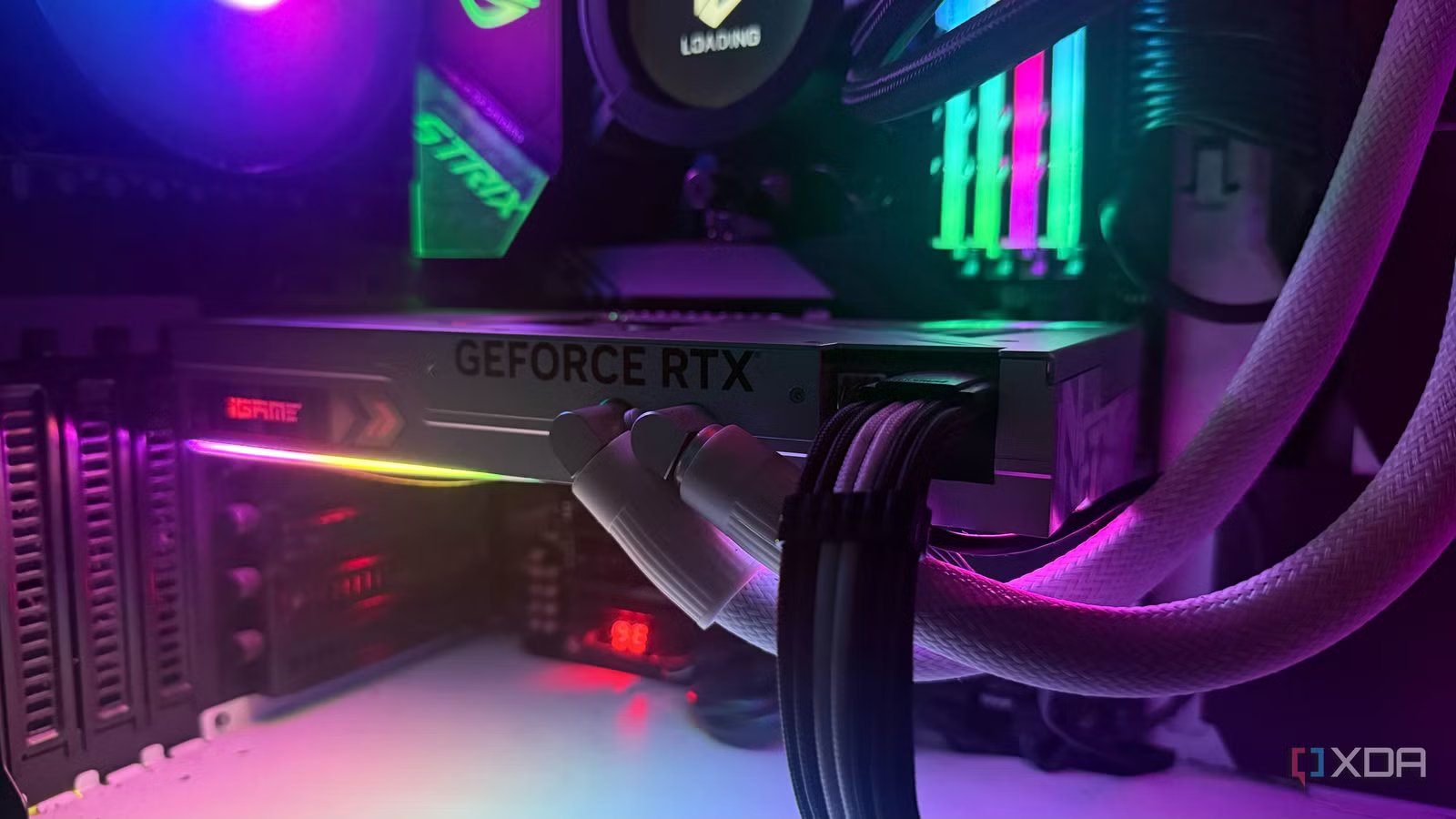
The Nvidia GeForce RTX 5080 is a powerful GPU with advanced AI cores.