UK Humanoid Startup Raises $152M as Bosch and Schaeffler Back Wheels Over Legs
London-based Humanoid announced a $152 million Series A at a $1.35 billion post-money valuation on July 21, 2026, making it what the company calls Europe’s first pure-play humanoid robotics unicorn. What sets the round apart from most robotics raises is not the dollar figure — Europe has seen bigger — but who wrote the checks: Bosch and Schaeffler are both investors and the company’s anchor customer and contract manufacturer, respectively, a dual role that gives Humanoid something most humanoid startups at this stage lack entirely: robots already working in factories, with binding contracts to deploy thousands more. (Exchange rate as of July 24, 2026; conversions are approximate.)
The round was led by Prime Movers Lab, the deep-tech venture firm that also backed Figure AI, with participation from Schaeffler, Bosch, Fubon Financial Holding Venture Capital, and Aglaé Ventures — the investment vehicle of LVMH chairman Bernard Arnault’s family. The raise brings total funding to $270 million.
The “pure-play” qualifier in Humanoid’s unicorn claim matters. Germany’s NEURA Robotics closed a Series C of up to $1.4 billion at a $7 billion valuation on June 10, 2026 — six weeks before Humanoid’s announcement — making it Europe’s most-funded humanoid robot maker by a significant margin. Humanoid’s use of “pure-play” appears to distinguish its single-product-line focus from NEURA’s broader portfolio, which also includes light robot arms and mobile platforms. Both companies are now accelerating simultaneously, and together they represent a European counterweight to a humanoid robotics race that has been dominated by US and Chinese capital.
Wheels Instead of Legs: The Engineering Bet That Won Bosch and Schaeffler
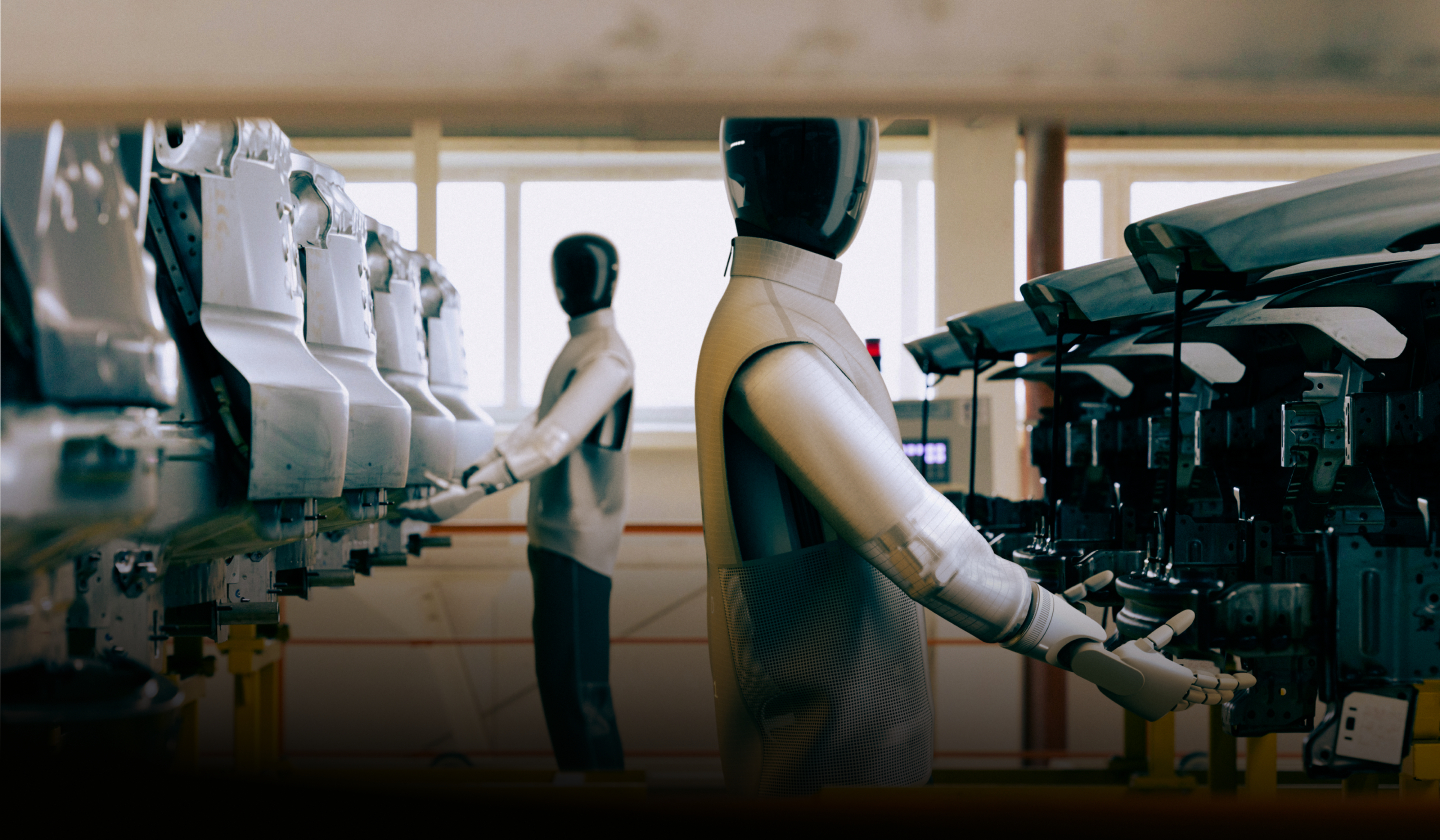
The HMND 01 Alpha is a dual-armed mobile manipulator mounted on an omnidirectional wheeled base. It stands 220 centimeters tall (7 feet, 2 inches), moves at a maximum speed of 7.2 km/h (4.5 mph), and carries a payload of up to 15 kilograms (33 lbs) total in its current Alpha configuration. The robot features close to 29 degrees of freedom, a modular hand system with either a 12-DOF five-finger hand or a parallel gripper, and runs on NVIDIA Jetson Thor, a robotics-grade compute platform delivering approximately 800 TOPS of AI inference capacity.
Choosing wheels over legs was a deliberate engineering decision with commercial consequences. Bipedal locomotion in structured factory environments requires substantial computational resources devoted entirely to balance — a problem that remains unsolved at commercial-uptime levels for any humanoid platform currently in production. By mounting HMND 01 on an omnidirectional wheeled base, Humanoid’s KinetIQ AI system can dedicate its full computational budget to manipulation, task reasoning, and fleet coordination instead. Wheels also substantially simplify CE certification, the European safety compliance requirement Humanoid is targeting by 2027 — a regulatory hurdle that is considerably more complex for bipedal platforms with dynamic balance systems. Humanoid’s chief product officer Sotirios Stasinopoulos has noted that the wheeled design also delivers greater energy efficiency than bipedal alternatives.
IDC projects wheeled humanoid robots will grow at a compound annual rate of approximately 120% — materially faster than the roughly 95% CAGR forecast for full bipedal humanoids — driven precisely by this stability and certification advantage in structured industrial environments.
For Schaeffler, the argument for wheels is grounded in direct operational experience. Schaeffler’s operational leadership has endorsed wheeled platforms for the structured, even-floored environments of modern manufacturing facilities, where the mobility advantages of legs do not offset the engineering complexity they introduce.
How KinetIQ Actually Works
KinetIQ is Humanoid’s proprietary AI framework for end-to-end orchestration of humanoid robot fleets. Its architecture is cross-timescale: four layers operate simultaneously, each running at a different decision frequency, from fleet-level goal assignment down to millisecond-level joint control.
At the top, System 3 functions as a fleet-level agentic AI, treating each robot as a tool and reacting within seconds to optimize operations across an entire facility. It integrates with existing facility management systems, ingests task requests, standard operating procedures, and real-time updates, and allocates work across wheeled and bipedal robots — coordinating robot swaps at workstations to maximize throughput and uptime.
Below that, System 2 is the individual robot’s executive function, using an omni-modal language model to observe its environment and decompose high-level instructions from System 3 into sub-tasks. Unlike pre-programmed sequences, System 2 updates its plans dynamically from visual context, allowing it to navigate environments that change in real time.
System 1 is the Vision-Language-Action layer, commanding target poses for specific body parts — hands, torso, base — at 5 to 10 Hz, handling the immediate mechanics of pick-and-place and container-handling tasks. It uses a prefix conditioning technique, preparing the next action chunk while the current one is still executing, which keeps robot motion fluid without interruption.
At the base, System 0 handles whole-body control at 50 Hz — the millisecond-level joint commands that govern stability, locomotion, and dynamic recovery. KinetIQ’s implementation of System 0 uses reinforcement learning trained entirely in simulation, requiring approximately 15,000 hours of simulation experience to produce a capable locomotion model. This simulation-first approach applies equally to both wheeled and bipedal platforms, meaning data collected on one embodiment feeds into performance improvements across the fleet — a cross-embodiment training flywheel that compounds over time.
The commercial implication of this architecture is specific: a single KinetIQ installation manages the entire stack, from which robots are assigned which tasks across a facility (System 3) down to which joint fires at what torque on each individual robot (System 0). That end-to-end vertical integration is what Bosch’s CTO Mathias Pillin described when he said the company’s DfX manufacturing framework covers “hardware design, production processes, supply chain management, and cost optimization” — the software and hardware stacks are being designed together, not bolted together after the fact.
When Your Investor Is Also Your Customer and Your Parts Supplier
The structural novelty of Humanoid’s funding round goes beyond the investor roster. Bosch and Schaeffler have each committed to roles that most robotics startups spend years trying to fill separately.
Schaeffler’s role is the deepest. On May 13, 2026, Humanoid and Schaeffler signed a binding, phased deployment and supply agreement to integrate humanoid robots directly into live Schaeffler manufacturing operations. The agreement targets a four-digit number of wheeled units across Schaeffler’s global facilities by 2032. The initial deployment phase, running from December 2026 through June 2027, will take place across two Schaeffler sites in Germany: Herzogenaurach, where the focus will be box handling in active production operations, and Schweinfurt, where a six-month validation phase will test stable, continuous operation approaching full production scale. Schaeffler is simultaneously Humanoid’s preferred actuator supplier, covering more than 50% of the company’s joint actuator demand for wheeled platforms through 2031 — an agreement the two companies say will involve a seven-digit number of actuators. This means Schaeffler wins regardless of which form factor ultimately dominates: it buys the labor from Humanoid’s robots, and it sells the joints that make those robots move.
Bosch’s role is equally concrete. Through its subsidiary Robert Bosch Robotics GmbH, Bosch has committed to serve as Humanoid’s contract manufacturing partner for the HMND 01 platform, with production capacity earmarked for up to 100,000 units over the next five years. Bosch is applying its DfX (design for excellence) framework — covering hardware design, production processes, supply chain management, and cost optimization — to prepare the robot for volume manufacturing. The partnership followed a completed proof-of-concept at a Bosch intralogistics facility in Bühl, Germany, where HMND 01 robots autonomously transferred boxes from a conveyor to a trolley across five different box sizes and footprints.
The actuator dimension is worth understanding technically. Actuators — the motorized joints that control each degree of freedom in a humanoid robot’s body — represent an estimated 40 to 60 percent of a humanoid robot’s bill of materials cost, making them the single largest manufacturing expense. Schaeffler is the world’s largest bearing manufacturer and a precision motion technology company, which positions it as one of the few industrial partners that can supply these components at the quality and volume Humanoid will need. By locking in 50%-plus of that supply chain through 2031 as part of the same deal that commits Schaeffler to deploying the robots, Humanoid has addressed its two largest cost and revenue risks simultaneously.
The governance implication the draft left unstated: investors who are also the company’s anchor customer and primary supplier hold leverage that pure-play VC investors do not. If Humanoid’s roadmap diverges from what serves Schaeffler’s factory operations or Bosch’s manufacturing economics, those parties have both the incentive and the contractual standing to redirect it. That alignment is Humanoid’s competitive advantage and, in a different light, its most significant structural constraint.
Europe’s Position in a Global Race
Until now, the global humanoid robotics race has been dominated by US companies — Figure AI (recently valued at $39 billion), Apptronik ($5.3 billion valuation after its February 2026 $520 million extension backed by Google and Mercedes-Benz) — and a fast-accelerating wave of Chinese competitors. Global robotics companies have already raised $55.8 billion in 2026, nearly double 2025’s full-year total, with the majority concentrated in US and Chinese companies.
Chinese humanoid robotics companies present the most direct volume competition. AI2 Robotics, a Shenzhen-based maker of wheeled humanoid robots, raised approximately $735 million at a nearly $3 billion valuation in early July 2026. Unitree shipped more than 5,500 humanoid robots in 2025, claiming approximately 32.4% of global humanoid unit shipments. For industrial buyers evaluating wheeled humanoid options, these represent real alternatives — at substantially lower price points than Western platforms, but subject to China’s National Intelligence Law Article 7 obligations, which legally require cooperation with Chinese state intelligence regardless of where the robots are deployed or where data is stored.
Humanoid’s Prime Movers Lab general partner Zia Huque described the field as consolidating around a handful of category leaders across the US, Europe, and China. Europe, until June 2026, had none. With NEURA Robotics and Humanoid both now past unicorn valuations, it has two.
The global humanoid robot market was valued at approximately $4.89 billion in 2025 and is projected to reach $6.24 billion in 2026, with analysts forecasting over $165 billion by 2034 at a compound annual growth rate above 50%.
What Humanoid Has Left to Prove
The metrics Humanoid self-reports carry appropriate caveats. The company claims 34,000 pre-orders worth approximately $2.4 billion and nine completed proof-of-concept projects with Fortune 500 partners. Neither figure has been independently verified. The POC results that have been independently confirmed include the Bosch Bühl intralogistics facility (box transfers across five different footprints and weights) and the Siemens Erlangen electronics factory (tote logistics, validated against speed, reliability, and uptime targets).
The more telling test is what happens when Beta robots enter sustained factory operation in Q4 2026 — not demonstrating capability but maintaining it across shifts, over weeks, and when box dimensions are dented or trolley positions are slightly off. The commercial humanoid robotics industry has not yet solved 95%-plus uptime at general-purpose scale. That is the standard Schaeffler’s production operations will apply.
Industry critics including Rodney Brooks — co-founder of iRobot and MIT professor emeritus — have long noted that humanoid robots pursuing dexterity through video-based learning face fundamental hardware constraints: current platforms can replicate only a fraction of the tactile sensing capacity of human hands. The KinetIQ system avoids this specific criticism by focusing on wheeled manipulation tasks that do not require fine tactile feedback — box handling, container transfer, bin picking — rather than assembly tasks that demand human-level dexterity. But the “last 10% problem” that independent analysts identify — humanoids handling 80–90% of targeted tasks well while edge cases still require human intervention — will apply at Herzogenaurach just as it does everywhere else.
Humanoid was incorporated as SKL Robotics Ltd. in 2024 and now employs more than 250 engineers, researchers, and operators across offices in London, Boston, Vancouver, and San Diego. Artem Sokolov, the founder and CEO — a serial entrepreneur whose family manufacturing background directly informed the company’s founding mission — said the company’s two-year trajectory “would typically take a decade.” Whether the Bosch and Schaeffler partnerships sustain that velocity through the harder discipline of sustained commercial deployment will define whether this raise marks a beginning or a ceiling.
Frequently Asked Questions
What makes Humanoid’s investor structure unusual for a robotics startup?
Both Bosch and Schaeffler are simultaneously investors, commercial partners, and supply-chain partners. Schaeffler has committed to deploying a four-digit fleet of wheeled robots across its global manufacturing facilities by 2032 — making it the anchor customer — while also supplying more than 50% of Humanoid’s joint actuators through 2031. Bosch is both a financial investor and the company’s contract manufacturer, committed to producing up to 100,000 units over five years. Most robotics startups raise funding from pure-play venture investors and pursue commercial agreements separately; Humanoid’s model collapses both into the same transaction, which eliminates the validation gap between funding and commercial deployment but also gives its major partners structural leverage over the company’s direction.
Why did Humanoid choose a wheeled robot instead of a bipedal humanoid for industrial deployment?
The wheeled design resolves two problems that have slowed every bipedal humanoid from reaching commercial scale. First, balance: bipedal locomotion requires dedicated computational resources just to keep the robot upright, resources that the KinetIQ system can instead devote entirely to manipulation, task reasoning, and fleet coordination. Second, certification: Europe’s CE safety standard and ISO compliance frameworks are substantially simpler for wheeled platforms than for bipedal robots with dynamic balance systems, accelerating Humanoid’s path to the 2027 certification target. IDC projects wheeled humanoid robots will grow at roughly 120% compound annually — faster than bipedal humanoids — driven by exactly this stability and certification advantage in structured factory environments. The tradeoff: wheeled robots cannot navigate stairs, ramps, or uneven terrain, so they are well-matched to modern flat-floor factories but not to all industrial environments.
How does KinetIQ’s four-layer architecture differ from how other humanoid robots are controlled?
Most humanoid control systems use a single model or a small number of separate models for different functions. KinetIQ runs four layers simultaneously at different timescales — from fleet-level task assignment that reacts within seconds (System 3) down to whole-body joint control at 50 Hz (System 0). The critical technical innovation is that each layer treats the layer below as a set of tools, orchestrating it through prompting and tool use, which mirrors how frontier AI systems scale: components can improve independently without requiring the entire system to be retrained. The RL-trained locomotion layer (System 0) requires approximately 15,000 hours of simulation training; once trained, that capability transfers across both wheeled and bipedal embodiments, so data from wheeled factory robots improves the bipedal R&D platform and vice versa.
Is Humanoid really Europe’s first pure-play humanoid robotics unicorn?
The “pure-play” qualifier is the operative word, and it requires context. Germany’s NEURA Robotics closed a Series C of up to $1.4 billion at approximately $7 billion valuation on June 10, 2026 — six weeks before Humanoid’s announcement — making it Europe’s most-funded humanoid robot company by a large margin. Humanoid’s “pure-play” claim appears to distinguish a company whose entire product portfolio consists of humanoid robots from NEURA’s broader portfolio, which also includes light robot arms and mobile platforms. Whether that distinction holds up over time — as both companies expand their platform offerings — is an open question. What is not in dispute: both companies now represent a European counterweight in a global humanoid race that previously had no European leaders.