Researchers Create Faster, Cheaper Way to Teach a Humanoid Robot to Walk Over Real-World Terrain
Wu also adjusted the training so that the teacher robot learns from what the student robot experiences in the simulation. That helps close what robotics researchers call the teacher-student imitation gap — essentially that even with good instruction from the teacher, the student is still making decisions based on partial information. The student might encounter an obstacle or terrain and not have some important piece of data to properly navigate it.
“This gap can be very sinister and difficult to solve. We tried to mitigate it by letting the teacher learn from the data that’s been collected by the student as well,” Wu said. “The teacher experiences what’s possible for the student, and the hope is that helps the teacher offer better instruction.”
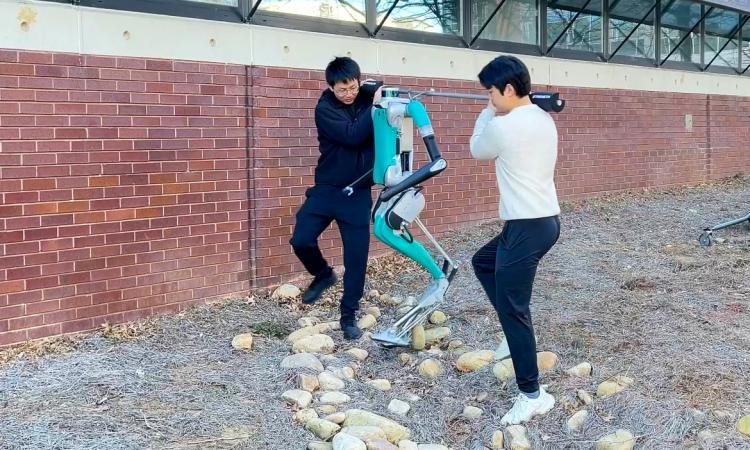
After applying their new approach and training a controller in simulations, they deployed it on a two-legged humanoid robot in Ye Zhao’s lab. It worked, allowing the robot to walk smoothly across a variety of surfaces.
The team also tried to forcefully push and pull the robot to see if they could disrupt its gait, but the robot adapted and adjusted to compensate.
Though Wu and his colleagues used a two-legged humanoid robot in their experiments, his “Learn to Teach” training framework is designed to be generic. It can be used for other robots with other configurations. It also can apply to other kinds of tasks besides walking.
Zhao, who co-advises Wu with CSE Assistant Professor Anqi Wu, said the control system performed better even than the controller provided by the robot’s manufacturer.
He said Wu brings a unique perspective to robotics work because of his background in machine learning.
“Most of the Ph.D. students in my lab come from a robotics and control background. Feiyang is starting to explore robotics problems from a more theoretical, algorithm-focused background, which is not easy,” said Zhao, associate professor and Woodruff Faculty Fellow in ME. “There’s a big barrier. If students get used to doing the programming and writing mathematics, they might not have the desire to explore working with the real hardware. Feiyang has a strong motivation to explore things on both sides, which is very unique.”