Warehouse Cleaning Robots Market : Global Industry Analysis and Opportunity Assessment, 2036
How big is Warehouse Cleaning Robots Market in 2026?
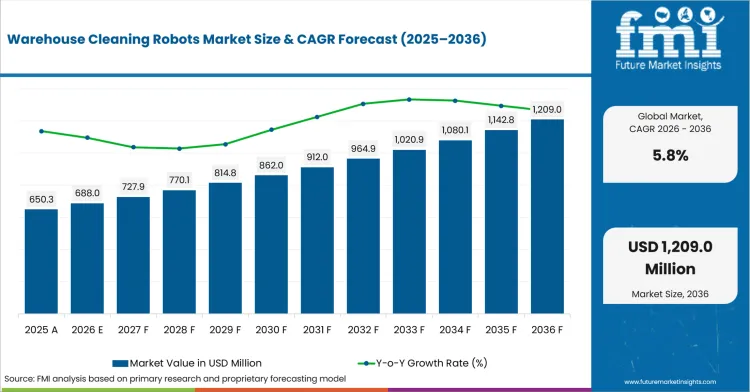
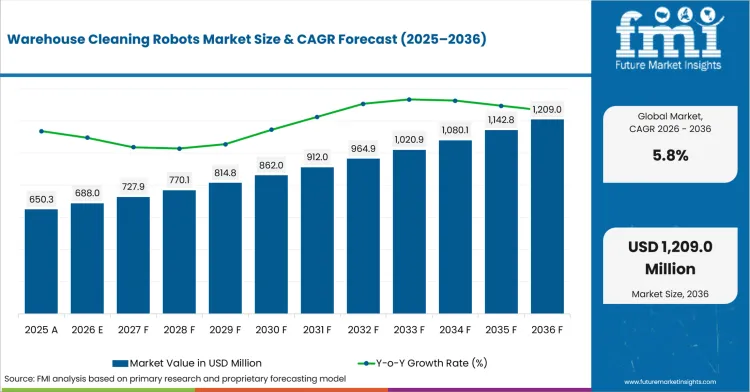
USD 688.0 million in 2026 and USD 1,209.0 million by 2036 at a 5.8% CAGR.
Warehouse cleaning robot sales are forecast to expand at 5.8% CAGR from 2026 to 2036, increasing industry valuation from USD 688.0 million in 2026 to USD 1,209.0 million by 2036, as distribution facilities assign repeat floor routes to autonomous equipment. The USA Bureau of Labor Statistics reported in July 2026 that private warehousing and storage establishments numbered 23,757 during the fourth quarter of 2025. That site base gives warehouse robotics a broad operating environment, yet cleaning projects often depend on protected route time. Coordination with material-handling equipment determines whether planned coverage can be completed during each normal operating shift.
Labor economics change the investment case across countries even though the cleaning task remains similar. USA Bureau of Labor Statistics data published in July 2026 placed average hourly earnings in warehousing and storage at USD 26.76 during May 2026. European facilities face another cost pattern, while Japanese logistics sites place greater emphasis on compact equipment and dependable local service. A pilot should therefore measure completed area and intervention time during typical traffic rather than an empty aisle. Clear warehouse design and layout rules protect scheduled cleaning windows, while established logistics robots can share traffic zones through agreed priorities. The useful comparison is annual route output against the labor and service cost that the robot replaces.
Summary of the Warehouse Cleaning Robots Market
| Market Signal | Commercial Impact |
|---|---|
| Demand and Growth Drivers | Large warehouse floors create repeat work that can be measured through completed area and route interruptions across receiving and storage zones throughout the week.
|
| Product and Segment View | Cleaning hardware sets the performance limit because navigation software cannot recover dirty solution or remove packaging debris without suitable brushes and tanks.
|
| Geography and Growth Outlook | Country growth differs according to warehouse scale and labor cost, yet local service coverage decides whether a pilot becomes a repeat operating program.
|
| Competitive Landscape | Competition depends on the fit between cleaning equipment and autonomy software, followed by the service response available after the machine enters daily use during routine warehouse shifts.
|
| Analyst Perspective | A robot creates value through repeatable warehouse coverage, not through a successful route completed during a controlled demonstration.
|
Source: FMI’s proprietary forecasting model and primary research.
How is the warehouse cleaning robots market segmented?
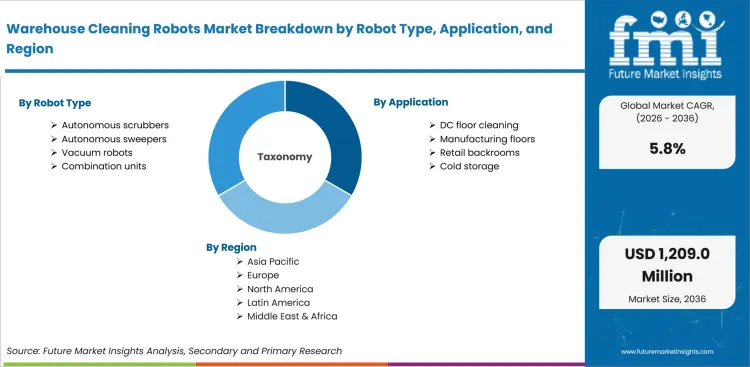
The warehouse cleaning robots industry is segmented by robot type, application, component, end-use industry, business model, and region.
The report compares six dimensions that connect floor conditions with equipment design and commercial access. Robot type separates scrubbers from sweepers and vacuum units, while application analysis distinguishes distribution centers from manufacturing and cold-storage sites. Component analysis divides machine hardware from software and services that coordinate repeated cleaning routes throughout each operating day. Third-party logistics and warehousing account for 36.0% of end-use demand because large sites provide enough floor work for regular machine use. Direct purchase holds 38.0% of business models, although subscription and managed-service options can reduce the commitment required to test mobile robots on working warehouse routes.
What makes autonomous scrubbers central to the robot type category?
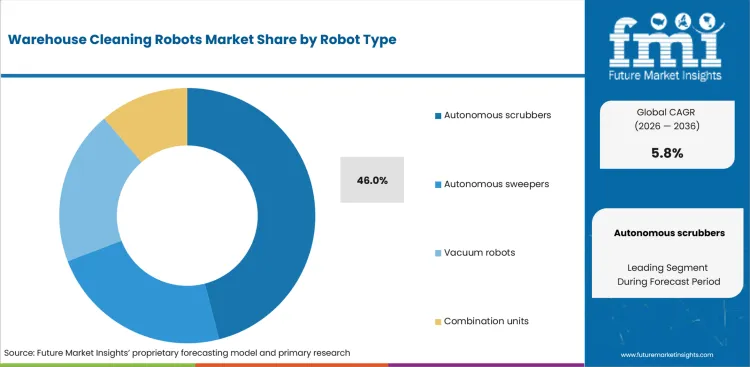
Broad hard-floor routes favor machines that wash and recover water during one planned cleaning cycle. Kärcher announced the KIRA B 200 in March 2025 with a cleaning width of up to 90 centimeters and output of up to 4,800 square meters per hour. Those specifications show why scrubber selection begins with route area and soil load rather than autonomy features. Shared routes with automated material handling systems require clear crossing priorities during active warehouse shifts. Water capacity and docking access determine how long the machine remains productive between service stops.
- By robot type, autonomous scrubbers are forecast to represent 46.0% share in 2026 through their ability to wash broad floors and recover dirty solution during the same pass. The format turns an open warehouse aisle into a measurable route with a defined start and finish. Tank service remains central to daily route planning because water and recovery systems determine whether the next cycle can start.
- Distribution and manufacturing facilities favor scrubbers for concrete or coated floors that collect tire marks and fine debris during repeated vehicle movement. Service crews must reach squeegees and filters quickly enough to protect the next scheduled cleaning window.
How does DC floor cleaning shape demand within the application category?
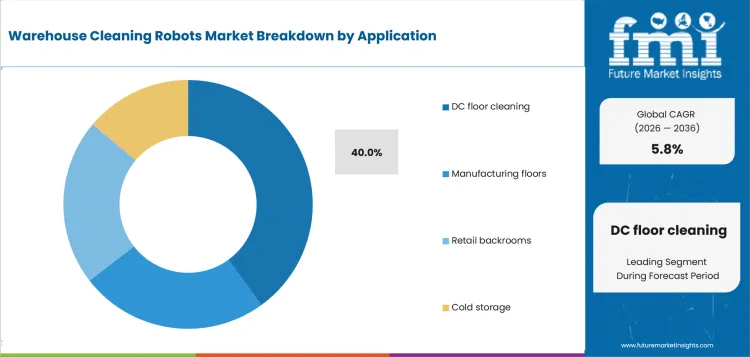
Distribution centers combine long aisles with changing traffic and packaging debris that spreads across several operating zones. Gausium introduced the Mira robot in September 2025 for midsized logistics and manufacturing spaces, with simultaneous sweeping and scrubbing for varied floor conditions. The launch connects route agility with mixed-debris handling required inside active logistics facilities during daily operations. Site planning therefore needs protected cleaning windows and clear priorities at crossings shared with goods-moving robots.
- Within application, DC floor cleaning is projected to hold 40.0% share in 2026 as long aisles create repeat work across receiving and storage zones. Coverage reports help supervisors see whether dock congestion is reducing completed floor care during each shift. That evidence supports route changes before repeated congestion turns missed cleaning zones into a routine problem.
- Fulfillment centers require cleaning plans that fit order waves and trailer schedules rather than a fixed building-wide route. Experience with autonomous mobile robots for logistics and warehousing can support shared traffic rules. Cleaning robots still need enough uninterrupted time to finish assigned zones while preserving the planned order cycle.
How is hardware positioned within the component category?
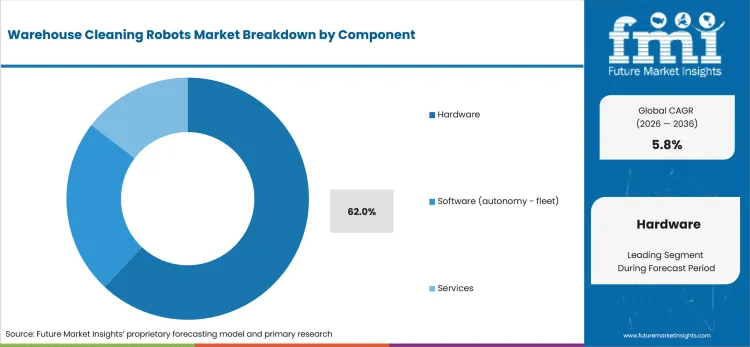
The physical machine carries the tanks and brushes that perform floor care, while its battery and drive system determine route endurance. Nilfisk launched the autonomous SC25 in September 2025 with output of 1,500 square meters per hour and tanks sized for three hours of operation. These figures explain why component value remains concentrated in the physical machine and its serviceable cleaning systems. Software improves route control, but it cannot compensate for weak recovery or limited service access.
- By component, hardware is estimated to hold 62.0% share in 2026 because tanks and batteries sit beside brushes and drive systems within each machine. The share reflects the equipment needed to clean and recover water under ordinary warehouse floor conditions and therefore shapes daily purchase price and service workload.
- Service managers assess parts access and battery replacement beside navigation features since mechanical downtime can remove an entire route from the weekly plan. Mobile robotics software becomes valuable after the hardware performs the required cleaning task with dependable output. Parts access and battery replacement therefore remain central to uptime during multi-shift warehouse cleaning programs.
What are the drivers, restraints, and opportunities in the warehouse cleaning robots market?
Repeat hard-floor routes support demand, changing warehouse traffic limits completed coverage, and service-based contracts can reduce the risk of early expansion.
- Driver: Large warehouse floors create repeated cleaning routes whose completed coverage can be measured across several shifts.
- Restraint: Pallets and forklifts can interrupt planned paths and reduce the area completed during an assigned cleaning window.
- Opportunity: Fleet data and service contracts can support wider use after a facility confirms suitable routes and maintenance needs.
Repeatable floor area is one of the significant demand drivers because each robot needs enough scheduled work to justify its capital and service cost. Brain Corp reported in March 2026 that early BrainOS Clean 2.0 installations increased unique area coverage by 22% and autonomy by 55%. The same release reported that rollout became more than three times faster across the initial installations reviewed. These results show how adaptive routing can improve completed work in changing environments, which strengthens the case for warehouse programs built around measured route output.
Dynamic traffic conditions remain a practical restraint, as warehouse routes can change between planning and execution, reducing the consistency of autonomous cleaning operations. OSHA standard 29 CFR 1910.22 requires passageways and walking-working surfaces to remain clean and orderly, with floors kept dry as far as feasible. The rule supports regular floor care but leaves site teams responsible for spills and blocked zones that need immediate action. Cleaning robots therefore need exclusion areas and escalation procedures that protect goods movement without weakening workplace housekeeping duties.
Service contracts create an opening for facilities that need route evidence before they accept full equipment ownership. A monthly fee can include software updates and field support, which lets the operating team compare actual coverage with the annual cost of the program. The commercial model gains relevance through robotics as a service, with machine access expanding after the first routes prove dependable. Contract terms should define response time and replacement equipment so service gaps do not erase the expected labor benefit.
Which country CAGRs are profiled in the warehouse cleaning robots market?
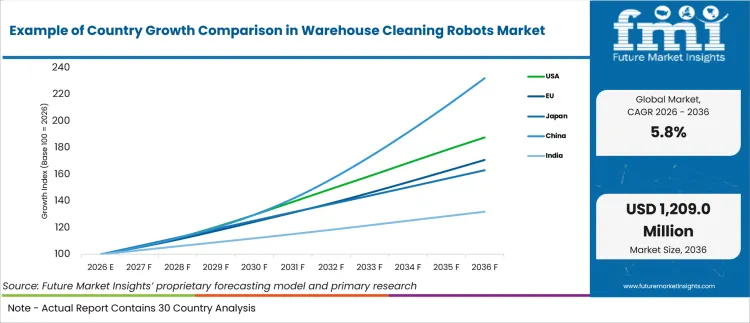
| Country | CAGR |
|---|---|
| United States | 6.5% |
| European Union | 5.5% |
| Japan | 5.0% |
Source: FMI’s proprietary forecasting model and primary research.
How do country-level CAGRs compare in the warehouse cleaning robots market?
Country growth depends on the scale of logistics facilities and the cost of keeping broad floor areas clean during normal operations. The United States supports multi-site programs across a broad warehousing base. European projects face different labor economics, and Japan places greater weight on compact equipment and dependable service. Warehouse digital twins can improve route planning and traffic-zone testing inside highly automated logistics facilities. Local maintenance capacity then determines whether a successful pilot can support routine use across several facilities.
- The United States supports multi-site cleaning programs across a broad network of warehousing and storage establishments. The country is projected to record 6.5% CAGR from 2026 to 2036 through multi-site operating programs. USA Bureau of Labor Statistics data published in July 2026 placed warehousing and storage employment at 1,850,600 during June 2026. That workforce scale shows why routine floor care competes with handling work for labor across many facilities. National operators can compare route performance between sites as local technician response remains necessary at each location. Purchasing decisions should therefore examine completed area and service response beside the initial equipment price during annual reviews.
- European warehouse projects place close attention on labor cost and documented operating performance across different national service networks. Warehouse cleaning robot industry in the European Union is forecast to advance at 5.5% CAGR from 2026 to 2036. Eurostat reported in March 2026 that hourly wage costs in transport and storage rose 4.1% during the fourth quarter of 2025. The increase improves the commercial case for automating repeat floor work in suitable regional logistics facilities. Regional growth should favor suppliers that can support several countries across multi-country networks without weakening local parts availability or technician response at each site.
- Japanese logistics facilities often combine constrained layouts with an aging workforce and strict expectations for dependable equipment. Adoption of warehouse cleaning robots in Japan is estimated to expand at 5.0% CAGR from 2026 to 2036. Compact robots with clear local support may therefore gain approval on repeat routes that do not obstruct warehouse movement during each shift.
Who are the notable companies in the warehouse cleaning robots market?
Tennant Company, Brain Corp, Nilfisk, Kärcher, Gausium, and Pudu Robotics are notable companies active in autonomous warehouse floor care.
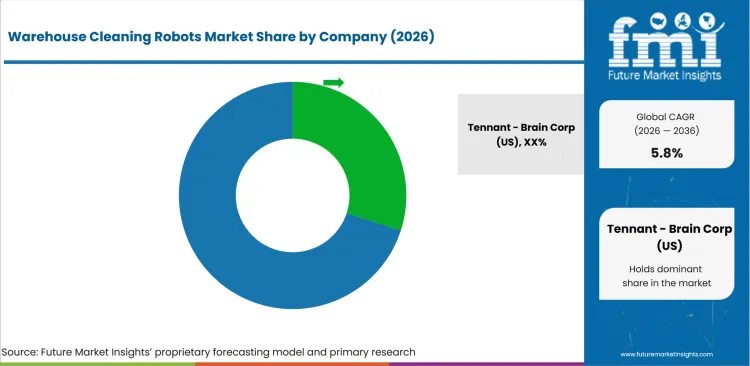
Competition combines established cleaning equipment with autonomy software and field support for daily warehouse operations. Tennant Company and Brain Corp connect commercial scrubbers with route planning and fleet reporting, while Nilfisk and Kärcher extend professional floor-care portfolios into autonomous machines. Gausium and Pudu Robotics focus on purpose-built robots for broad operational spaces and mixed debris. Operators compare these offers against route completion and intervention needs rather than product lists alone. mobile robot fleet traffic management becomes relevant in facilities that share aisles between cleaning and goods-moving machines. Service response then determines whether performance remains stable across several sites during ordinary operating weeks.
- Tennant Company and Brain Corp focus on linked equipment and autonomy technology that support route reporting across several scrubber sizes. Their combined offer suits warehouse groups that want common operating data, although local service coverage still affects expansion beyond the first facility.
- Nilfisk and Kärcher bring established floor-care engineering and parts networks to autonomous cleaning inside working warehouses. Their position becomes useful in warehouses that already maintain commercial scrubbers, since technicians can compare robotic models with familiar water systems and consumable requirements during multi-site expansion programs.
- Gausium and Pudu Robotics design machines around autonomous operation in broad commercial and logistics spaces. Their offers attract facilities seeking purpose-built sweeping or scrubbing, yet each project still needs proof that route behavior matches local debris and daily traffic patterns.
Competitive Benchmarking: Warehouse Cleaning Robots Market
| Company | Autonomous Floor-Care Portfolio | Warehouse Evidence | Fleet Reporting | Field Service | Geographic Reach |
|---|---|---|---|---|---|
| Tennant Company | High | Medium | High | High | High |
| Brain Corp | High | Medium | High | Medium | High |
| Nilfisk | High | High | High | High | High |
| Kärcher | Medium | High | Medium | High | High |
| Gausium | High | High | High | Medium | High |
| Pudu Robotics | Medium | High | Medium | Medium | High |
Scoring basis: High indicates broad verified capability in the stated dimension, Medium indicates relevant capability with narrower evidence or partner dependence, and Low indicates limited direct evidence.
Source: Future Market Insights competitive assessment, July 2026. Ratings compare verified autonomous floor-care activity and warehouse relevance.
Key Developments in the Warehouse Cleaning Robots Market
- In April 2025, Tennant Company, introduced the X6 ROVR autonomous floor scrubber for large commercial and light-industrial facilities. The official announcement stated that the machine can clean up to 75,000 square feet per cycle and operate for up to six hours. The launch expands autonomous cleaning toward warehouse-scale routes in which tank capacity and battery endurance shape completed coverage. It gives logistics facilities a machine designed for broad floors rather than short demonstration paths.
- In March 2026, Pudu Robotics, launched the BG1 series of large autonomous scrubber-dryers for extensive commercial and industrial floor areas. The official announcement described AI-based route generation and cleaning systems developed for broad operational spaces. The release widens the equipment choices available to warehouses that need wet cleaning across long routes.
- In August 2025, SoftBank Robotics, began selling the PUDU MT1 for large facilities in Japan and offered trials to 50 organisations through December 2025. The official release stated that the sweeper can cover up to 100,000 square meters and named logistics sites among its intended applications. The rollout gives Japanese warehouses a locally supported option for broad dry-debris routes inside large facilities.
- In April 2026, Brain Corp, announced an extension of its strategic partnership with Tennant Company to accelerate robotic floor-scrubber rollout and the next generation of cleaning technology. The agreement matters to warehouse operators because software continuity and equipment support affect fleet expansion across several sites.
Key Players in the Warehouse Cleaning Robots Market
Equipment and autonomy partnerships
- Tennant Company
- Brain Corp
Professional cleaning equipment companies
Purpose-built autonomous cleaning companies
Warehouse Cleaning Robots Market – Report Scope
| Coverage field | Report scope |
|---|---|
| Market breakdown | Robot type, application, component, end-use industry, business model, and region. |
| Quantitative Units | Revenue in USD million and CAGR in percentage terms. |
| Market Definition | Autonomous scrubbers, sweepers, vacuum robots, and hybrid machines used for routine warehouse floor care. |
| Regions Covered | North America, Latin America, Europe, East Asia, South Asia, Oceania, and Middle East and Africa. |
| Countries Covered | United States, Canada, China, Japan, India, selected European economies, and more than 20 countries within the regional model. |
| Key Companies Profiled | Tennant Company, Brain Corp, Nilfisk, Kärcher, Gausium, and Pudu Robotics. |
| Forecast Period | 2026 to 2036. |
| Approach | Bottom-up equipment and service estimates reconciled with company activity, and logistics indicators. |
Source: FMI’s proprietary forecasting model and primary research.
Warehouse Cleaning Robots Market – Research Methodology
| Method | Approach |
|---|---|
| Primary Research | FMI analysts gathered input from manufacturers, service providers, technology developers, distributors, end users, procurement teams, and subject-matter experts. Interviews examined purchasing decisions, product or service evaluation, adoption barriers, approval requirements, pricing considerations, and expectations for technical or commercial support. Respondents were also asked what evidence is required before a trial, pilot, or initial order develops into regular purchasing. |
| Desk Research | Desk research covered government statistics, regulatory publications, trade data, industry associations, technical literature, standards, company filings, product information, and official corporate announcements. Sources were reviewed for relevance, publication date, geographic coverage, and consistency with the defined market scope. Claims relating to performance, applications, approvals, capacity, investment, and commercial activity were retained only when supported by credible public evidence. |
| Market Sizing and Forecasting | The market model combined the baseline value with historical performance, segment structure, pricing and volume indicators, adoption levels, company participation, and country-level demand conditions. Forecast assumptions considered economic activity, investment trends, regulatory developments, technology adoption, purchasing cycles, supply availability, and barriers to wider market use. Segment and regional estimates were reconciled before the final market total was calculated. |
| Data Validation | Estimates were checked against multiple independent indicators, including public data, company activity, trade patterns, industry developments, and findings from primary interviews. Validation also tested whether products, services, applications, and company revenues fell within the defined market boundaries. Adjacent categories, unsupported claims, overlapping revenues, and activities without direct market relevance were excluded to reduce double counting and maintain consistency across segments and countries. |
Source: Future Market Insights analysis based on proprietary forecasting and completed primary research.
Warehouse Cleaning Robots Market by Segments
Warehouse Cleaning Robots Market segmented by Robot Type:
- Autonomous Scrubbers
- Autonomous Sweepers
- Autonomous Vacuum Robots
- Hybrid Sweep-and-Scrub Robots
Warehouse Cleaning Robots Market segmented by Application:
- DC Floor Cleaning
- Manufacturing Floor Cleaning
- Cold Storage Cleaning
- Retail Backroom Cleaning
Warehouse Cleaning Robots Market segmented by Component:
- Hardware
- Software
- Services
Warehouse Cleaning Robots Market segmented by End-use Industry:
- 3PL and Warehousing
- E-commerce Fulfillment
- Manufacturing
- Retail Distribution
- Cold Chain Logistics
Warehouse Cleaning Robots Market segmented by Business Model:
- Direct Purchase
- Robotics as a Service Subscription
- Lease
- Pilot Program
- Managed Cleaning Contract
Warehouse Cleaning Robots Market by Region:
- North America
- Latin America
- Europe
- Germany
- United Kingdom
- France
- Italy
- Spain
- East Asia
- South Asia
- Oceania
- Middle East and Africa
- Gulf Cooperation Council Countries
- South Africa
- Türkiye
Research Sources and Bibliography
- USA Bureau of Labor Statistics. (2026, July). Warehousing and storage: NAICS 493.
- Kärcher. (2025, March). New scrubber dryer robot from Kärcher.
- Gausium. (2025, September). From clean to beyond: Gausium introduces Mira at CMS Berlin.
- Nilfisk. (2025, September). Autonomous floor cleaning at a new level.
- Brain Corp. (2026, March). BrainOS Clean 2.0 with SelfPath AI for Tennant floor-cleaning robots.
- Occupational Safety and Health Administration. (2026, July). General requirements, 29 CFR 1910.22.
- National Bureau of Statistics of China. (2026, February). Statistical communique on China’s 2025 economic and social development.
- Eurostat. (2026, March). Annual increase in labour costs at 3.3% in the euro area.
- Ministry of Land, Infrastructure, Transport and Tourism. (2025, June). Summary of the 2025 white paper on land and transport infrastructure in Japan.
- Press Information Bureau. (2025, September). Building resilient infrastructure for storage of food grains.
- Tennant Company. (2025, April). Tennant Company launches X6 ROVR for large and complex facilities.
- Pudu Robotics. (2026, March). Pudu Robotics launches the PUDU BG1 series of large scrubber-dryer robots.
- SoftBank Robotics. (2025, August). Sales begin for the PUDU MT1 cleaning robot for large facilities.
- Brain Corp. (2026, April). Brain Corp and Tennant Company extend their robotic floor-care partnership.
This bibliography is provided for reader reference and uses primary government, standards-body, official trade body, and company sources.
Frequently Asked Questions
What is driving growth in the Warehouse Cleaning Robots Market?
Large hard-floor areas create repeat routes that robots can clean through a planned operating schedule. Growth depends on enough available route time to justify equipment, support, and maintenance costs annually.
Who are the key players in the Warehouse Cleaning Robots Market?
Tennant Company and Brain Corp combine floor-care equipment with autonomy software for repeat warehouse routes. Nilfisk and Kärcher offer established platforms, while Gausium and Pudu Robotics focus on autonomous logistics floor cleaning.
What is a notable restraint in the Warehouse Cleaning Robots Market?
Pallets and forklifts can interrupt planned cleaning routes during receiving and picking activity inside active warehouses. Repeated stops reduce completed coverage and weaken the financial case for wider deployment across several sites.
Why should executives track the Warehouse Cleaning Robots Market?
The category can redirect routine floor work without removing responsibility for spills and edge-cleaning tasks. Route data gives executives a measurable basis for expansion decisions across several warehouse sites with confidence.
What business problem does the Warehouse Cleaning Robots Market address?
The market addresses repeated cleaning across broad warehouse floors that consume staff travel time each week. Robots can cover stable routes, leaving people available for spills and other exceptions during shifts.
What should procurement teams evaluate before selecting suppliers?
Procurement teams should compare completed area and intervention time under normal warehouse traffic during a representative pilot. They should confirm parts availability and technician response before approving wider use across several facilities.
What limits return on investment for purchasers?
Low route availability can leave expensive machines underused across the operating week at an active warehouse. Maintenance delays and frequent traffic interruptions reduce the labor benefit expected from automation at each site.
What supports long-term commercial confidence in the Warehouse Cleaning Robots Market?
Consistent cleaning performance across ordinary warehouse traffic builds confidence in the operating model over time. Documented service response and route reporting give site managers evidence for expansion across several facilities.