US ally trials robotic drone mothership for autonomously launching UAVs
The Royal Navy is testing a robotic boat capable of autonomously launching and recovering a drone at sea, in a demonstration aimed at expanding uncrewed maritime surveillance.
British maritime robotics company ACUA Ocean and US-based Teledyne FLIR Defense conducted two days of trials for the UK Ministry of Defence and offshore industry partners.
The system combines an uncrewed surface vessel (USV) with a tethered uncrewed aerial system (T-UAS), allowing the boat to deploy an airborne sensor without human intervention.
The demonstration was supported by UK Defence Innovation (UKDI), which funds emerging technologies with potential military applications.
Autonomous drone vessel
The Royal Navy is exploring a new approach to persistent maritime surveillance by combining an autonomous drone launch system with an uncrewed surface vessel (USV), allowing aerial reconnaissance to continue for extended periods without putting personnel at risk.
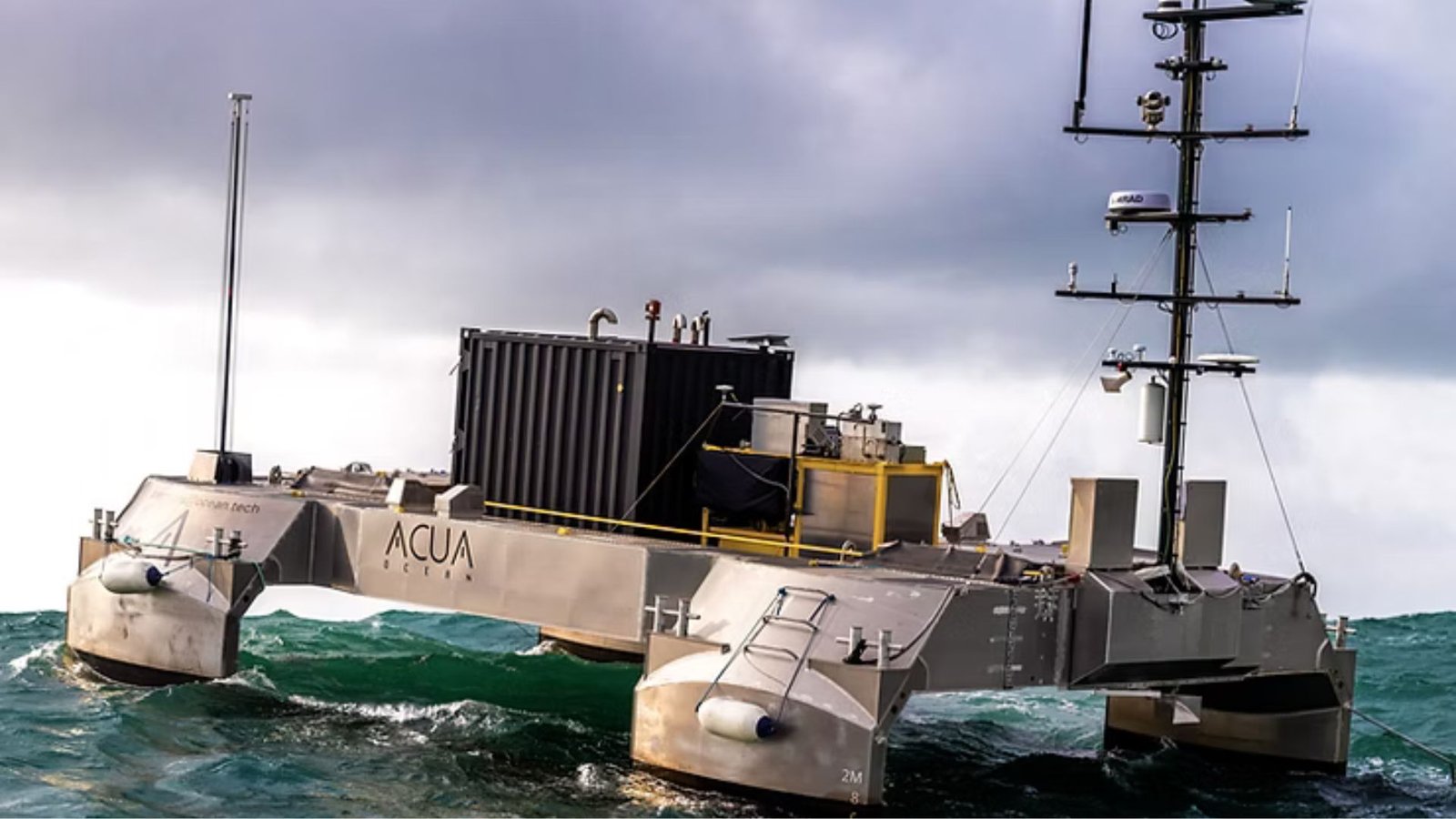
At the center of the demonstration were Teledyne FLIR Defense’s SkyCarrier and SkyRanger R70, working alongside ACUA Ocean’s Pioneer USV. SkyCarrier is an autonomous drone launch-and-recovery system housed in a protective container that unfolds into an articulating landing pad. During the trial, it autonomously launched and recovered the SkyRanger R70 from the deck of the Pioneer, even as the vessel operated at sea, reports Defence Blog.
The SkyRanger R70 remained connected to the Pioneer through a managed power and data tether. Rather than relying solely on its onboard battery, the drone received continuous power from the vessel, enabling longer-duration aerial surveillance. The tether also keeps the aircraft positioned above the USV, allowing it to maintain a persistent view of the surrounding area without independently flying away.
The R70 is designed for demanding surveillance missions and features multiple embedded NVIDIA processors for onboard artificial intelligence, including real-time object detection and classification. Four dedicated computer-vision cameras support autonomous operations, while a stabilized electro-optical and infrared sensor suite provides long-range, high-resolution imagery.
Autonomous maritime surveillance
The demonstration also depended on the Pioneer’s ability to remain stable in challenging sea conditions. ACUA Ocean said the USV demonstrated its seakeeping capabilities in January 2026 in waves reaching 4.25 meters (13.9 feet). The company reported a 60 percent reduction in roll and a fourfold reduction in peak roll rates compared with traditional monohull vessels.
That stability is critical for autonomous drone operations, as excessive vessel movement could make launching, recovering and maintaining a tethered aircraft difficult in open-ocean conditions.
ACUA Ocean said the Pioneer has already completed several Royal Navy demonstration contracts focused on intelligence, surveillance and reconnaissance (ISR) and anti-submarine warfare. The latest trial builds on those efforts by combining persistent aerial and surface surveillance into a single autonomous system, reports Defence Blog.
The companies said the technology could support anti-submarine warfare, mine countermeasures, intelligence gathering and protection of critical maritime infrastructure, including undersea cables and offshore energy facilities.
“Integrating the SkyRanger R70 with the Pioneer creates something genuinely new: a persistent, deployable multi-domain ISR capability that the Royal Navy can put to sea today, said Neil Tinmouth, CEO, ACUA Ocean, in a statement.