New Global CARE-AI Framework Sets Standard for Responsible AI in Health Education and Care
Newswise — (Toronto, July 27, 2026) An international team of researchers, clinicians, educators, ethicists, and patient partners has developed and validated the Health CARE-AI (Contextual, Accountable, Responsible, and Equitable Artificial Intelligence) Framework. Published in JMIR Medical Education, the landmark study provides an actionable, consensus-backed roadmap for the responsible integration of AI across the health care learning and practice continuum.
Developed through a rigorous 3-phase modified Delphi consensus process involving 303 unique international participants, the framework received near-unanimous endorsement from experts. A staggering 96% of participants agreed or strongly agreed that the framework clearly defines professionalism expectations for AI across educational, technological, and ethical needs.
From High-Level Principles to Day-to-Day Accountability
While organizations like the World Health Organization (WHO) and UNESCO have established broad ethical principles for AI, clinicians and educators on the ground often lack clear direction when navigating patient privacy, algorithmic bias, student assessment, or data stewardship.
The study highlights that AI is not simply an extension of existing digital or social media tools—it introduces fundamental challenges to clinical autonomy, relational trust, and health equity. The Health CARE-AI initiative was designed to move beyond abstract values into concrete competencies, professional accountability, and structural commitments to equity that can be directly taught, supervised, and institutionalized.
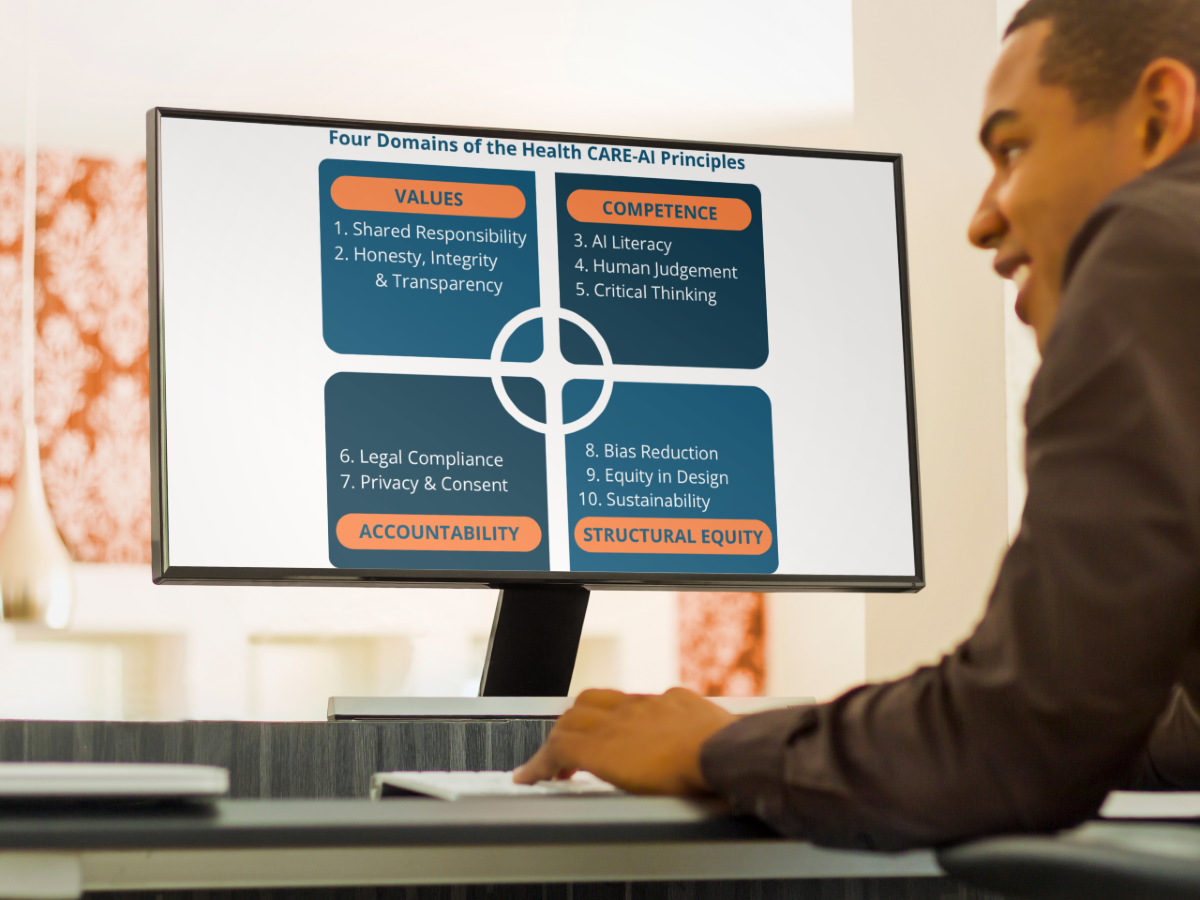
The Health CARE-AI Framework: 4 Domains, 10 Actionable Principles
Reported in accordance with the ACCORD (Accurate Consensus Reporting Document) guidelines, the Health CARE-AI Framework organizes 10 core principles into 4 interconnected domains:
- Values: Establishing AI use as a shared individual and collective duty while ensuring transparency, honesty, and integrity in AI-assisted care and learning.
- Competence: Committing to continuous, role-appropriate AI literacy and maintaining critical human judgment—ensuring AI complements rather than replaces clinical and educational decision-making.
- Accountability: Treating AI as a present “third party” during interactions, adhering strictly to legal, privacy, and consent boundaries, and practicing ethical data stewardship.
- Structural Equity: Actively identifying and mitigating algorithmic bias, embedding equity into AI design and governance through co-design with affected communities, and advancing environmental and workforce sustainability.
Designed for Immediate Real-World Application
Unlike static policy documents, the Health CARE-AI Framework is paired with a companion implementation guide and toolkit. The toolkit includes scenario-based applications across teaching, research, and governance, allowing medical schools, residency programs, and health system leaders to proactively evaluate their readiness, update curricula, and audit AI deployments.
As AI tools continue to redefine medical education and clinical workflows, the Health CARE-AI Framework offers a timely, validated compass to safeguard patient welfare, protect relational trust, and foster structural equity across global health systems.
Original article:
Sonnenberg L, Wiljer D, Mamdani M, Do V, Tang B, Haroon B, Jaffer B, Maniate J. Principles for Responsible AI in Health Professions Education, Research, and Care: Health CARE-AI (Contextual, Accountable, Responsible, and Equitable Artificial Intelligence) Framework Delphi Consensus Study. JMIR Med Educ 2026;12:e91626
URL: https://mededu.jmir.org/2026/1/e91626
DOI: 10.2196/91626
About JMIR Publications
JMIR Publications is a leading open access publisher of digital health research and a champion of open science. With a focus on author advocacy and research amplification, JMIR Publications partners with researchers to advance their careers and maximize the impact of their work. As a technology organization with publishing at its core, we provide innovative tools and resources that go beyond traditional publishing, supporting researchers at every step of the dissemination process. Our portfolio features a range of peer-reviewed journals, including the renowned Journal of Medical Internet Research.
To learn more about JMIR Publications, please visit jmirpublications.com or connect with us via X, LinkedIn, YouTube, Facebook, Bluesky, and Instagram.
Head office: 130 Queens Quay East, Unit 1100, Toronto, ON, M5A 0P6 Canada
Media contact: [email protected]
The content of this communication is licensed under the terms of the Creative Commons Attribution License (https://creativecommons.org/licenses/by/4.0/), which permits unrestricted use, distribution, and reproduction in any medium, provided the original work, published by JMIR Publications, is properly cited.