Triple shocks hitting AI semiconductors! NVIDIA lending risk…

On July 27, $PHLX Semiconductor Index (.SOX.US)$ the index fell nearly 5% intraday and closed down 2.23%. $NVIDIA (NVDA.US)$ dropped nearly 5%, $SanDisk (SNDK.US)$ plunged more than 11% (already down over 40% from its year-to-date high), $SK hynix (SKHY.US)$ declined over 7%, falling below its IPO price for the first time. $Micron Technology (MU.US)$$ASML Holding (ASML.US)$$Applied Materials (AMAT.US)$$Lam Research (LRCX.US)$ also saw broad selling pressure.

However, U.S. equities did not see a broad-based decline. $Apple (AAPL.US)$ rose against the trend, with some software and cloud-related companies posting notable gains. This suggests capital is not simply flowing out of the technology sector but is being reallocated within the AI supply chain.

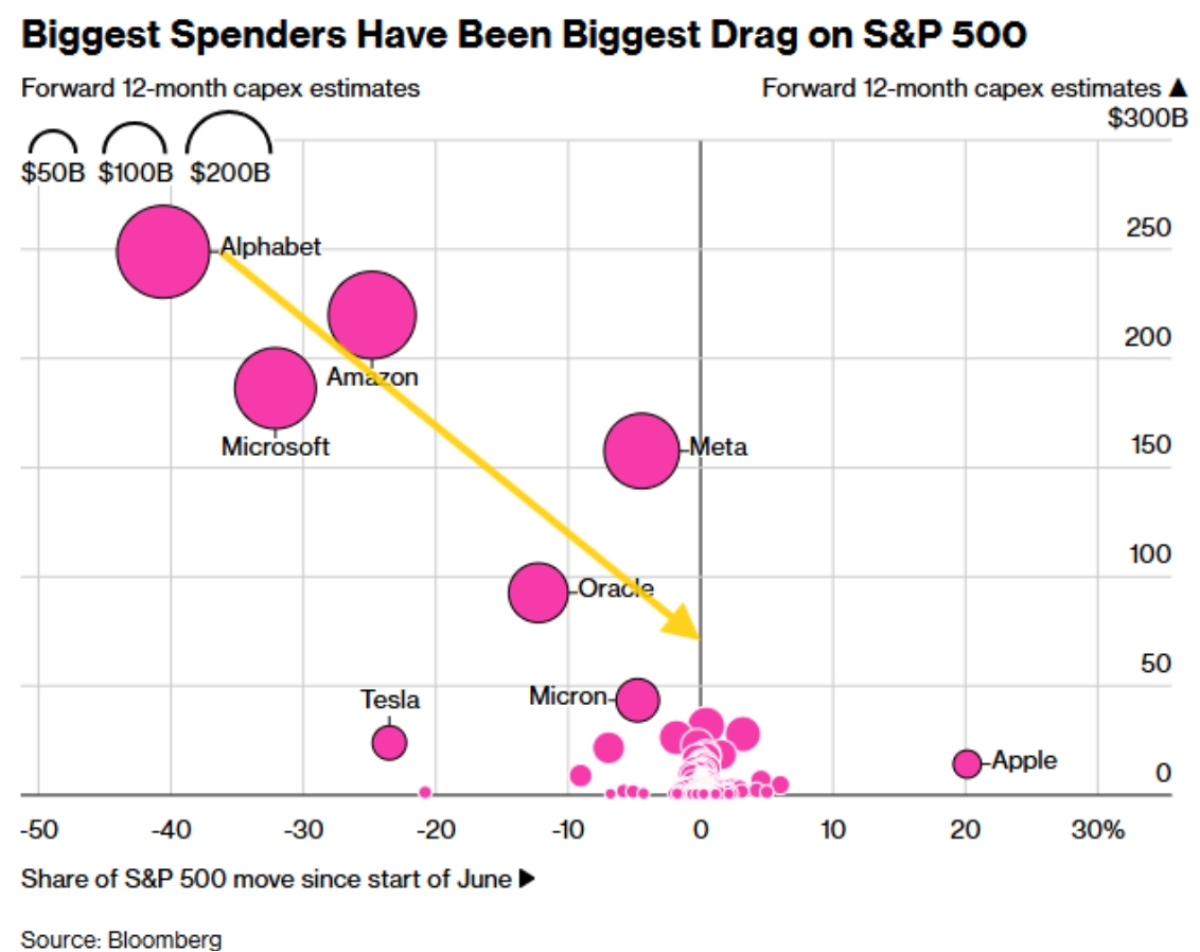
Another key observation is that since July, large-cap tech stocks’ returns have shown a clear inverse correlation with their projected capital expenditure over the next 12 months. Historically, the market interpreted upward revisions in capex as directly signaling higher demand for GPUs, servers, and data centers. Now, however, investors are beginning to ask whether these investments can actually translate into revenue, earnings, and free cash flow.

July 27, $PHLX Semiconductor Index (.SOX.US)$ The index fell nearly 5% intraday and closed down 2.23%. $NVIDIA (NVDA.US)$ dropped nearly 5%, $SanDisk (SNDK.US)$ plunged more than 11% (already down over 40% from its year-to-date high), $SK hynix (SKHY.US)$ fell more than 7%, breaking below its IPO price for the first time. $Micron Technology (MU.US)$ 、 $ASML Holding (ASML.US)$ 、 $Applied Materials (AMAT.US)$ 、 $Lam Research (LRCX.US)$ also saw broad selling pressure. However, U.S. equities did not see a broad-based decline. $Apple (AAPL.US)$ rose against the trend, with some software and cloud-related companies showing notable gains. This suggests capital is not simply flowing out of the technology sector but is being reallocated within the AI supply chain...

At the same time, polarization within the U.S. equity market has become increasingly evident.

The number of stocks with negative beta has risen markedly, and the correlation between the equal-weighted S&P 500 and the market-cap-weighted S&P 500 has fallen well below its long-term average. While the index appears stable on the surface, the drivers of its gains are becoming increasingly concentrated, and the market’s buffer is shrinking.

Therefore, what this recent sharp selloff truly reveals is not a sudden disappearance of AI demand. Rather, it reflects a shift in market sentiment—from the notion that ‘more capital expenditure is always better’ toward a more discerning focus on demand quality, supply dynamics, and return on invested capital.

A triple blow to AI hardware: simultaneous reassessment of demand, supply, and technological barriers

1. China’s largest DRAM maker$CXMT Corporation (688825.SH)$ ‘s mega IPO: Market concerns center on future production capacity

China’s largest DRAM maker, CXMT, launched its initial public offering (IPO) on the Shanghai Stock Exchange’s STAR Market—a board dedicated to high-tech and emerging firms—on the 27th.It surged approximately 466% on its debut day,reaching a market capitalization of roughly RMB 3.28 trillion, making itthe largest by market capin the A-share market. The IPO raised approximately USD 8.6 billion, making itIt became one of the largest in Asia this year.

The real reason behind the blow to overseas memory stocks is not merely that CXMT has already captured a large volume of orders. Rather, it lies in CXMT’s enhanced capabilities—bolstered by massive fundraising—to expand production capacity, invest in R&D, and adopt domestically produced equipment.approximately 8%and its monthly wafer-based production capacity is expected to reach 350,000 wafers by year-end, $Micron Technology (MU.US)$ gradually approaching [Company X]’s 375,000 wafers.

July 27, $PHLX Semiconductor Index (.SOX.US)$ The index fell nearly 5% intraday and closed down 2.23%. $NVIDIA (NVDA.US)$ dropped nearly 5%, $SanDisk (SNDK.US)$ plunged more than 11% (already down over 40% from its year-to-date high), $SK hynix (SKHY.US)$ fell more than 7%, breaking below its IPO price for the first time. $Micron Technology (MU.US)$ 、 $ASML Holding (ASML.US)$ 、 $Applied Materials (AMAT.US)$ 、 $Lam Research (LRCX.US)$ also saw broad selling pressure. However, U.S. equities did not see a broad-based decline. $Apple (AAPL.US)$ rose against the trend, with some software and cloud-related companies showing notable gains. This suggests capital is not simply flowing out of the technology sector but is being reallocated within the AI supply chain...

Moreover, according to reports, $Apple (AAPL.US)$ [Company Y] is testing and evaluating CXMT’s DRAM for certain devices sold in the Chinese market. While it cannot yet be said that AAPL has adopted CXMT’s chips at scale, this move signifies that CXMT has entered the supply chain evaluation process of a top-tier global customer. For AAPL, this could serve as leverage to diversify its supply chain and negotiate lower procurement prices.

However, CXMT’s initial impact will be on commodity DRAM, not immediately disrupting the HBM (High Bandwidth Memory) market.
HBM involves advanced DRAM processes, TSV (Through-Silicon Via) stacking, packaging, thermal management, and GPU platform certification. In this area, CXMT still lags behind Samsung and $SK hynix (SKHY.US)$$Micron Technology (MU.US)$ [Company Z] by roughly three to four years.

In other words, while the dominance of major players in commodity DRAM is beginning to waver, the market structure for HBM—the core AI memory—remains robust in the short term.

2. Mass production of Chinese-made DUV tools: Short-term valuation headwind, long-term weakening of barriers to ASML’s China business

According to a report by U.S. tech news outlet The Information, a Shanghai-based company backed by state-owned capital has begun limited production of immersion DUV (deep ultraviolet) lithography systems. The company aims to deliver five units this year and plans to ramp up to 20 units annually by 2027, with initial customers including SMIC, Hua Hong Semiconductor, and CXMT.

$ASML Holding (ASML.US)$ Compared to ASML’s approximately 131 immersion DUV shipments last year, domestically produced Chinese tools still face a significant gap in the short term. Longer-term validation will also be required regarding overlay accuracy, wafer throughput, operational stability, process software, and volume production yield.

However, what the market is pricing in is not near-term replacement volumes but rather long-term shifts in market share. Chinese customers account for$ASML Holding (ASML.US)$ approximately 29% of ASML’s revenue. If domestic DUV tools gradually capture orders tied to mature-node processes and certain memory capacity expansions, this would weigh on the long-term valuation of ASML’s China business.

As a result, ASML’s stock price initially plunged sharply, and the selling pressure spread across the entire supply chain—from European semiconductor equipment makers to U.S. equipment suppliers, memory manufacturers, wafer producers, and AI chip companies.

Therefore, what domestically produced DUV tools undermine is not ASML’s immediate position as the world’s leading lithography equipment maker, but rather the market expectation of its absolute monopoly in the Chinese market.The barriers ASML has built through its EUV (extreme ultraviolet) lithography systems, advanced-node capabilities, and global service infrastructure remain high.

3. NVIDIA’s loan guarantees: AI orders now subject to credit review

According to reports, $NVIDIA (NVDA.US)$ is in discussions to provide loan guarantees of up to approximately $250 billion for OpenAI’s planned 10GW data center.

At the heart of market concerns isthe fact that OpenAI has not yet established a stable cash flow sufficient to fund its massive infrastructure investments. When semiconductor suppliers also act as their customers’ investors, financial backers, or credit guarantors, it becomes necessary to reassess whether certain orders reflect genuine end demand or are instead driven by the suppliers’ own credit support.

Meanwhile, major cloud vendors are facing pressure from rising capital expenditures and deteriorating free cash flow. According to BofA estimates, the aggregate free cash flow margin of cloud vendors could turn negative in 2026 and decline further in 2027.

July 27, $PHLX Semiconductor Index (.SOX.US)$ The index fell nearly 5% intraday and closed down 2.23%. $NVIDIA (NVDA.US)$ dropped nearly 5%, $SanDisk (SNDK.US)$ plunged more than 11% (already down over 40% from its year-to-date high), $SK hynix (SKHY.US)$ fell more than 7%, breaking below its IPO price for the first time. $Micron Technology (MU.US)$ 、 $ASML Holding (ASML.US)$ 、 $Applied Materials (AMAT.US)$ 、 $Lam Research (LRCX.US)$ also saw broad selling pressure. However, U.S. equities did not see a broad-based decline. $Apple (AAPL.US)$ rose against the trend, with some software and cloud-related companies showing notable gains. This suggests capital is not simply flowing out of the technology sector but is being reallocated within the AI supply chain...

This does not mean AI demand is absent; rather, it indicates that market focus is shifting from ‘whether there are orders’

to ‘who will ultimately pay for these orders’ and ‘whether this capex will generate cash revenue.’

Actual smart money flows: Reducing tech positions does not mean abandoning semiconductor investments

According to Goldman Sachs data, in the eight weeks through July 16, net fund flows from hedge funds into U.S. information technology (IT) equities approached -10%, marking one of the most extreme selling paces in over a decade.

July 27, $PHLX Semiconductor Index (.SOX.US)$ The index fell nearly 5% intraday and closed down 2.23%. $NVIDIA (NVDA.US)$ dropped nearly 5%, $SanDisk (SNDK.US)$ plunged more than 11% (already down over 40% from its year-to-date high), $SK hynix (SKHY.US)$ fell more than 7%, breaking below its IPO price for the first time. $Micron Technology (MU.US)$ 、 $ASML Holding (ASML.US)$ 、 $Applied Materials (AMAT.US)$ 、 $Lam Research (LRCX.US)$ also saw broad selling pressure. However, U.S. equities did not see a broad-based decline. $Apple (AAPL.US)$ rose against the trend, with some software and cloud-related companies showing notable gains. This suggests capital is not simply flowing out of the technology sector but is being reallocated within the AI supply chain...

Semiconductors had also been extremely overheated. In June, global semiconductor stocks accounted foras much as 24%reached, and allocations to U.S. semiconductor stocks also14%rose to such elevated levels that any negative catalyst is likely to trigger concentrated profit-taking and unwinding of leveraged quant positions.

Following the correction, global semiconductor stock allocations have declined to approximately 19%, and U.S. semiconductor allocations have fallen to around 11%, significantly alleviating the most dangerous levels of overheating.

More importantly, net semiconductor trading flows have recently rebounded from low levels.This suggests that some capital has begun seeking re-entry opportunities again.

July 27, $PHLX Semiconductor Index (.SOX.US)$ The index fell nearly 5% intraday and closed down 2.23%. $NVIDIA (NVDA.US)$ dropped nearly 5%, $SanDisk (SNDK.US)$ plunged more than 11% (already down over 40% from its year-to-date high), $SK hynix (SKHY.US)$ fell more than 7%, breaking below its IPO price for the first time. $Micron Technology (MU.US)$ 、 $ASML Holding (ASML.US)$ 、 $Applied Materials (AMAT.US)$ 、 $Lam Research (LRCX.US)$ also saw broad selling pressure. However, U.S. equities did not see a broad-based decline. $Apple (AAPL.US)$ rose against the trend, with some software and cloud-related companies showing notable gains. This suggests capital is not simply flowing out of the technology sector but is being reallocated within the AI supply chain...

Naturally, this recovery in fund flows does not necessarily confirm a bottom for the sector; it may include short covering or passive rebalancing. Only when sustained inflows, an end to downward earnings revisions, and renewed technical stabilization all coincide can we confirm a resumption of trend-following buying.

The most likely actions smart money will take now are as follows:

Reduce overall tech equity exposure and exit the most overheated momentum trades, while maintaining AI exposure and shifting toward segments with higher barriers to entry and greater earnings visibility.

AI hardware bids farewell to across-the-board gains and enters an era of bifurcation

1. Short term: First, reduce volatility and wait for the negative feedback loop to subside

Currently, the technology and memory sectors are caught in a recursive downturn. Weak stock prices are prompting investors to reduce positions, which further reinforces concerns about an AI bubble, peaking cycles, and potential substitution by Chinese alternatives.

Until the sector reclaims key technical levels, rushing to buy simply because prices have fallen significantly still carries the risk of being caught in sharp volatility. From a portfolio perspective, moderately increasing exposure to assets with high dividends, short duration, and stable cash flows—such as large-cap value stocks—could help cushion the shock from deleveraging in AI hardware. $Vanguard Value ETF (VTV.US)$ continues to $Vanguard S&P 500 ETF (VOO.US)$ outperform

July 27, $PHLX Semiconductor Index (.SOX.US)$ The index fell nearly 5% intraday and closed down 2.23%. $NVIDIA (NVDA.US)$ dropped nearly 5%, $SanDisk (SNDK.US)$ plunged more than 11% (already down over 40% from its year-to-date high), $SK hynix (SKHY.US)$ fell more than 7%, breaking below its IPO price for the first time. $Micron Technology (MU.US)$ 、 $ASML Holding (ASML.US)$ 、 $Applied Materials (AMAT.US)$ 、 $Lam Research (LRCX.US)$ also saw broad selling pressure. However, U.S. equities did not see a broad-based decline. $Apple (AAPL.US)$ rose against the trend, with some software and cloud-related companies showing notable gains. This suggests capital is not simply flowing out of the technology sector but is being reallocated within the AI supply chain...

2. Cloud Vendors: Transitioning from Capital Expenditure to Cash Flow Inflection Point

Going forward, the tech sector will fully leave behind the era of across-the-board gains where ‘anything AI-related rises,’ and shift toward pronounced bifurcation driven by genuine fundamental validation.

Regarding cloud vendors, the market anticipates it will still take roughly two more years before free cash flow turns positive again. Over the coming quarters, investor sentiment will remain highly sensitive around this ‘cash flow inflection point.’

The most dangerous scenario would be one where capital expenditure continues to be revised upward while AI-related revenue realization remains limited, causing free cash flow to keep deteriorating. In contrast, if AI revenue sustains growth even as capex growth slows, the cash flow inflection point could become a significant catalyst for cloud vendors.

3. Memory: Shifting from Price Elasticity to Profit Stability

Turning to the memory segment, Morgan Stanley forecasts that the year-over-year increase in DRAM contract prices could peak around Q4 2026. This does not imply an immediate price decline, but rather suggests that the period of fastest profit growth is drawing to a close.

Future excess returns will depend on the earnings stability provided by long-term supply contracts and a market reassessment of valuations. Further validation through data over the coming quarters will be necessary to confirm this earnings stability and valuation reassessment, which together constitute the potential upside for memory stocks.

July 27, $PHLX Semiconductor Index (.SOX.US)$ The index fell nearly 5% intraday and closed down 2.23%. $NVIDIA (NVDA.US)$ dropped nearly 5%, $SanDisk (SNDK.US)$ plunged more than 11% (already down over 40% from its year-to-date high), $SK hynix (SKHY.US)$ fell more than 7%, breaking below its IPO price for the first time. $Micron Technology (MU.US)$ 、 $ASML Holding (ASML.US)$ 、 $Applied Materials (AMAT.US)$ 、 $Lam Research (LRCX.US)$ also saw broad selling pressure. However, U.S. equities did not see a broad-based decline. $Apple (AAPL.US)$ rose against the trend, with some software and cloud-related companies showing notable gains. This suggests capital is not simply flowing out of the technology sector but is being reallocated within the AI supply chain...

4. AI Infrastructure: Have Some Price Rally Cycles Just Begun?

More importantly, within the AI supply chain, certain infrastructure sub-segments—such as advanced liquid cooling and specific power management solutions—may have only just entered their price rally cycles.

These segments still offer significant room for upward earnings revisions.

Areas such as power connectivity, backup power systems, liquid cooling, 800G and 1.6T optical communications, CPO (co-packaged optics), advanced packaging, testing, high-end substrates, PCBs (printed circuit boards), and high-speed switches may still be in a phase of constrained production capacity and ongoing upward earnings revisions.

July 27, $PHLX Semiconductor Index (.SOX.US)$ The index fell nearly 5% intraday and closed down 2.23%. $NVIDIA (NVDA.US)$ dropped nearly 5%, $SanDisk (SNDK.US)$ plunged more than 11% (already down over 40% from its year-to-date high), $SK hynix (SKHY.US)$ fell more than 7%, breaking below its IPO price for the first time. $Micron Technology (MU.US)$ 、 $ASML Holding (ASML.US)$ 、 $Applied Materials (AMAT.US)$ 、 $Lam Research (LRCX.US)$ also saw broad selling pressure. However, U.S. equities did not see a broad-based decline. $Apple (AAPL.US)$ rose against the trend, with some software and cloud-related companies showing notable gains. This suggests capital is not simply flowing out of the technology sector but is being reallocated within the AI supply chain...

If AI hardware enters its next upswing phase, capital could preferentially flow into these ‘narrow-gate assets’—whose supply bottlenecks are harder to resolve and whose pricing cycles have been delayed.

On the other hand, $ASML Holding (ASML.US)$ Valuations should be assessed separately. EUV (extreme ultraviolet) lithography tools and global leading-edge process businesses will continue to enjoy scarcity premiums, whereas DUV (deep ultraviolet) lithography operations in China face a long-term discount due to domestic substitution efforts. Although domestically produced DUV tools won’t immediately alter ASML’s global dominance, they do dampen market expectations of perpetual monopoly in China.

Summary

At this point, there is insufficient evidence to conclusively prove that demand for AI computing power has fully reversed. What has genuinely changed is that the market no longer assigns uniform valuations across all AI-related capital expenditures.

Going forward, key investment themes will differ by segment: cloud vendors will focus on free cash flow inflection points; memory stocks on HBM (high-bandwidth memory), long-term contracts, and supply discipline; and infrastructure segments on pricing trends and capacity bottlenecks.

For investors, the critical question moving forward is no longer whether ‘AI will keep growing,’ but rather the following three more specific points.

Is demand genuine and backed by purchasing power? Can capital expenditures be converted into cash returns? Does the company possess barriers such as hard-to-replicate technology and a solid customer base?

The long-term AI trend remains upward, but the next wave of excess returns will come not from simply holding the entire AI hardware sector, but from selecting the right stocks and supply chain segments.

Source: moomoo, Market Public Documents

-moomoo News Sherry

This article uses partial automatic translation.

Similar Posts

Leave a Reply

Your email address will not be published. Required fields are marked *