From prototype to production in 3 days: How LS Manufacturing supports European hardware startups in their fast-paced development (Sponsored)
On the fast-moving European startup scene, it’s software companies who often dominate the news cycle talking about the quick turnaround of their products and the benefits of agile sprints. Though, a quieter and at the same time just as significant transformation is currently happening in the hardware industry.
According to the 2026 European DeepTech Report, venture capital funding for DeepTech and advanced hardware startups reached a historic high of €20.3 billion last year, representing 32% of all venture capital investment on the continent. However, whilst capital is flowing, a critical physical bottleneck remains: the speed of hardware prototyping and supply chain iteration.
Traditional manufacturing cycles still operate on timescales of weeks or months, leaving innovative startups vulnerable during crucial product development windows. This is where LS Manufacturing, a pioneering digital manufacturing partner specialising in civil and commercial high-precision components, steps in to rewrite the rules of hardware speed.
By combining advanced CNC machining, rapid prototyping workflows, and flexible sheet metal fabrication, the company enables European hardware innovators to transition from an initial CAD drawing to a production-grade physical prototype in just 72 hours.
“In high-growth sectors like electric vehicles and medical hardware, physical speed to market is the ultimate competitive advantage. Our mission is to eliminate the months of waiting by delivering production-grade prototypes directly to an engineer’s desk in three days,” said Gloria Wu, Director of Technical Support and Solutions at LS Manufacturing.
The hidden bottleneck: Why 3D printing is not enough
For years, the initial stage of hardware prototyping has relied heavily on additive manufacturing. Whilst 3D printing is an excellent tool for basic form-factor validation and aesthetic mock-ups, it regularly fails to meet the rigorous demands of real-world engineering testing.
Startups developing complex applications in MobilityTech, MedTech, and industrial robotics require prototypes that can withstand extreme mechanical stress, high temperatures, and strict chemical environments.
This is where high-precision CNC machining steps in. It differs from 3D printers in that it uses actual production-grade materials, such as aerospace-grade aluminium, copper, and stainless steel, as well as high-grade engineering materials such as PEEK and Delrin.
But sourcing the parts from conventional European machine shops is a huge drawback. Based on recent industrial statistics, approximately 84% of small-to-medium manufacturing companies in Europe are still using non-digitised processes.
To a startup, this means that the RFQ (Request for Quote) response may take days even before the three-to-four-week processing/development lead time for a couple of prototype parts. Where a delay of the first launch for even a month may result in the company being forced to file for bankruptcy, such analogue delays are definitely not a way to go.
High-precision CNC as the foundation of functional testing
In order to address this issue, LS Manufacturing has gone ahead and digitised the complete prototyping stage. Driven by their commitment to a short-turnaround time, the company offers high-precision CNC machining services that allow clients to experience the exact fit and feel of a final product.
The resulting prototypes are so precise, with a tolerance of just ±0.005 mm, that they are ideal for functional validation. This level of manufacturing accuracy is a necessary factor in the assembly of intricate mechanical systems, where a deviation of only a micrometre is enough to cause an entire system failure during bench testing of a physical setup.
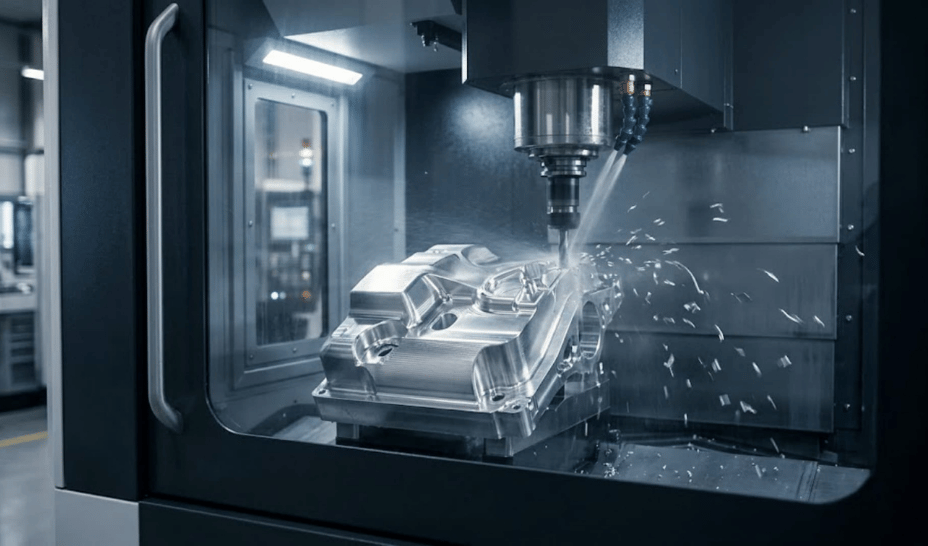
By utilising advanced 3-axis, 4-axis, and 5-axis CNC machining centres, the company can process complex geometries in a single setup. This significantly reduces the time required for manual repositioning and fixture adjustments, which is typically the most time-consuming aspect of traditional machining.
For startups, this means that parts such as custom heat sinks, complex optical housings, and structural drone arms can be machined, inspected, and shipped in less than 72 hours.
Furthermore, this rapid-turnaround capability does not sacrifice material integrity. Startups receive parts machined from certified, solid block materials, ensuring that the physical and mechanical properties of the prototype are 100% identical to the eventual mass-produced components.
Sheet metal fabrication: Completing the hardware enclosure
Rarely does a hardware product consist solely of machined internal parts. To bring a complete product to market, founders must also design and test the physical enclosures, chassis, and brackets that house these internal systems. This is where sheet metal fabrication plays a vital role.
Traditionally, sheet metal prototyping has been treated as a separate procurement process, forcing startups to coordinate with multiple vendors. LS Manufacturing removes this administrative burden by integrating sheet metal fabrication services with its precision machining capabilities.
Whether a team requires a simple mounting bracket or a complex, multi-bend electronic enclosure with custom PEM inserts, the combined workflow allows both internal CNC components and external sheet metal structures to be produced in parallel.
By utilising CNC laser cutting, CNC hydraulic bending, and rapid welding, sheet metal enclosures can be completed alongside the machined components, ensuring perfect fitment and assembly compatibility upon arrival.
Typical application: Accelerating EV thermal management development
To understand how this rapid-turnaround workflow functions in practice, consider the development of thermal management systems within the rapidly growing MobilityTech sector. A common challenge for startups developing electric vehicle (EV) battery packs or power electronics is the design of custom liquid cooling plates and battery distribution enclosures.
The liquid cooling plate requires intricate, high-precision internal fluid channels machined via CNC with absolute hermetic sealing, whilst the battery housing box requires robust, lightweight sheet metal fabrication to protect the cells from external impacts.
Under a traditional manufacturing model, a design engineer would wait several weeks to receive these two disparate parts. If physical testing reveals that the coolant flow rate is insufficient or the sheet metal bracket interferes with a wire harness, the design must be modified, and the multi-week waiting game begins anew.
Under the LS Manufacturing digital workflow, the process is streamlined into a single, cohesive 72-hour cycle:
- Day 1 (Digital DFM Analysis): The startup uploads their CAD files to the online platform. Within hours, the proprietary Design for Manufacturability (DFM) system analyses the geometries, identifies potential machining or bending issues, and provides immediate feedback to the engineers. Once approved, the job is queued for production.
- Day 2 (Parallel Production): The high-precision 5-axis CNC machines cut the complex aluminium liquid cooling plate, whilst the digital sheet metal department lasers and bends the enclosure chassis.
- Day 3 (Quality Control & Dispatch): The machined cooling plate undergoes rigorous coordinate measuring machine (CMM) dimensional checks and pressure leak testing. The parts are cleaned, deburred, and shipped via express courier, arriving at the startup’s European lab the following day.
By replacing sequential delays with parallel, digital production, hardware startups can execute three full design iterations in the time it would normally take to complete one.
Empowering European hardware sovereignty
As Europe strives to strengthen its technological sovereignty and build more resilient local supply chains, the ability to iterate hardware rapidly on home soil has never been more critical. By bridging the gap between digital software agility and physical manufacturing reality, LS Manufacturing is giving European hardware founders the tools they need to compete on a global scale.
In the world of hardware, the future belongs to those who can iterate the fastest – and with a 3-day turnaround, that future is already here.