Teleoperated Humanoid Robots Complete Surgeries in World-First Demonstration

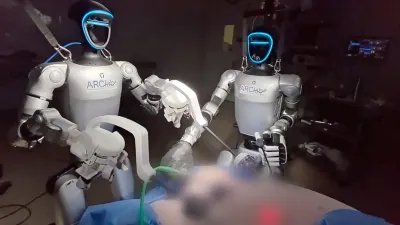
Two teleoperated humanoid robots completed two surgeries in a preclinical trial, according to a new report in Nature. The project was a collaboration between engineers and surgeons at UC San Diego.
This proof of concept is an early step toward bringing humanoid robots into operating rooms. In the study, a human-robot team removed a gallbladder, and two humanoid robots completed a surgery together on large non-primate mammals.
Unlike specialized robotic surgery systems that perform only one function, humanoid robots are versatile and could perform a wide range of procedures. They are also easier to deploy in remote and challenging environments, where versatility is important.
A shortage of surgeons and rising patient needs are causing longer wait times and reduced access to care, said Michael Yip, faculty member in the UC San Diego Department of Electrical and Computer Engineering and a senior author of the study. He explained that remotely operated and autonomous humanoid robots could expand access to critical surgeries.
“We aim to develop autonomous surgical assistants, since many communities face staff shortages that leave patients untreated. Our vision is a future operating theater where humanoid robots and humans work together to deliver care, both in hospitals and in field medicine,” said Yip.
Humanoid robots are much less expensive and require far less space than traditional systems, making them easy to deploy in settings ranging from rural communities to battlefields and even space. Traditional surgical robots are bulky, heavy, and require special operating rooms and large teams. In contrast, the humanoid robots used in this study, called Surgie, are lightweight, compact, and mobile. This makes them especially useful in remote or resource-limited areas.
Humanoid robots fit easily into operating rooms and can use standard surgical tools with adapters. Researchers said controlling them feels more natural, especially for those not trained on specialized systems. Procedures performed by teleoperated humanoid robots are just as precise as those done with traditional robotic systems. “We were surprised at how well Surgie meshed with our workspace and workflow,” said co-author Nikita Thareja, MD, a general surgery resident at UC San Diego School of Medicine.
Teleoperation still faces challenges. Robots needed several recalibrations during surgery, making procedures longer than with specialized systems. The team is working to reduce latency for remote operations. Researchers say Surgie could also fetch tools for surgeons and clean up after procedures.
“This study shows that humanoid robots have a viable future in the field of surgery,” said Yip. “You can imagine these robots being deployed in remote communities where staffing is challenging, or in austere environments like search and rescue scenarios where a massive deployment of field medicine is needed in a short period of time.”