China’s Biggest Chip IPO Isn’t Just About Chips. It’s Xi Jinping’s New Blueprint For Building Tech Giants | Explainers News
Last Updated:
For Beijing, CXMT is proof that the Chinese state can do what Silicon Valley’s venture capitalists have long done—identify, nurture and scale the next generation of tech champions




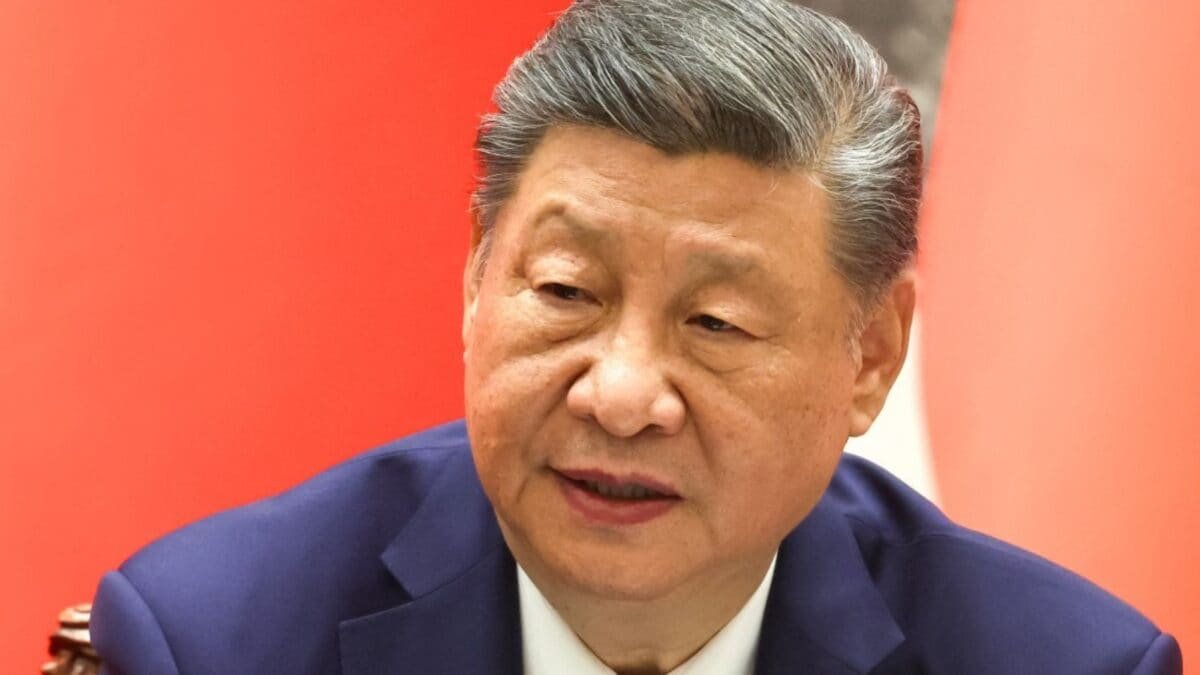
China seems to be following a different model. Instead of waiting for private venture capital to discover the next breakthrough company, President Xi Jinping’s government is actively trying to create one. (AFP Photo)
ChangXin Memory Technologies (CXMT) has done more than deliver one of the biggest stock market debuts in recent history. Its blockbuster IPO has become the clearest symbol yet of a profound shift underway in China — one that could change how the world’s next generation of technology companies is financed and built.
The Chinese memory-chip maker’s shares surged around 470% on their debut on Shanghai’s STAR Market, briefly giving it a market value of 3.3 trillion yuan (about $489 billion) and making it mainland China’s most valuable listed company. The IPO raised nearly 57.9 billion yuan ($8.6 billion), making it the largest listing on the STAR Market and Asia’s biggest IPO this year.
For Beijing, CXMT is proof that the Chinese state can do what Silicon Valley’s venture capitalists have traditionally done — identify, nurture and scale future technology champions.
Why The Chinese IPO Is A Much Bigger Story
On paper, CXMT’s debut looks like another blockbuster IPO driven by the global artificial intelligence boom. The company manufactures DRAM (dynamic random-access memory) chips, a crucial component used in AI servers, smartphones, personal computers and data centres.
But unlike many of America’s technology giants, CXMT did not grow primarily because private investors took a chance on an ambitious start-up. It grew because governments did.
When the company was founded in Hefei — the capital of Anhui province in eastern China, nearly a decade ago, the country’s ambition to build a globally competitive memory-chip industry was viewed as risky. Developing advanced semiconductors requires billions of dollars, years of research and no guarantee of success. Private investors were hesitant but Chinese governments were not.
Today, that early bet has turned into one of the most valuable technology companies in the country, and one of the clearest demonstrations of Beijing’s long-term industrial strategy.
Silicon Valley’s Playbook vs Xi Jinping’s Model
Private venture-capital firms raise money from investors, fund hundreds of risky start-ups, accept that most will fail and hope a handful become companies such as Nvidia, Google, Meta or Airbnb. Success depends on market forces deciding which ideas deserve capital.
But China seems to be following a different model. Instead of waiting for private venture capital to discover the next breakthrough company, President Xi Jinping’s government is actively trying to create one.
The state is no longer acting only as a regulator or provider of subsidies. Increasingly, it is functioning as a venture capitalist—deploying public money into strategically important sectors, accepting long investment horizons and betting that national priorities can produce globally competitive businesses.
“Rather than operating via a single entity, this public capital flows through a layered matrix of national funds, local investment vehicles, state-owned enterprises (SOEs) and privately managed funds. It is a system that converts top-down policy priorities into private-market bets, with an alternative perspective on what can be considered a return on investment,” according to a report by the South China Morning Post.
The Economist recently said Xi has “effectively” turned the Chinese government into one of the world’s largest venture-capital investors, reflecting a broader shift in how innovation is being financed.
“Silicon Valley runs on pension funds, endowments, and family offices that ultimately want a return within a definable window. China runs on state capital, over 90% of the committed pool at last count. Valley funds carry a limited-partner promise that pushes towards an exit in five to seven years; Beijing’s mandate is explicitly long-term, with no exit pressure priced into the fund structure. The goals differ completely. Valley money chases disruption, category creation, and internal rate of return. Chinese state capital chases self-sufficiency in semiconductors, quantum, aerospace, and advanced materials, categories the sovereign has flagged as strategic. One system is hunting for the next unicorn, sorted by return per dollar deployed. The other is building a supply chain that cannot be sanctioned into submission. Both architectures produce breakthroughs, and both have failure modes. Valley waste shows up in bankruptcies and down rounds; state-capital waste shows up in corruption probes and misallocated fabs,” said Tushar Badjate, Director, Badjate Stocks & Shares Pvt Ltd.
What Is ‘Investment With Chinese Characteristics’?
Rather than relying primarily on traditional venture-capital firms, China has built an ecosystem of state-backed financing that includes central government guidance funds, provincial investment vehicles, municipal governments and state-owned investment companies. Their objective goes beyond earning financial returns.
The goal is to accelerate China’s technological self-reliance in industries Beijing considers strategically essential, including semiconductors, artificial intelligence, robotics, biotechnology, electric vehicles and quantum computing.
Last year, state-backed investors supplied more than 90% of the committed capital in China’s private-equity market, which was a 79% in 2021, according to domestic data provider Zerone.
The South China Morning Post also underlined that the “order” came directly from the top, following a high-level national science and technology gathering in Beijing on July 8 where Xi asked financial capital firms to “invest early, invest small, invest for the long term and invest in hard technology”.
This approach has become even more important as tensions with the US have intensified. At present, the US semiconductor strategy towards China rests on two key objectives. The first is to strengthen domestic chip manufacturing and build a more secure supply chain. The second is to curb China’s influence over global semiconductor supply chains, ensuring Beijing cannot challenge America’s technological edge.
Why CXMT Became Beijing’s Showcase
Few companies illustrate this strategy better than CXMT. The company received substantial backing from Hefei’s municipal government and state investment funds long before it became commercially successful. One of its major shareholders is China’s National Integrated Circuit Industry Investment Fund—commonly known as the “Big Fund”—which was created specifically to strengthen China’s semiconductor industry. Hefei itself has emerged as one of China’s most aggressive investors in strategic technologies, previously backing companies such as display-maker BOE and electric-vehicle manufacturer Nio.
Those investments now look remarkably prescient. Financial Times reported that Hefei’s original investment has generated returns of roughly 5,000%, with its stake now worth close to 1 trillion yuan on paper after the IPO. What initially appeared to be an expensive industrial gamble has become one of the biggest investment successes in China’s technology sector.
Supporters argue that CXMT demonstrates how patient state capital can succeed where private investors may hesitate, particularly in industries requiring enormous upfront investment and years before profits emerge.
Can Governments Really Pick Winners?
Supporters of China’s approach argue that governments are often better placed to finance technologies with long development cycles that private investors may avoid because of uncertain returns. State-backed investment can also help countries reduce dependence on foreign suppliers, pursue strategic objectives beyond quarterly profits and withstand geopolitical shocks such as US export restrictions.
Critics remain unconvinced. They argue governments often allocate capital less efficiently than markets, risk favouring politically connected companies over commercially superior ones and may discourage private investment by dominating entire sectors. They also warn that one spectacular success does not prove the model can consistently produce world-class innovators.
Even analysts who praise CXMT caution that its extraordinary valuation reflects exceptional circumstances, including strong AI-driven demand for memory chips, limited tradable shares and intense investor enthusiasm. Whether similar results can be replicated across other sectors remains uncertain.
“Right place, right shortage. CXMT’s Shanghai debut surged 466%, briefly pushing its market capitalisation past $500 billion in a single session… AI-driven server demand has choked global DRAM supply through 2025 and 2026, and CXMT was already the world’s fourth-largest DRAM producer with roughly 8% of global shipments before it listed, sitting behind Samsung, SK Hynix, and Micron. A decade of Hefei city and Big Fund capital, with state-linked entities holding close to half of the pre-IPO equity, built the fabrication capacity. The AI capex cycle then handed the company its listing window. This was not a lucky print. It was patient capital positioned into a supply crunch it did not create but was structurally ready to serve. The read-through is that when a strategic buyer of scale needs the output and the sovereign can carry losses through the build-out, listing timing becomes an execution variable, not the thesis itself,” explains Badjate.
Can India Learn From China’s Playbook?
India is pursuing its own semiconductor ambitions through the India Semiconductor Mission, production-linked incentives and public investment aimed at attracting chip manufacturing and strengthening its AI ecosystem. That makes China’s experiment particularly relevant.
So, it is not essentially about which country will build the most advanced chips. It is about which country can build the most effective system for creating technology companies in the first place.
“China spent more than a decade and hundreds of billions of yuan across three Big Fund tranches before this listing even happened. That’s the part observers tend to skip. India’s semiconductor push under the ISM (India Semiconductor Mission) is real and directionally correct. But the committed sovereign capital in the first phase sits an order of magnitude below what Beijing put in play,” points out Badjate.
India can “absolutely build that stack, but it requires holding the policy line through changes in political cycle,” said Badjate. India also needs to accept that a fabrication ecosystem takes close to 10 years before the first commercially competitive output arrives. “Copy the patience and the persistence. There is no shortcut version of this playbook that delivers the same result in half the time.”
About the Author

Shilpy Bisht is a News Editor at News18, where she leads the English app operations. She writes on world affairs, health, AI, career, business, and issues affecting women and children. A former print …Read More

Stay Ahead, Read Faster
Scan the QR code to download the News18 app and enjoy a seamless news experience anytime, anywhere.