
Business Resilience vs. Business Continuity: Key Differences
When disruption happens, business continuity and resilience are essential, but they are not the same.
When the term resilience first made its appearance more than two decades ago, the business continuity (BC) community wondered if it meant the end of the term business continuity and of the profession that has been around since the 1980s. In the years since its emergence, resilience has become an increasingly important factor in how business and government organizations operate.
Resilience has evolved into a key component of the overall business and government survivability landscapes, whereas BC remains an important operational activity that is often used interchangeably with business resilience.
What is business resilience?
Business resilience is an organization’s ability to adapt and recover to disruption without affecting the delivery of products or services.
A resilient business has the people, culture, procedures, technology, facilities and more to return to its previous state of operation. This can happen after an event that might otherwise disrupt or shut down the firm.
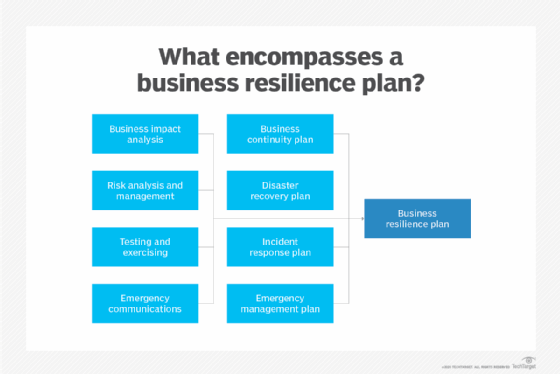
An organization can deliver resilience using the following techniques:
- BC management.
- Technology disaster recovery (DR).
- Incident response and management.
- Emergency management.
- Business impact analysis (BIA).
- Risk management.
- Testing the plan and associated technologies.
- Emergency communications.
- A culture of resilience embraced by employees.
- Senior leadership committed to resilience.
A business resilience plan, also referred to as an organizational resilience plan, results from the collaboration and blending of the above activities and their outcomes into a concise plan.
The flavors of resilience
Organizational resilience and operational resilience are among the current implementations of resilience.
At the moment, much of the attention focuses on organizational resilience, which addresses the entire organization, its people, culture, business processes, technology infrastructure and physical facilities. The idea is to link all relevant elements of an organization into a cohesive unit that can collectively regroup, recover and modify as needed and resume operations following an incident.
By contrast, operational resilience focuses more on actual business processes, such as an assembly line the organization uses to prepare its work product. Although the terms seem to be separate entities, it makes more sense to position operational resilience as a necessary component of organizational resilience.
Another variant, supply chain resilience, defines steps to ensure that supply chains can be quickly recovered and returned to their normal functions. The concept also enables changes to the supply chain that can provide yet more survivability.
What is business continuity?
Business continuity is an organization’s ability to maintain or restore operations during and after disruption.
In practice, BC merges a number of specific activities — DR and incident management, for example — into a holistic approach that establishes a series of internal and external activities an organization can initiate to respond to an incident, recover from the situation and resume business operations to an acceptable level. When this level of activity is achieved, the organization can notify its employees and stakeholders that it has resumed business operations.
What are the differences between business resilience vs. business continuity?
Business continuity is a set of procedures that help an organization return to operational status and resume providing products and services after a disruption. Business resilience is the organization’s ability to absorb the effects of a disruption and adapt to a new way of operating that meets the needs of management, employees and stakeholders.
In simpler terms, business continuity focuses on getting back to normal operations, while business resilience focuses on adapting and thriving in the new normal.
Figure 1 provides a visual comparison of the two terms.
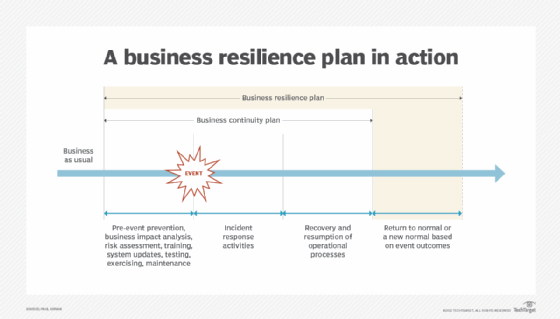
Continuity and resilience plans
Though business resilience and business continuity are often considered in tandem, there are key differences, including the following:
- Scope. Business continuity focuses on recovery, while business resilience takes a broader view, with a focus on long-term adaptation.
- Outcomes and goals. Business continuity focuses on restoring business operations as quickly as possible, while business resilience has a stronger focus on recovery and long-term effects.
- Culture. Business continuity primarily considers processes and procedures, while business resilience takes into account leadership and decision-making.
Creating a business resilience plan can be as simple as redefining a business continuity plan, as most of the activities are the same. Key goals in a business resilience plan include the following:
- Identifying how the business should function following the event.
- Defining how the business anticipates the potential of an incident and prepares for it.
- Determining alternate or interim methods of operating the business.
- Recognizing the effect of company culture on business recovery.
Standards for resilience
Two standards currently define and establish methods for achieving resilience. The first standard, ASIS SPC.1-2009, Organizational Resilience: Security, Preparedness, and Continuity Management Systems — Requirements with Guidance for Use, dates back to 2009 and was developed by ASIS International. It uses the management system model used by other standards organizations, such as ISO. The second, more recent resilience standard is the ISO 22316:2017, Security and Resilience.
One of the key differences between business resilience and business continuity standards is the importance of anticipating potential disruptions instead of simply responding to them.
How emerging risks are changing business continuity and resilience
Organizations face a much broader range of challenges than they did a decade ago. From the AI boom to supply chain disruption, business continuity and resilience have never been so important.
While business continuity remains focused on restoring operations following disruption, business resilience has evolved to help organizations anticipate change. Some of the biggest drivers of this shift include the following:
- AI. As businesses around the world grapple with AI for the enterprise, continuity plans must address potential AI failures and outages, while resilience plans establish regulatory frameworks and guardrails to keep data safe.
- Climate change and extreme weather. Floods, fires and extreme heatwaves are becoming more common and pushing organizations to consider how to operate as the environment changes. Business continuity plans focus on maintaining operations during individual events, while business resilience may involve relocating facilities or even diversifying suppliers
- Supply chain disruption. The last few years have seen major events, such as the COVID-19 pandemic and geopolitical conflicts like the closure of the Strait of Hormuz, that have drastically affected the supply chain. Business continuity helps organizations respond, whereas resilience focuses on reducing dependency through supplier diversification.
How are business resilience and business continuity similar?
Business continuity and business resilience plans share some similarities, including the following:
- Similar analytical processes, such as BIA and risk analysis.
- Both include response and recovery procedures.
- Both provide initiatives to support operational preparedness.
Business continuity provides procedures to return critical business functions, systems, facilities where the work is done and the people that support them to a state where the organization can fulfill its commitments and obligations. These activities are part of an overall program to ensure the organization can minimize the chances of an incident and — if one does occur — has the resources, culture and commitment to mitigate the event, recover, survive and prosper.
Business resilience builds on each of the activities noted above to return the organization to normal operations.
Why you need a business resilience plan and how it works
For organizations committed to protecting their ability to function, especially following a disruptive event, a business resilience plan built on a BC foundation could be the answer. Before reaching that point, however, ensure the various plans and activities listed earlier in this article are developed and regularly exercised to ensure they fulfill their specific objectives.
A business resilience plan should not be viewed as a static document. Instead, it should be treated as an ongoing program. Regular testing, reviews and updates help ensure that plans remain effective as new challenges emerge, from cyber threats and supply chain disruption to climate-related events and technology changes, such as AI.
Key elements of a business resilience plan include the following:
- Assess vulnerabilities and risks to review exposure and identify weaknesses.
- Establish executive-level resilience governance and define resilience objectives.
- Prepare for multiple disruption scenarios.
- Invest in visualization tools, real-time visibility platforms and risk assessment dashboards.
- Testing, regular reviews and ongoing goal setting.
Perhaps a key aspect of a business resilience plan is defining the organization’s end state following the completion of all relevant recovery and resumption processes. It’s easy to say an organization has recovered from an incident. But does that mean it’s resilient? Ultimately, the organization must determine what constitutes a state of resilience.
Editor’s note: Paul Kirvan originally wrote this article, and Rosa Heaton has expanded it to reflect changes in the market.
Paul Kirvan, FBCI, CISA, is an independent consultant and technical writer with more than 35 years of experience in business continuity, disaster recovery, resilience, cybersecurity, GRC, telecom and technical writing.
Rosa Heaton is a content manager and writer for the IT Strategy team at TechTarget.