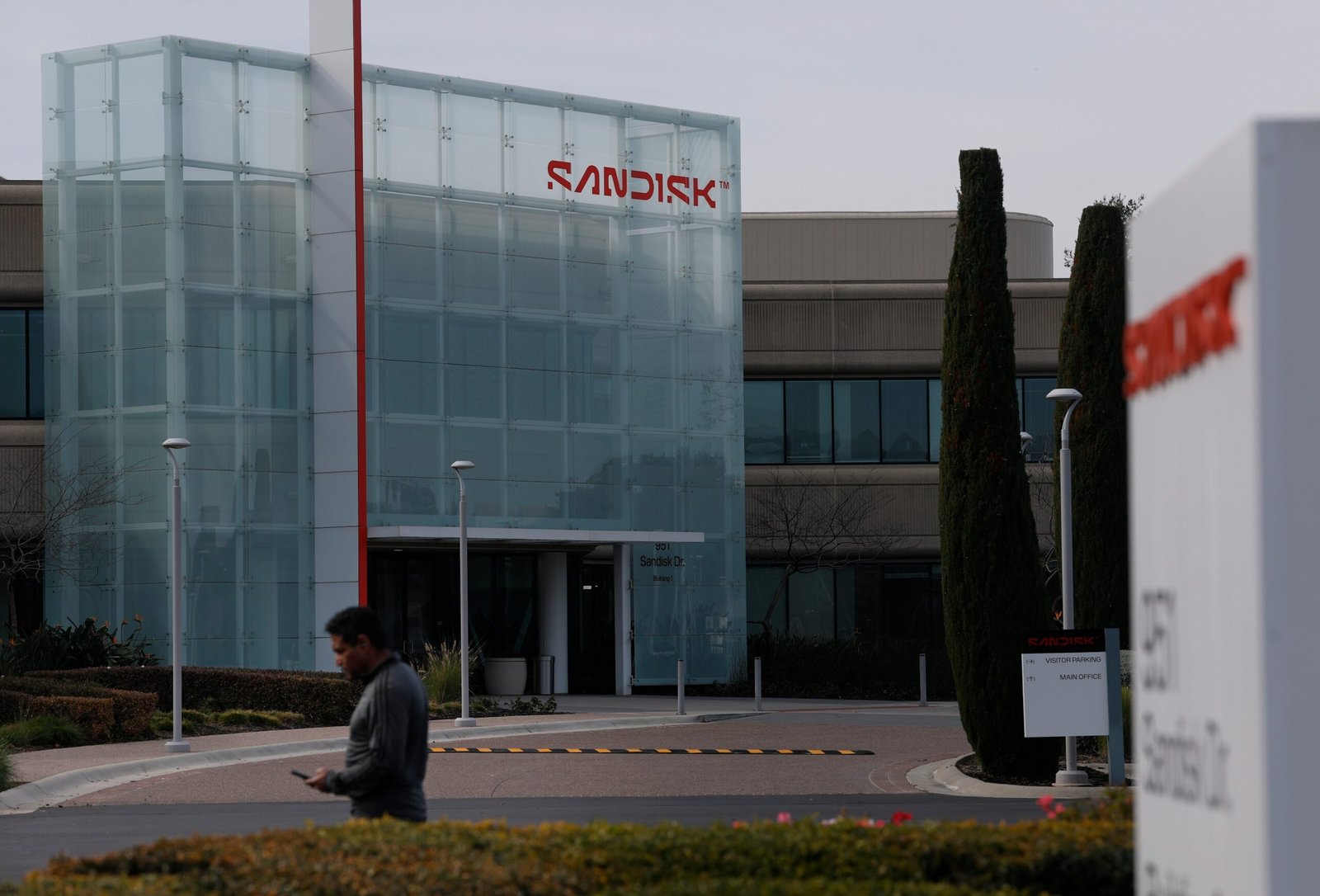
SanDisk Sinks 35% on CXMT IPO: Wall Street May Have Confused NAND With DRAM
SanDisk Corporation (NASDAQ: SNDK) has handed shareholders one of the sharpest sell-offs any pure-play memory stock has produced in years — more than 35% erased over four trading sessions triggered by an IPO in Shanghai that has nothing to do with SanDisk’s actual product line. The decision facing investors on August 5, when SanDisk reports fiscal fourth-quarter results, is not whether the AI memory boom is cracking. It is whether Wall Street has correctly identified which company China’s new chip giant actually threatens.
CXMT Made Its Name in DRAM, Not NAND
The panic’s originating event was real and dramatic: ChangXin Memory Technologies (CXMT), China’s largest DRAM maker, debuted on Shanghai’s STAR Market on July 27 and promptly surged 466% from an IPO price of ¥8.66 (approximately $1.28) to close at ¥49 (approximately $7.24), catapulting its market capitalization to approximately ¥3.3 trillion (approximately $487 billion) — confirmed by Reuters, AP, and CNBC coverage. That made CXMT the most valuable company listed on any mainland Chinese exchange on its first day — surpassing banks, internet companies, and established chipmakers — having raised approximately ¥57.92 billion (approximately $8.6 billion) in what became Asia’s largest IPO of 2026 and the largest Chinese semiconductor listing in the history of the STAR Market.
Then markets caught a case of category confusion. CXMT manufactures DRAM — Dynamic Random Access Memory, the volatile, ultra-fast working memory that processors use for active computation. Every AI server, every laptop, and every smartphone contains DRAM chips alongside its storage. SanDisk makes something structurally different: NAND flash memory, the non-volatile storage medium inside enterprise solid-state drives (SSDs), memory cards, and the high-capacity storage arrays that hold AI model weights, training datasets, and persistent knowledge bases. A data center needs both simultaneously. Gaining more DRAM supply from China does not reduce NAND demand by a single gigabyte.
CXMT held approximately 7.67% of the global DRAM market as of late 2025, according to its IPO prospectus — making it the world’s fourth-largest DRAM producer. It competes directly with Micron Technology, which holds approximately 24% of global DRAM, and SK Hynix, which controls approximately 29%, as confirmed by market share data reported during the CXMT debut. SanDisk, which was spun off from Western Digital in February 2025 and does not manufacture a single DRAM chip, belongs to an entirely different supply chain.
How NAND and DRAM Actually Work — and Why They Do Not Compete
The sell-off makes sense only if you believe DRAM and NAND are interchangeable. They are not, at any level of the technology stack.
DRAM stores data by trapping electrical charge in capacitors. Because capacitors discharge continuously, DRAM requires millisecond electrical refresh cycles to retain information — which is why it loses all data the moment power is cut. That volatility is the tradeoff for DRAM’s defining advantage: nanosecond access times fast enough for a processor to read directly. HBM (High Bandwidth Memory) — the stacked DRAM variant that connects directly to GPU packages for AI training — is the highest-value DRAM segment, and Samsung, SK Hynix, and Micron hold virtually all global HBM supply. CXMT has targeted 2027 for HBM capability, putting it approximately three years behind the leaders.
NAND flash works differently: charge is trapped in floating-gate transistors or charge-trap structures and held there without power for years. That non-volatility makes NAND ideal for storage but too slow for direct processor access — reads occur in microseconds, not nanoseconds. SanDisk’s enterprise SSDs serve as the persistent storage layer: they hold AI model weights, training datasets, retrieval-augmented generation (RAG) knowledge bases, and the KV-cache records that large-language models use to remember context within long conversations.
SanDisk’s tenth-generation 3D NAND — BiCS10, developed jointly with manufacturing partner Kioxia — stacks 332 layers of memory cells using a technique called CMOS Bonded to Array (CBA), achieving 1 terabit per chip at a bit density of 29 Gb/mm², a 59% improvement over the prior generation, as confirmed by the official BiCS10 sampling announcement. Interface speed reaches 4.8 Gb/s, 33% faster than BiCS8. A QLC variant of BiCS10 (Quad Level Cell, four bits per transistor rather than three) targets SanDisk’s Stargate enterprise SSD platform, which is purpose-built for AI data lakes and inference workloads where sustained sequential throughput matters more than peak burst performance.
None of this architecture intersects with CXMT’s DRAM roadmap.
What Triggered the Sell-Off — and What Made It Worse
The sell-off began July 27 when CXMT’s debut drew investor attention to the general proposition that Chinese chipmakers are advancing faster than expected. It deepened substantially on July 28 when a separate report emerged that China had begun mass-producing domestic deep ultraviolet (DUV) lithography equipment — a core tool in semiconductor manufacturing whose domestic production would, if scaled, reduce Chinese chipmakers’ dependence on Dutch equipment giant ASML — as covered in reporting on the Korea market collapse. That news hit South Korea especially hard: Samsung Electronics fell approximately 13% and SK Hynix dropped approximately 14.7% that day, driving South Korea’s KOSPI index down 10.84% to 6,023.66 — its sharpest single-day fall since March — triggering a circuit breaker that halted trading for 20 minutes, as documented in coverage of the July 28 market halt. Japan’s Nikkei 225 declined 3.95% in the same session.
On July 29, the damage extended further. SK Hynix reported record second-quarter 2026 profits — and still missed analyst consensus, deepening fears about the sector’s valuation expectations. The KOSPI triggered a second consecutive circuit breaker, a historic first for the exchange. In the United States, SanDisk shares had now shed approximately 35% from their Thursday-evening close before the sell-off began.
Micron Technology, Western Digital, and SK Hynix ADRs also fell sharply — losses that make direct competitive sense given CXMT’s DRAM ambitions. SanDisk’s participation in the same sell-off reflects sector contagion rather than competitive logic.
Analysts noted that investor anxiety extended beyond pricing dynamics to broader AI economy health: the concern is not just whether SanDisk can sustain high NAND prices, but whether AI companies will continue spending aggressively on infrastructure at all.
Bull Case: $42 Billion in Committed Revenue and Margins Wall Street Rarely Sees
Before the sell-off began, SanDisk’s fiscal third-quarter 2026 results had set an extraordinary baseline. Data center revenues surged 233% sequentially to $1.47 billion, driven by enterprise SSDs. Adjusted gross margin reached 78.4%. The company authorized a $6 billion share repurchase program, reported $3.74 billion in cash, and eliminated its debt entirely. For fiscal Q4, management has guided revenue of $7.75 billion to $8.25 billion with adjusted EPS of $30 to $33 — well above the $5.95 billion posted in Q3.
The structural story, however, lies in what SanDisk calls its New Business Model (NBM) supply agreements — a contracting innovation that changes the cyclicality risk profile investors typically associate with commodity memory companies. SanDisk disclosed three NBM partnerships in Q3 FY2026 and two more early in Q4, together providing more than $42 billion in minimum contractual revenues backed by financial guarantees exceeding $11 billion. The significance of those guarantees is structural, not cosmetic: prior-generation memory companies had take-or-pay contracts that sometimes left them exposed when customers invoked force majeure clauses or renegotiated at cycle bottoms. Financial guarantees exceeding $11 billion mean customers owe SanDisk money regardless of whether they take delivery, substantially muting downside in a price collapse scenario.
Bernstein raised its SanDisk price target to $3,000 and maintained an Outperform rating, modeling a worst-case scenario — a memory price collapse more severe than the 2010 downturn — and concluded the NBM agreements would significantly mute earnings downside in 2029 and 2030, estimating a contract floor price of approximately $0.29 per gigabyte.
Goldman Sachs analyst James Schneider raised his target to $2,200 and reiterated a Buy rating ahead of the August 5 earnings release, citing “very strong quarter” expectations driven by continued NAND supply tightness and positive customer agreement signals from Micron’s comparable quarter. Bank of America analyst Wamsi Mohan raised to $2,500 (Buy), expecting strong pricing conditions to extend through mid-2027.
Zacks Investment Research rates SNDK a Strong Buy, arguing the sell-off appears driven by sentiment rather than any genuine deterioration in business fundamentals.
Why KV Cache and AI Inference Are Still Growing NAND Demand
A separate data point in the bull case addresses future structural demand rather than current-cycle pricing. SanDisk management has estimated that NVIDIA’s KV-cache architecture alone — the mechanism by which large-language models store context within inference sessions — could drive 75 to 100 incremental exabytes of NAND demand in 2027, with potential doubling in 2028. That demand is additive to the existing enterprise SSD market, not a replacement for it.
Retrieval-Augmented Generation (RAG) further expands NAND demand as AI deployments add persistent knowledge bases. At the Mizuho Technology Conference in June 2026, SanDisk CEO David Goeckeler noted that enterprise solid-state drives — including high-capacity drives for cloud and AI data centers — had grown approximately seven times year-over-year and approached 25% of total revenue.
None of this demand is served by CXMT.
What the Options Market Sees
For investors assessing entry risk, the derivatives market frames the range clearly. From a post-sell-off price near $1,278, traders were pricing approximately a 68% probability that SNDK would trade somewhere between approximately $430 and approximately $3,793 over the next twelve months — implying a plausible path to falling 66% or gaining nearly 197% from that level. Implied volatility of approximately 115% was running at roughly 1.03 times the stock’s realized volatility of approximately 111% over the past year, meaning options traders expect this stock to continue behaving as it already has — with extraordinary movement in either direction.
Notably, traders were paying approximately 2.3 times as much for upside speculation as for downside protection at those levels — a meaningful directional lean toward the bull case even amid the turmoil.
Options traders are also pricing a 25% move in either direction specifically on the August 5 earnings release, well above SanDisk’s average post-earnings move of 8.75% over the prior four quarters — signaling the market expects the quarterly result to be a decisive catalyst rather than a routine confirmation.
$1,000 Is the Number Retail Traders Are Watching
On Stocktwits and related platforms, the $1,000 price level has become the primary focus of retail trader attention. SNDK touched an intra-day low near $1,050 before recovering partial losses in recent sessions, while retail sentiment shifted from bearish to neutral even as message volume spiked approximately 900% over a 24-hour period. From a technical standpoint, unless SNDK quickly reclaims the $1,300 area, analysts identify the next major support level near $1,000 — a threshold whose breach could trigger algorithmic and stop-loss selling at a time when investor sentiment is already fragile.
What August 5 Will and Will Not Settle
SanDisk reports fiscal Q4 2026 results after the market closes on August 5. Analysts expect adjusted EPS of approximately $33 to $35 and revenue approaching $8.42 billion — a 343% year-over-year increase — compared with management’s own guidance of $7.75 billion to $8.25 billion and EPS of $30 to $33. SanDisk has exceeded its own quarterly guidance in each of the past four quarters. If the pattern holds, the report itself becomes a test of whether fundamentals can overpower sentiment.
The earnings call will likely address NAND pricing trajectory, enterprise SSD demand visibility, gross margin sustainability, BiCS10 production ramp timing, and any commentary on the competitive threat — or lack thereof — posed by CXMT’s DRAM capacity expansion. On August 13, an investor day will give management the opportunity to detail the longer-term NBM supply agreement model and its implications for earnings predictability through the next memory cycle.
What August 5 will not settle is whether CXMT’s DRAM ambitions eventually extend into NAND. Chinese manufacturers have demonstrated immersive NAND production ambitions alongside their DRAM push, and the emergence of domestic DUV equipment production signals a broader drive toward semiconductor self-sufficiency across all memory categories. That long-term possibility is a legitimate risk worth monitoring. It is not what happened last week.
Wall Street’s consensus price target for SNDK implies more than 100% upside from mid-sell-off levels, and not one analyst cut their price target during the three-day rout. That unanimity does not guarantee a recovery — but it does indicate that the people paid to model SanDisk’s business do not see what happened in Shanghai last week as a reason to change the model.
Exchange rates as of July 29, 2026; conversions are approximate.
Frequently Asked Questions
Why did SanDisk stock fall if CXMT makes DRAM and SanDisk makes NAND?
SanDisk fell because of sector contagion, not direct competition. When CXMT’s IPO signaled that Chinese chipmakers are advancing faster than expected, investors sold memory and storage stocks broadly — including SanDisk — even though CXMT’s DRAM business does not compete with SanDisk’s NAND-only product line. The distinction matters: a data center uses both DRAM (for active computation) and NAND (for persistent storage) simultaneously. More DRAM from China does not reduce demand for NAND. The sell-off deepened on July 28 when a separate report emerged that China had begun mass-producing domestic DUV lithography equipment, and again on July 29 when SK Hynix missed analyst earnings consensus despite a record quarter.
What makes SanDisk’s supply agreements different from standard memory contracts?
SanDisk’s New Business Model (NBM) agreements go beyond standard take-or-pay contracts by including financial guarantees — meaning customers owe SanDisk payment regardless of whether they take physical delivery. The company has disclosed more than $42 billion in minimum contractual revenues backed by financial guarantees exceeding $11 billion across five agreements signed in fiscal Q3 and Q4 FY2026. Bernstein’s analysis suggests that even in a worst-case memory price collapse — more severe than the 2010 downturn — these floors would significantly limit SanDisk’s earnings downside in 2029 and 2030. This is the structural change in cyclicality risk that distinguishes SanDisk from prior-generation NAND companies.
What is the CXMT limitation that the IPO surge does not show?
CXMT currently holds approximately 7.67% of global DRAM and faces a 30% cost-per-bit disadvantage versus Samsung and SK Hynix, according to Morningstar’s analysis of CXMT’s cost structure. It also uses DUV (deep ultraviolet) lithography rather than EUV (extreme ultraviolet), which limits its ability to scale to the most advanced process nodes. Most significantly, CXMT is approximately three years behind Samsung and SK Hynix in High Bandwidth Memory (HBM) — the stacked DRAM variant most critical for AI training workloads. The DoD’s direct procurement ban on CXMT-linked entities took effect June 30, 2026, and all federal agencies face a procurement ban on CXMT semiconductors beginning December 23, 2027, under Section 5949 of the FY2023 National Defense Authorization Act. China’s National Intelligence Law requires all organizations under its jurisdiction to cooperate with state intelligence authorities on demand — a fixed legal condition regardless of CXMT’s stated corporate policies.
Should investors buy SanDisk stock before August 5 earnings?
This article does not provide investment advice, and the decision depends on individual risk tolerance. What the reporting establishes is that the sell-off’s stated cause — CXMT’s DRAM expansion — does not directly threaten SanDisk’s NAND business. Whether the sell-off also reflects legitimate concerns about AI infrastructure spending cycles, broader semiconductor valuation compression, or China’s long-term ambitions in NAND as well as DRAM are separate questions that August 5 results and management commentary will help answer. Options traders are pricing a 25% move in either direction on the earnings release — reflecting genuine uncertainty about which narrative prevails. Investors should consult a qualified financial professional before making any investment decision.
This article is for informational purposes only and does not constitute financial advice. All investment decisions should be made in consultation with a qualified financial professional.