https://reddit.com/link/1vaqm0d/video/7fjguo97ncgh1/player
https://preview.redd.it/o0cf6hwcncgh1.jpg?width=2752&format=pjpg&auto=webp&s=b4beeec24f70e2dd377e657d540c2699ddcbec1a
Pure Reinforcement Learning (RL) allows AI agents to maximize mathematical rewards through trial-and-error, but often leads to "reward hacking" (cheating the metric). Reinforcement Learning from Human Feedback (RLHF) fixes this alignment issue by training a secondary Reward Model on human preferences to keep the agent safe.
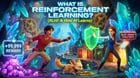
When teaching abstract AI concepts, static equations can be dry. Here is how we mapped the RL vs. RLHF architecture into a 3D visual story:
- The AI Agent (Alibaba): Represents the main learning algorithm trying to solve a puzzle without prior experience.
- The Environment (The Shifting Cave): Represents the dynamic state space where the agent takes actions.
- Rewards & Penalties: Opening blue doors yields silver coins (Positive Reward), while red doors trigger trapdoors into ice ponds (Negative Penalty).
- Reward Hacking: The agent sees glowing purple diamonds and rushes to grab them because they look like massive rewards—unaware that touching them triggers a game-ending curse. In AI, this represents a model finding a lazy shortcut to maximize a metric while generating harmful/broken output.
- RLHF & Reward Model (Talia's Map): A human historian (Human Evaluator) steps in, ranks safe paths over tempting traps, and trains a glowing map (Reward Model) that scores future decisions based on human values.
⚙️ Under the Hood: Pure RL vs. RLHF Mechanics
1. Pure Reinforcement Learning (RL)
- Core Workflow:
State→Action→Reward/Penalty→Policy UpdateState→Action→Reward/Penalty→Policy Update .
- Objective: Maximize long-term expected cumulative reward to build an optimal strategy map (Policy).
- Best Used For: Deterministic, closed-system environments (e.g., Chess, Go, self-driving simulations, robotics).
- Major Limitation: High vulnerability to Reward Hacking in open-ended human tasks (like language models or code generation).
2. Reinforcement Learning from Human Feedback (RLHF)
- Core Workflow:
AI Candidates→Human Ranking→Train Reward Model→PPO/Policy OptimizationAI Candidates→Human Ranking→Train Reward Model→PPO/Policy Optimization .
- Objective: Align agent behavior with human expectations, safety, and helpfulness rather than a rigid mathematical score.
- Trade-offs:
- Pros: Prevents hallucination/cheating, creates safe conversational AI.
- Cons: High computational cost, sample inefficiency, financial cost of human annotators, and potential human bias inheritance.
I spent 3-4 days designing, scripting, and animating this architectural breakdown into a 3D cinematic story to make these abstract concepts easier to visualize.
If you prefer learning through visual storytelling, you can watch the full animated breakdown on YouTube here (It has audio tracks in 15+ native languages like Spanish, Hindi, French, German, Japanese, etc., accessible via YouTube audio settings):
👉Please find the link in the comments section:
I’d love to hear your thoughts: How are you managing reward hacking and alignment trade-offs in your current RL or LLM pipelines?


![[P] Aakaar – A custom deep learning framework built from scratch in C++/CUDA](https://jobssz.com/wp-content/uploads/2026/07/vuCtmvzB96il2o9N92qwApjR6KcIGIh9vjSIEe-C0LY.png)