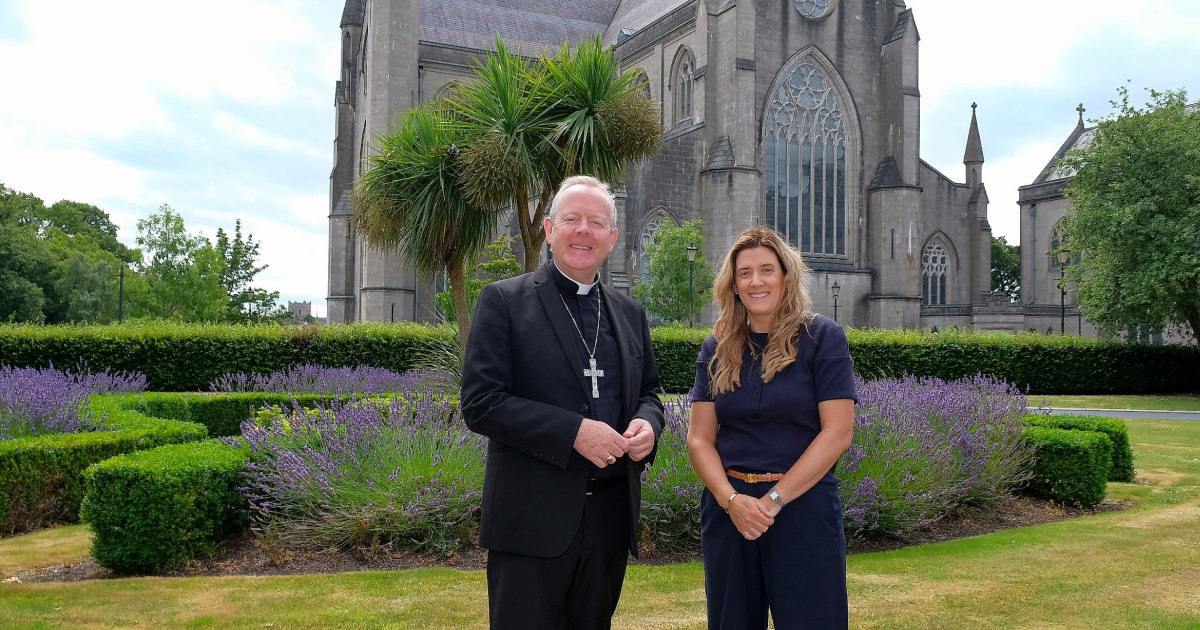
Archbishop Martin urges ethical AI in talks with OpenAI Ireland
Archbishop Eamon Martin of Armagh met with the head of OpenAI Ireland to discuss Pope Leo XIV’s encyclical Magnifica Humanitas. Archbishop Martin, Primate of All Ireland, emphasised the importance of serving the common good by defending the dignity of workers and the most vulnerable.
Archbishop Martin was joined at the meeting, held at his residence, by Emma Redmond, head of OpenAI Ireland, and Derek Nolan, policy and partnerships lead for Ireland and the Nordics at OpenAI Ireland.
Archbishop Martin said: “I am grateful that OpenAI Ireland met with me to discuss the Holy Father’s encyclical letter at this time when humanity stands at a ‘historic crossroads.’ I feel that our discussion was fruitful, especially in the context of the onus and responsibilities held by governments, companies and citizens in the ethical shaping of artificial intelligence on the island of Ireland, and universally. We agree that the common good of humanity can best be served by defending the dignity of workers and of every human person, especially the most vulnerable among us.”
Archbishop Martin was joined in the meeting at his residence by Emma Redmond, Head of OpenAI Ireland, and Derek Nolan, Policy and Partnerships Lead for Ireland and the Nordics at OpenAI Ireland.
Following the meeting, Redmond said she welcomed the archbishop’s engagement on artificial intelligence as it pertains to serving human dignity and the common good.
She said: “OpenAI strives to ensure that advanced AI benefits everyone. We believe AI should expand people’s capabilities, not replace human judgment about what matters; be developed safely and responsibly; and create opportunities whose benefits are widely shared. Discussions like these are an important part of ensuring the development of AI is informed by a broad and inclusive range of perspectives and always focused on serving people and society.”
Magnifica Humanitas drew widespread acclaim beyond Christian discourse for its engagement with the ongoing debate surrounding artificial intelligence. Pope Leo posited in the encyclical that the question surrounding artificial intelligence was who governed and regulated the technology and how its wide-ranging impact could be directed towards the common good. In it, he stated that its development and adoption “changes the structure of power”.
During the presentation of the encyclical, the Pope was joined by Anthropic co-founder Christopher Olah, which develops the large language model Claude. The Vatican has sought an ongoing dialogue with artificial intelligence companies and industry leaders since the encyclical’s release on May 15.
On July 10, Pope Leo called for international dialogue on the subject at what he called an “epochal turning point”. In his message to the AI for Good Global Summit, organised by the United Nations and co-convened with the Government of Switzerland, the Pope expressed his desire for “new paths for the common good and for promoting a dignified life for all”.
The statement read: “Magnifica Humanitas was born from his listening ‘to scientists and engineers who work with sincere enthusiasm on technologies capable of alleviating immense suffering; to political leaders and public officials who have perseveringly sought just rules; to parents and teachers who are deeply concerned for the future of younger generations’. However, at the same time, it was also impelled by troubling accounts of the potential misuses of algorithms and by the loss of human agency in critical areas.”