UF researchers uncover surprising boiling behavior in liquids that could advance future space missions News
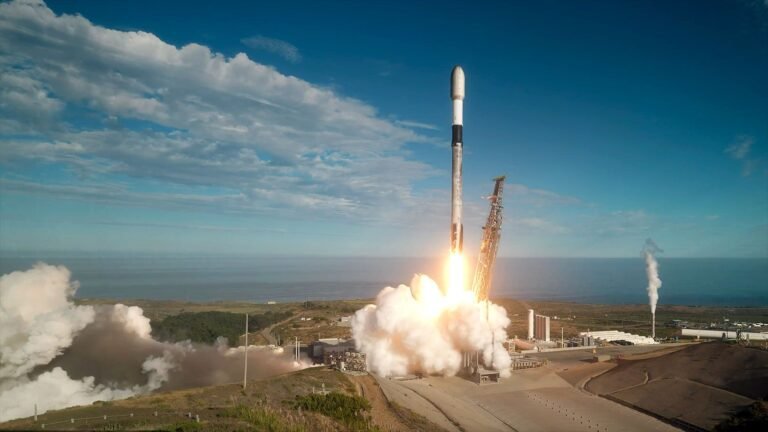
When astronauts travel deeper into space, every drop of fuel becomes critical, and keeping those fuels stable for months or even years is one of the biggest engineering challenges facing future missions. Now, University of Florida researchers have uncovered a surprising behavior in boiling liquids that could help solve that challenge.
The findings, published July 8 in npj Microgravity, establish an important foundation for designing next-generation spacecraft systems that depend on cryogenic liquid — the ultracold liquids used both as rocket propellants and as coolants for onboard electronics.
The research was led by Youngsup Song, Ph.D., assistant professor in the mechanical and aerospace engineering department and a member of the Astraeus Space Institute, whose team investigated how liquid nitrogen behaves under reduced-gravity conditions. The work challenges long-standing assumptions about boiling in space and provides new insight into how engineers can better manage cryogenic fluids for future exploration.
Boiling plays a critical role in both challenges, but engineers want opposite behaviors from it. For cooling electronics, enhanced boiling is the goal. It carries heat away efficiently, and the more of it the better. For storing propellants such as liquid hydrogen and liquid oxygen, boiling is the enemy. Every bubble is fuel lost to “boil-off.” Either way, designing these systems requires knowing exactly how a liquid boils in orbit, which has never been clear, because engineers have long assumed reduced gravity makes boiling less efficient, since bubbles rely on buoyancy to lift away from heated surfaces.
“Because we lose buoyancy in reduced gravity, we expected boiling would become less effective across the board,” Song said.
The findings show a more nuanced effect. While reduced gravity improved heat removal under certain conditions, it lowered the maximum heat the surface could safely sustain before boiling became unstable by about 65%.
“What we found is that up to a point, boiling actually got more effective, which was the opposite of what we expected,” Song said. “The catch is that the safety limit drops sharply. Both halves matter if you’re designing real hardware.”
The researchers hypothesize that this improvement occurs because bubbles remain on the heated surface longer in reduced gravity, creating an extremely thin liquid layer between the bubble and the heater that speeds heat transfer.
“Our hypothesis is that bubbles stop floating away, so they linger on the surface,” Song said. “When bubbles are on the surface, there is a small liquid gap between the bubble and the heater, and that liquid layer is so thin that it can improve heat transfer.”
To reach these conclusions, the team boiled liquid nitrogen on atomically smooth silicon dioxide surfaces during parabolic flight campaigns. The smoothness was the point. Earlier experiments used metal surfaces, whose microscopic scratches and pits influence boiling in ways that are impossible to separate from the effects of gravity itself. By removing those imperfections as much as physically possible, the team isolated gravity’s role and produced a clean reference dataset that other researchers can measure engineered surfaces against, whether they are trying to enhance boiling or suppress it.
That baseline points directly at the storage problem. If surface features can strengthen boiling, they can also be designed to hold it back, which can be directly used for “zero boil-off” technologies designed to prevent the loss of valuable fuel during extended missions.
“That means we can tune the surface features, like structures and chemistry, to suppress boiling,” Song said. “We want to engineer surfaces to see if we can delay boiling in the storage tank. That is related to a zero boil-off storage tank.”
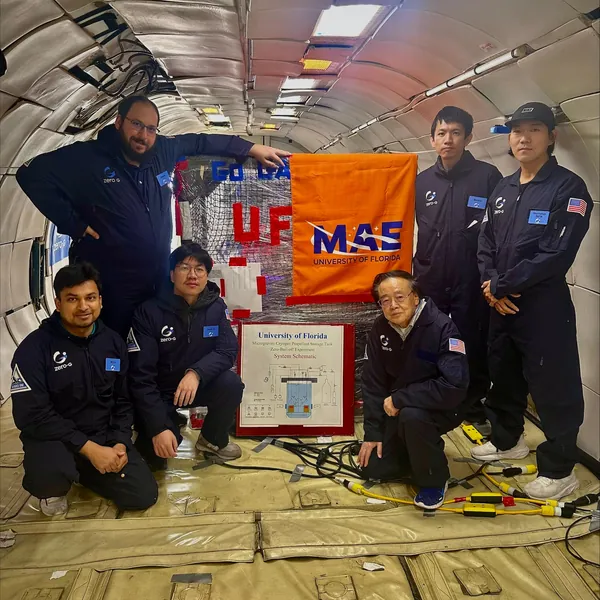
The project also highlights the collaborative nature of space research at UF, bringing together faculty, graduate students and NASA researchers to address complex challenges in aerospace engineering. The study included UF graduate students Mohammad S. Reza, Philip Ignatoff and Jimmy Almacddissi, along with collaborators Jason Hartwig Ph.D., research aerospace engineer at NASA’s Glenn Research Center, and Jacob Chung Ph.D., professor in the Department of Mechanical and Aerospace Engineering.
Song and his team hope future work will expand these findings through additional spaceflight testing and further development of engineered surfaces that can improve cryogenic fluid management in space.