Alzheimer’s disease: 9 recent breakthroughs
This article has been updated.
- Of the 57 million people living with dementia worldwide, 60-70% are thought to have Alzheimer’s.
- From AI diagnoses to new drugs, here are some of the recent breakthroughs in the battle against the disease.
- The Forum’s Davos Alzheimer’s Collaborative continues to develop and scale promising solutions to a disease that costs the global economy $1.3 trillion a year.
The most common form of dementia, Alzheimer’s is a brain disorder characterized by the slow erosion of a person’s memory and thinking skills.
It is the sixth leading cause of death in the US, and while lifestyle changes and medication can help ease symptoms, there is currently no cure.
With the number of people with dementia expected to increase to 150 million by 2050, the pressure is on to find a solution to this debilitating and devastating disease.
In recent years, however, a number of breakthrough discoveries around Alzheimer’s, in particular, have provided hope. Here are nine of them.
The ADHD link
A 2025 study found a possible link between the brain make-up of people with ADHD and that of “old age-related dementias such as Alzheimer’s disease”. Using a combination of MRI brain imaging and blood tests, the researchers at the University of Geneva compared 32 adults with ADHD to 29 adults without ADHD (in both cases, aged between 25 and 45 years).
What they found was that the ADHD adults had more iron in certain regions of their brain, along with higher levels of neurofilaments in their blood, both of which are markers for dementia and Alzheimer’s. While it was a small case study, it nevertheless paves the way for further research to determine if a reduction of iron levels in the brain of a person with ADHD could reduce the likelihood of developing dementias like Alzheimer’s down the line.
The menopause link
Recent research has pinpointed the menopause as a potential contributing factor. Close to two-thirds of perimenopausal and postmenopausal women experience memory issues, reports Nature Medicine. The decline in oestrogen levels during this period may affect brain metabolism and has been described by some researchers as causing the female brain to begin “consuming its own tissue”, according to scientist Roberta Brinton. These findings were backed up by a UK study of nearly 125,000 women, which concluded that not only does the menopause reduce grey matter related to memory and emotion, but that hormone replacement therapy (HRT) did not appear to prevent this loss.
However, this is contrasted by other research, including a US study, which found that “synaptic dysfunction” and “elevated tau” – a toxic protein in the brain – were more prevalent in menopausal women who were not on HRT. The authors point out that interventions “addressing both hormonal factors and synaptic health” could potentially help stave off Alzheimer’s in women.
Yet female-dominant conditions like the menopause received less than 1% of research funding in recent years, according to the World Economic Forum’s Women’s Health Investment Outlook. Closing this gap has become a public health imperative, says the report.
Breakthrough drugs
Last year saw the first drugs enter the market to tackle Alzheimer’s. Donanemab and lecanemab both block harmful proteins in the brain and can slow decline by around 30%, reports The Guardian. The Alzheimer’s Society found that the drugs could slow down disease progression by 60% if given at an early stage. But other research was less positive, with a UK trial of lecanemab finding that patients were better off by only 0.45 points on an 18-point scale. More recently, the Cochrane Collaboration concluded that while the drugs do slow progress, they do not make a meaningful difference.
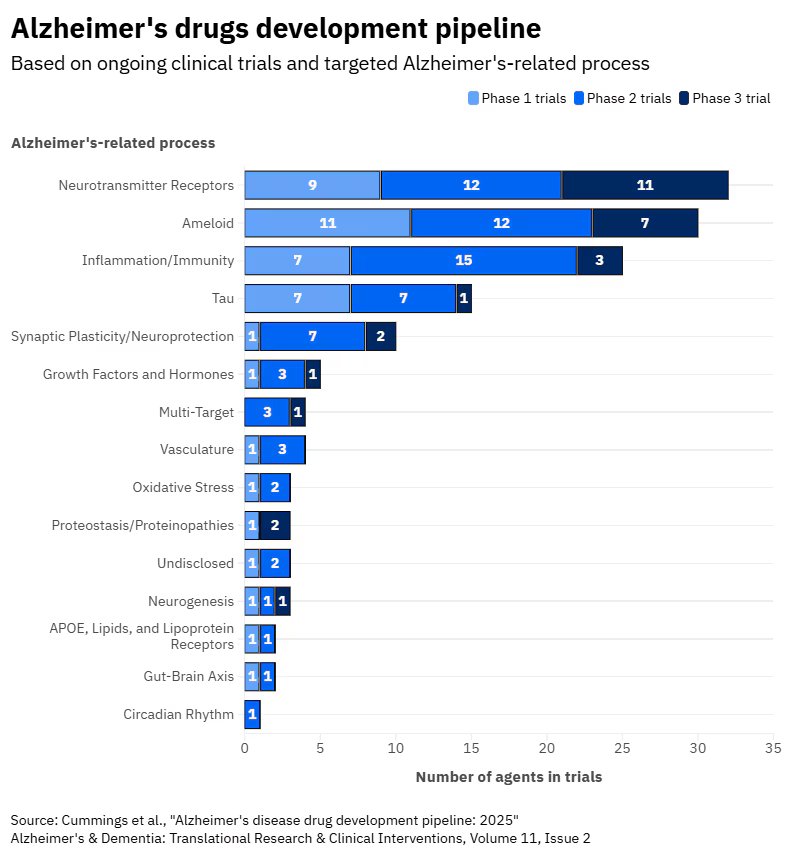
They are also currently expensive – an 18-month course of the drugs costs around $121,000 – and the UK’s National Health Service doesn’t offer them to patients. Despite these setbacks, the drugs “represent genuine progress“, says Alzheimer’s Research UK. There are nearly 140 drugs for Alzheimer’s currently being tested, including the ones in the table below, so the possibility of finding a cure is not out of reach.
New tests for Alzheimer’s
In the US, a blood test has been approved by the US Food and Drug Administration (FDA) to help identify Alzheimer’s in its earliest stages. Until recently, the only diagnostic option has been an expensive PET brain scan or an invasive lumbar puncture test; now, anyone over the age of 55 and exhibiting Alzheimer’s symptoms can get a blood test to establish if amyloid plaques, key markers of the disease, are present.
In clinical studies, the blood test correctly identified the presence of amyloid plaques in over 91% of cases, with clinicians making the final call as to whether Alzheimer’s was the cause.
“Alzheimer’s disease impacts too many people, more than breast cancer and prostate cancer combined,” FDA Commissioner Martin A. Makary said in a press release. “Knowing that 10% of people aged 65 and older have Alzheimer’s, and that by 2050 that number is expected to double, I am hopeful that new medical products such as this one will help patients.”
There has also been a recent UK breakthrough in testing for Alzheimer’s risk. Scientists at the University of Bath have developed a three-minute at-home memory test called “Fastball”. It uses a form of electroencephalogram (EEG) to record brain activity as a person watches a stream of images, some of which are repeated.
The test is designed to detect amnestic mild cognitive impairment (MCI), a specific type of memory issue that can indicate a higher risk of developing the disease. While not predictive of Alzheimer’s on its own, if validated in larger trials, it could help identify patients most likely to benefit from new treatments.
Herpes and Alzheimer’s
Perhaps surprisingly, scientists have discovered a link between herpes simplex virus type 1 (HSV-1), the virus that causes cold sores, and the development of Alzheimer’s. HSV-1 often lies dormant and undetected in the body’s nervous system and can trigger the aforementioned amyloid plaques, a hallmark of Alzheimer’s.
In test cases involving over 344,000 older adults with Alzheimer’s and controls without the disease, researchers found that 0.44% of adults with Alzheimer’s had also previously had HSV-1, against 0.24% of the controls. While the percentages are small, the percentage difference is significant, with an 80% increased risk of developing Alzheimer’s when HSV-1 has been present. Notably, if the adult had received anti-viral treatment for their HSV-1, the Alzheimer’s risk was reduced by 17%.
The results “place an even greater emphasis on viewing the prevention of herpes viruses as a public health priority”, say the study’s authors.
AI can predict Alzheimer’s
Two studies, one in the US and one in the UK, have demonstrated how artificial intelligence (AI) can successfully predict the onset of Alzheimer’s. Researchers at the University of California created a machine learning model that can predict the disease up to seven years before any symptoms appear. The machine was accurate up to 72% of the time, reports Alzheimer’s Research Association, and also identified different risk factors for men and women. Hypertension, high cholesterol and vitamin D insufficiency registered as predictors of Alzheimer’s in both genders. Osteoporosis was a specific predictor for women, while erectile dysfunction and an enlarged prostate were indicators of susceptibility for men.
“This has the potential to significantly improve patient wellbeing, showing us which people need closest care, while removing the anxiety for those patients we predict will remain stable,” said Professor Zoe Kourtzi, one of the study’s senior authors. “At a time of intense pressure on healthcare resources, this will also help remove the need for unnecessary invasive and costly diagnostic tests.”
AI is also helping those currently living with dementia and Alzheimer’s, as this video shows:
Is the immune system to blame?
Scientists are exploring the possibility that Alzheimer’s is at least partly caused by the immune system trying – and failing – to fix damage to the brain. Researchers at the University of Virginia School of Medicine in the US discovered that an immune molecule called STING is responsible for the plaques and tangles that contribute to Alzheimer’s – and that by blocking this molecule, mental decline is avoided, at least in the case of lab mice.
What’s more, the discovery could be key to stopping cognitive decline in other neurodegenerative diseases too, such as motor neurone disease and Parkinson’s, say the researchers.
While it’s early days for this intervention, the potential is now there for future treatments that target this particular molecule.
How implants could help
The Forum’s Davos Alzheimer’s Collaborative continues to spearhead breakthroughs in the battle against the disease, which currently costs the global economy $1.3 trillion a year. One of its aims is to build a clinical trial network, connecting researchers worldwide to speed up innovation and reduce costs, which can be a barrier to progress.
On the cusp of a cure?
With studies ongoing to find ways to tackle Alzheimer’s, hope keeps emerging. And sometimes in unusual places. One recent study found that aloe vera could help fight the disease, while another is exploring the possibility that Chinese celery could have an impact.
Meanwhile, a US research team has floated the possibility of a cure for Alzheimer’s in the near future.