Silicon Valley’s Top VCs Gather with President Lee for Korea-US Venture Investment Meetup
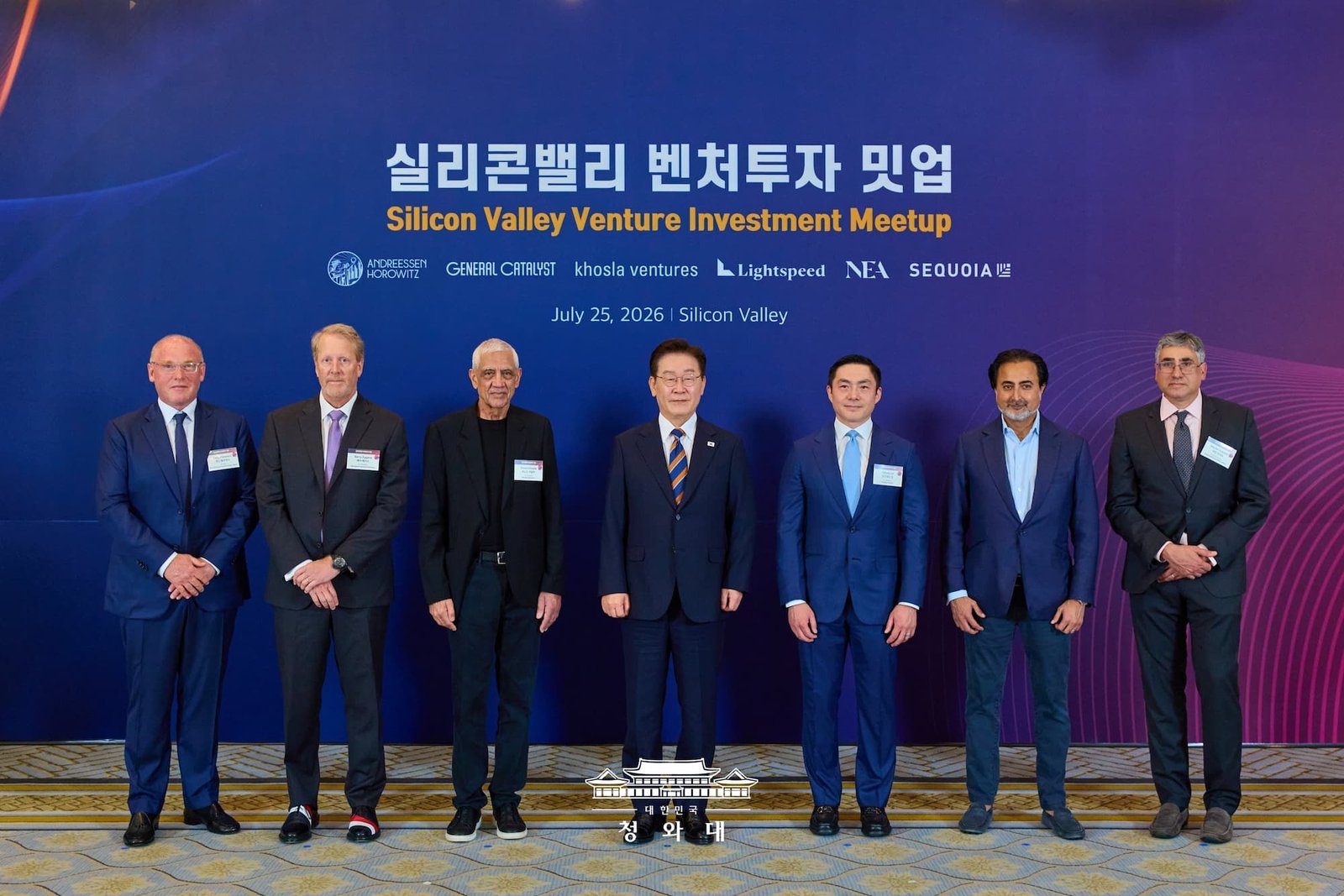
Korea’s Ministry of SMEs and Startups (MSS) convened the Silicon Valley Venture Investment Meetup in Silicon Valley on July 25 (local time), bringing together President Lee Jae-Myung and six of the region’s most influential venture capital firms to deepen investment cooperation between Korea and the United States.
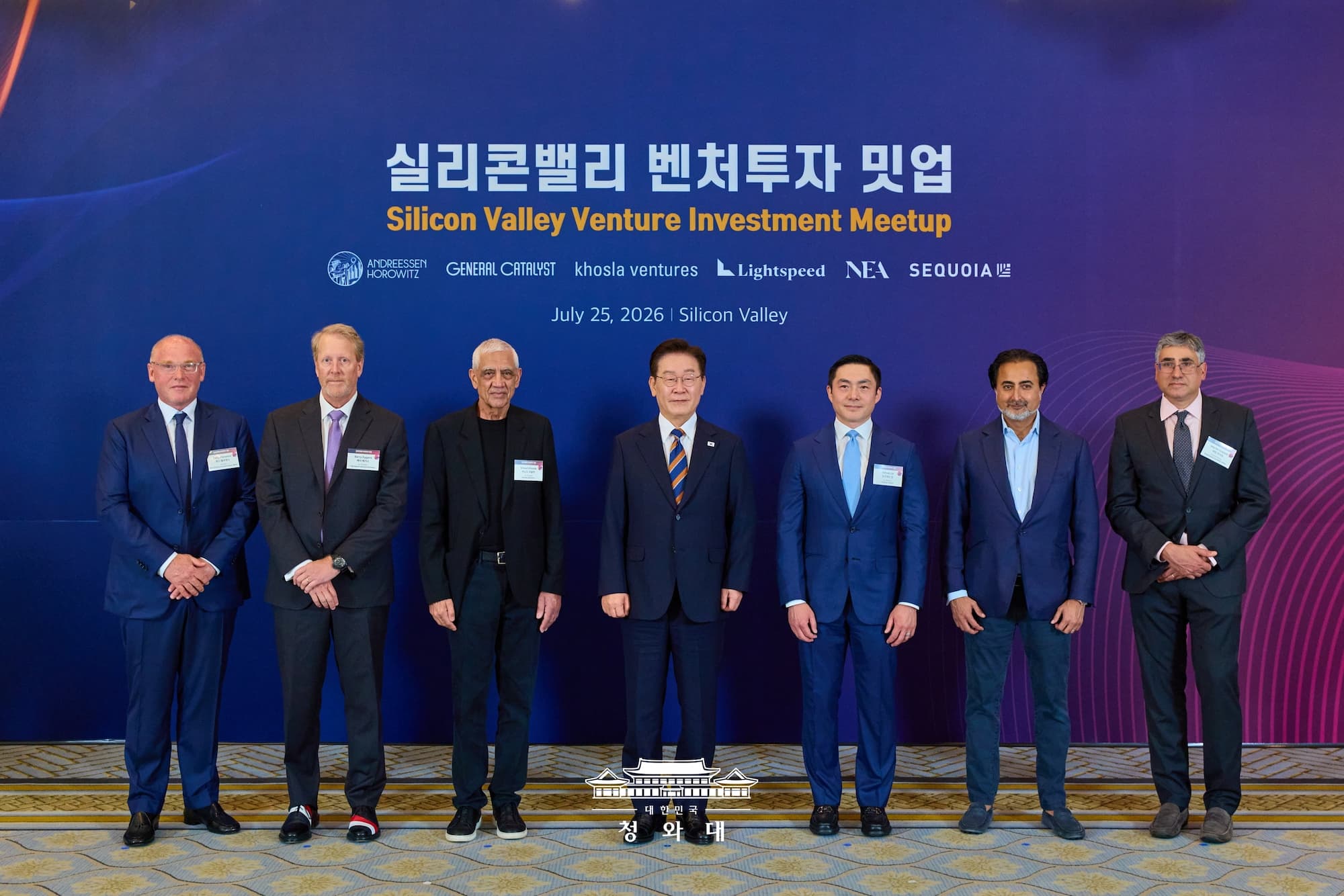
The event featured two main segments: the signing of investment cooperation memoranda of understanding (MOUs) between Korea’s National Pension Service (NPS) and six Silicon Valley VCs, followed by a roundtable discussion on the current state of venture ecosystems in both countries and pathways to strengthen global investment partnerships.
Participating firms included Andreessen Horowitz, General Catalyst, Khosla Ventures, Lightspeed Venture Partners, New Enterprise Associates, and Sequoia Capital – Silicon Valley heavyweights collectively managing approximately USD 300 billion in assets.

Strategic MOUs to Anchor Long-Term Collaboration
In the first session, the NPS signed cooperation agreements with each of the six venture capital firms. The MOUs establish a framework for expanding strategic cooperation with Korea’s innovation ecosystem and developing long-term relationships aimed at identifying promising innovative companies and global investment opportunities.
The NPS, which operates its local VC network from its San Francisco office, plans to leverage these agreements to strengthen ties with Silicon Valley’s top firms – seeking out high-potential investment opportunities while simultaneously helping Korean startups attract overseas investment. To translate the MOUs into concrete action, the NPS will develop a detailed implementation plan for investing in overseas venture capital firms.
Roundtable: AI Investment and Korea’s Talent Pool
The roundtable session covered a wide range of topics, including global and Silicon Valley investment trends, promising sectors, case studies and decision factors in investing in Korean startups, differences between the Korean and U.S. investment environments, obstacles investors face, and strategies to strengthen cooperation between the two venture ecosystems.
Every participating VC emphasized the critical importance of investing in AI-related technology, praised Korea’s strong pool of AI talent and founders, and expressed a desire to expand their engagement with Korean startups.
Alfred Lin of Sequoia Capital, which has spent 54 years in Silicon Valley making early investments in landmark technology companies ranging from Google to NVIDIA, shared that he had recently visited Korea and been impressed by its cuisine and the warmth of its culture. He underscored the importance of encouraging young people to take bold risks and the startup support systems that make such entrepreneurship possible.
Martin Casado of Andreessen Horowitz (a16z), Silicon Valley’s largest VC firm, noted that the firm has invested in more than 20 Korean companies across fields such as robotics and bio-health, and plans to deepen its partnership with Korea through its newly established Korea office. “If Korea’s hardware and manufacturing strength were combined with America’s software and AI capabilities, it would greatly benefit both countries,” Casado said.
Vinod Khosla, one of Silicon Valley’s most respected investors, described Korea as a powerhouse of talent and affirmed that venture capital follows talent, which is why he intends to continue expanding his investments in Korea. He noted that a culture that tolerates failure would help strengthen the venture ecosystem and support founders in starting and growing their companies.
Barry Eggers of Lightspeed Venture Partners characterized Korea as a country with world-class technical talent and a strong industrial and technological base, and said he hoped to work more closely with Korean partners. “If global and local investors collaborate to identify the best companies and founders, and if we strengthen the connections between venture capital and university networks, the venture ecosystems of both countries will grow stronger,” Eggers said.
Hemant Taneja of General Catalyst pointed out that startups require substantial capital to scale, so the pool of venture funding must expand. He added that Korea operates top-tier automated robotic factories and should actively foster startups in this field – an effort that could be supported by building innovation clusters where large companies and startups collaborate.
Tony Florence of New Enterprise Associates (NEA) said he had been impressed by Korea’s entrepreneurial spirit, noting that NEA has already invested in Korean startups such as Twelve Labs and is actively seeking additional opportunities in Korea, home to many strong startups including Rebellions.
Government Commitment to Global Ecosystem Integration
“The VCs at this Silicon Valley meetup are among the best in the world, and bringing them together to discuss cooperation with Korea’s venture ecosystem is an important move toward opening our ecosystem to the world,” said Vice Minister Roh Yong-Seok.
“We will continue to expand policy support to build a venture and startup environment that meets global standards and to help our startups break into overseas markets.”
Korea has been actively strengthening its innovation ecosystem through a combination of venture investment growth and strategic government policy. In 2025, Korea’s venture investment surged 14% to $9.6 billion, driven by large-scale mega rounds and policy support. Leading AI chip startup Rebellions raised $424 million in a pre-IPO round earlier this year as the first direct investment under Korea’s National Growth Fund, reflecting the government’s focus on nurturing globally competitive technology companies.