AI Factory Buildout Lifts Teradyne Robotics to First-Ever $100M Quarter
The machines now building AI have started buying robots. Teradyne Robotics posted $100 million in revenue for the second quarter of 2026 — the highest quarterly result the division has ever recorded — driven by a 50% sequential surge in orders from electronics manufacturers and semiconductor facilities constructing AI data centers. The milestone caps five consecutive quarters of growth for a business that spent 2025 cutting roughly a quarter of its global workforce, and it offers the clearest evidence yet that AI infrastructure spending is reshaping who buys industrial robots and why.
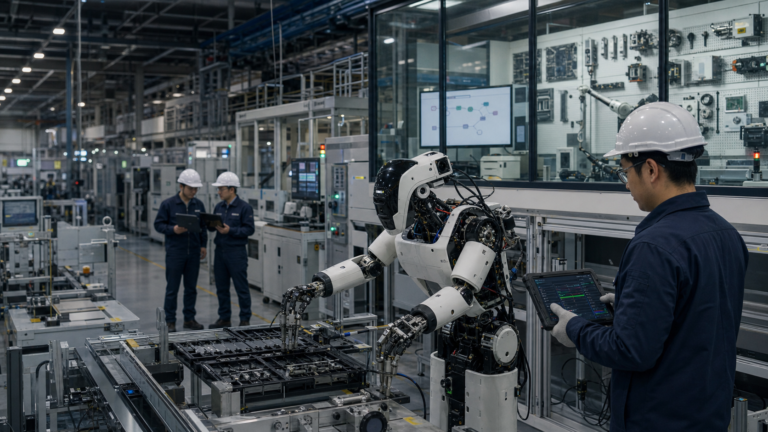
That shift matters beyond Teradyne’s own numbers. For the first time in the company’s history, electronics manufacturing and semiconductors displaced automotive and general manufacturing to become Teradyne Robotics’ single largest end market in a quarter. The cobots assembling circuit boards, routing optical fiber, and running burn-in tests inside AI data centers are the same robots that spent decades serving car plants. The demand engine behind them is now fundamentally different.
What Drove a 33% Revenue Jump
Teradyne Robotics, which operates collaborative robot maker Universal Robots (UR) and autonomous mobile robot provider Mobile Industrial Robots (MiR), reported $100 million in Q2 2026 revenue, up 33% from $75 million in the same quarter a year earlier and up 9% from the $91 million it recorded in Q1 2026.
Parent company Teradyne Inc. reported total revenue of $1.329 billion for the quarter — up 104% year over year — with its Semiconductor Test division surpassing $1 billion for the second consecutive quarter. CEO Greg Smith opened the earnings call with an unambiguous attribution: “For the second quarter in a row, we delivered record revenue, and once again, AI was the driver.” He said AI-linked sales accounted for more than 60% of revenue across all three of the company’s business units — Semiconductor Test, Product Test, and Robotics.
The robotics division’s fastest-growing verticals in the quarter were electronics manufacturing and semiconductors, both fueled by AI data center construction. Revenue from those two categories rose 50% sequentially from Q1 2026 and became the robotics group’s largest end market — a distinction they had not previously held. Smith projected a “multibillion-dollar market for assembly, automation, test, and burn-in equipment” in the AI infrastructure space and forecast mid-double-digit growth rates through the end of the decade.
Why AI Factories Specifically Need Cobots
The connection between AI data center construction and cobot demand is not intuitive, and understanding it requires looking past the headline revenue figure to what is actually happening on the factory floor.
Building the hardware that runs AI means assembling increasingly complex electronics — graphics processing units, high-bandwidth memory modules, custom networking switches, photonic interconnects — in configurations that change with each new GPU generation. These tasks share four properties that collectively rule out most automation alternatives: they are high-mix and low-volume (the specific component layout changes frequently), they require precise force control (connectors inserted with too much torque fail silently), they depend on visual verification (each placement must be confirmed by camera), and they involve too much variety to justify the fixed tooling and safety enclosures that traditional industrial robots require.
Cobots address all four. Their force-limiting joints prevent over-torquing. Their integrate-able vision systems confirm placement. Their rapid reprogrammability lets a facility reconfigure for a new GPU generation without weeks of engineering work. And their collaborative safety profile means they can share floor space with technicians in environments where every square meter is expensive. Teradyne’s framing of its business as a “wafer to AI data center” strategy captures this precisely: the company supplies test equipment for the wafer level and cobots for the assembly level, following the value chain from chip to data center.
The broader market data supports Teradyne’s experience. Cobot orders across North America surged 55.6% in the first quarter of 2026, per the Association for Advancing Automation (A3), with semiconductors and electronics posting 31.7% unit growth and a 79.2% revenue increase year over year — the latter figure signaling that buyers are selecting higher-value, more specialized systems.
The Technical Bet: Cobots as AI Training Hardware
Teradyne’s robotics investments go beyond supplying precision assembly capacity for data center builders. Universal Robots and Scale AI launched the UR AI Trainer at NVIDIA’s GTC 2026 conference in March — a system that positions cobots not just as output devices for manufacturing tasks but as hardware for generating AI training data.
The mechanism works as follows. An operator physically guides a UR cobot through a task — smartphone packaging, connector insertion, or another dexterous manipulation — while the AI Trainer captures synchronized motion, force-torque, and visual data in high fidelity. That dataset becomes the training input for a Vision-Language-Action (VLA) model: a neural network architecture that unifies visual scene understanding, natural language instruction following, and motor command generation in a single forward pass. The trained VLA model can then be deployed directly on the same factory-floor UR robot used to generate the data, closing what Universal Robots VP of AI Robotics Products Anders Beck called the “lab-to-factory gap.”
“Our customers, ranging from large enterprises to AI research labs, are no longer just asking for AI features,” Beck said at the GTC 2026 launch. “They need a way to collect high-fidelity, synchronized robot and vision data to train AI models on the same robots they intend to deploy.”
The implication is structural: cobots are no longer only manufacturing output devices. They are also AI training hardware. Every organization building AI models for physical manipulation tasks needs robots capable of generating high-quality, force-aware demonstration data. Teradyne’s UR platform, with its force-torque sensors and high-fidelity data capture, is positioned to serve that requirement. Cobot sales are now coupled to AI R&D spending — not just to factory construction cycles.
At Automate 2026 in Chicago in June, Teradyne went further, showcasing what it described as deployable — not conceptual — physical AI applications, including two UR12e robots running autonomously on Generalist AI’s GEN-1 model, demonstrating complex dexterous manipulation without task-specific programming. Jean-Pierre Hathout, President of the Teradyne Robotics Group, said at Automate: “The demos we are presenting are real and deployable. Manufacturers can purchase the physical AI-enabled applications we have on display today.”
The company also unveiled the MiR1200 Pallet Jack at Automate 2026, which it describes as its first physical AI product — an autonomous mobile robot designed to operate in dynamic, unstructured environments through on-device AI inference, rather than requiring pre-mapped facilities.
A US Market Taking Shape
Alongside the AI infrastructure narrative, a reshoring story is emerging in Teradyne’s numbers. US sales climbed to 32% of total Teradyne Robotics revenue in Q2 2026, up from lower levels in recent quarters, reflecting broader trends in American manufacturing policy and domestic investment.
To serve this demand directly from American soil, Teradyne Robotics is renovating a 67,000-square-foot (6,225-square-meter) facility in Wixom, Michigan — about 30 miles (48 kilometers) northwest of Detroit — as its new US Operations Hub. Universal Robots cobots will be manufactured there, with the potential to add MiR AMR production over time. The facility will also function as a regional customer training center and service hub. The company expects to create hundreds of new jobs at the site in the years ahead.
The Wixom location places Teradyne in the center of the US automotive and advanced manufacturing corridor, and Hathout has noted publicly that the hub is intended partly to serve a large, undisclosed e-commerce client widely believed to be Amazon — whose Vulcan warehouse robot incorporates a UR cobot arm.
CFO Michelle Turner said at the Q2 earnings call that the company expects growth to continue through the second half of 2026. Smith pointed to wafer fab equipment investment — which Teradyne projects will approach $250 billion globally by the end of the decade — as the demand backdrop for sustained robotics growth into 2027 and beyond.
Context: The Turnaround After Two Rounds of Cuts
The record quarter arrives after one of the most difficult periods in Teradyne Robotics’ history. The division peaked at $326 million in annual revenue in 2022, driven by pandemic-era automation investment, then declined steadily: $304 million in 2023, $293 million in 2024.
The decline prompted two rounds of workforce reductions in 2025. In January, Teradyne cut roughly 10% of its global robotics staff — approximately 140 employees. In November, the company executed a second reduction affecting approximately 14% of the remaining workforce. Combined, the two rounds reduced the division’s headcount by roughly a quarter. At the time, the company described the moves as a “proactive step to strengthen the business and ensure we are focused on the areas where we can deliver the greatest value.”
The restructuring included consolidating Universal Robots and MiR’s previously separate sales, marketing, and customer service organizations into a single unified team — a move Teradyne said reduced its robotics breakeven revenue threshold from $440 million in 2024 to $365 million in 2025. The pivot to AI-exposed verticals — particularly electronics manufacturing, data center assembly, and semiconductor facilities — came alongside that consolidation.
The outcome so far: five consecutive quarters of sequential growth, a record quarterly revenue figure, and a share price that has gained substantially as AI-related revenue now accounts for more than 60% of total company sales.
How Does Cobot IP Fit Into a More Competitive Market?
The recovery is happening against a backdrop of intensifying competition from Chinese cobot manufacturers. In March 2026, Teradyne Robotics filed a copyright infringement lawsuit in Germany against Elite Robots Deutschland GmbH, accusing the company of copying Universal Robots’ PolyScope 5 operating software — the platform through which tens of thousands of UR cobots are programmed and operated worldwide. The Regional Court of Hamburg issued a preliminary injunction in Teradyne’s favor on April 21, 2026, halting Elite Robots Germany from distributing the allegedly infringing software and requiring the company to disclose details about affected customers.
Hathout framed the legal action as more than a standard IP dispute, calling on European policymakers “to ensure that Europe continues to be a safe environment for innovation” and warning that unchecked infringement “effectively subsidizes non-European rivals at the expense of domestic innovators.” The company has indicated it will pursue action against Elite Robots’ distributors and partners if they continue offering the infringing software. A separate patent suit against Teradyne filed by Sensor360 was jointly dismissed with prejudice in February 2026.
What Changed to Make Cobots the Smartest Bet in Industrial AI?
The Q2 numbers alone do not explain why AI data center construction specifically became a cobot demand driver. The structural answer lies in the nature of the work. AI data centers are not built once and left unchanged — they are continuously upgraded, reconfigured for new chip generations, and expanded on timelines driven by GPU release cycles and cloud provider capacity commitments. That rate of change makes fixed industrial automation economically irrational. What it demands is exactly what cobots offer: precision manipulation that can be reprogrammed in hours, not weeks, with integrated vision and force feedback that can adapt to new component geometries without rebuilding tooling.
The Flex partnership, expanded in April 2026, illustrates the industrial logic. Flex — one of the world’s largest contract electronics manufacturers — both deploys UR cobots and MiR AMRs in its own facilities and manufactures key robotics components for Teradyne customers. The arrangement builds on a 20-year relationship in which Flex manufactured Teradyne’s semiconductor test equipment; extending it into robotics signals that the same customers building AI chips need the same partner to help them automate assembly.
Universal Robots also integrated with NVIDIA’s Isaac and Cosmos development platforms — announced at GTC in March 2026 — giving UR cobots access to simulation-to-real training infrastructure and world foundation models for physical AI development. The integration means companies building VLA models for manufacturing can now train on UR platforms within NVIDIA’s simulation environment before deploying to physical hardware, reducing the cost and time of training.
Frequently Asked Questions
Why are AI data centers driving demand for cobots specifically — not traditional industrial robots?
AI data centers require assembling complex, rapidly evolving electronics at a pace and variety that make fixed industrial robots economically impractical. Traditional industrial robots excel at high-volume, low-mix tasks performed identically thousands of times per day — the type of work that has defined automotive assembly for decades. AI data center hardware changes configuration with each GPU generation, requires force-sensitive connector insertion, and must be visually verified at each step. Cobots handle all of these requirements without safety caging, can be reprogrammed in hours rather than weeks, and can share workspace with engineers doing concurrent tasks. Teradyne’s results reflect a structural fit, not a trend.
What is the UR AI Trainer, and why does it matter beyond this earnings report?
The UR AI Trainer, developed with Scale AI and launched at GTC 2026, lets operators physically guide a UR cobot through a task while capturing synchronized motion, force-torque, and visual data. That dataset trains a Vision-Language-Action (VLA) model that can then run directly on the same production robot — eliminating the gap between AI research environments and factory deployment. The broader implication is that cobots are now AI training hardware, not just manufacturing output devices. Every organization building AI models for physical tasks needs robots capable of generating high-quality demonstration data. Cobot sales are now coupled to AI R&D spending — a demand channel structurally different from factory construction cycles.
How did Teradyne Robotics recover so quickly after two rounds of layoffs in 2025?
The recovery reflects both structural timing and deliberate repositioning. In 2025, Teradyne consolidated Universal Robots and MiR’s separate sales organizations into a unified team and shifted go-to-market resources toward verticals with AI infrastructure exposure — electronics manufacturing, semiconductor facilities, and data center assembly. The pivot arrived just as AI data center construction spending accelerated globally. The restructuring also reduced the division’s breakeven revenue threshold from $440 million to $365 million, meaning the same volume of sales produces a more favorable margin outcome than it would have two years ago.
What does the Wixom, Michigan plant mean for US manufacturers considering cobots?
The Wixom hub — a 67,000-square-foot (6,225-square-meter) facility being opened as Teradyne’s US Operations Hub — will manufacture Universal Robots cobots domestically for the first time and serve as a regional training and service center. For US manufacturers considering cobot adoption, domestic manufacturing generally implies shorter lead times, easier access to technical support, and a supply chain that is less exposed to tariff risk on imported robotics hardware. Teradyne has positioned the facility partly to serve the Midwest automotive and manufacturing base, but the timing also aligns with broader US industrial policy favoring domestic automation investment as a response to labor shortages and reshoring imperatives.