Cats are known for the whiskers on their faces. However, if you look closely, you can see that they also have whiskers on their legs. So why do cats have leg whiskers?
To answer why they’re useful, it’s important to understand what whiskers are. Technically known as vibrissae, whiskers are specialized hairs that are stiffer and several times thicker than other hairs. Although whiskers themselves do not contain nerves, their bases are rooted in specialized receptacles loaded with nerve endings, making whiskers very sensitive.
“Facial whiskers are as sensitive as human fingertips,” Robyn Grant, a sensory biologist at Manchester Metropolitan University in the U.K., told Live Science.
A cat’s whiskers around the nose, which are also known as the mystacial vibrissae, are the longest whiskers they have, according to the veterinary reference book “The Feline Patient” (Wiley, 2025). Although there is variation among cats, on average there are 12 mystacial whiskers set in four rows on each side of the muzzle.
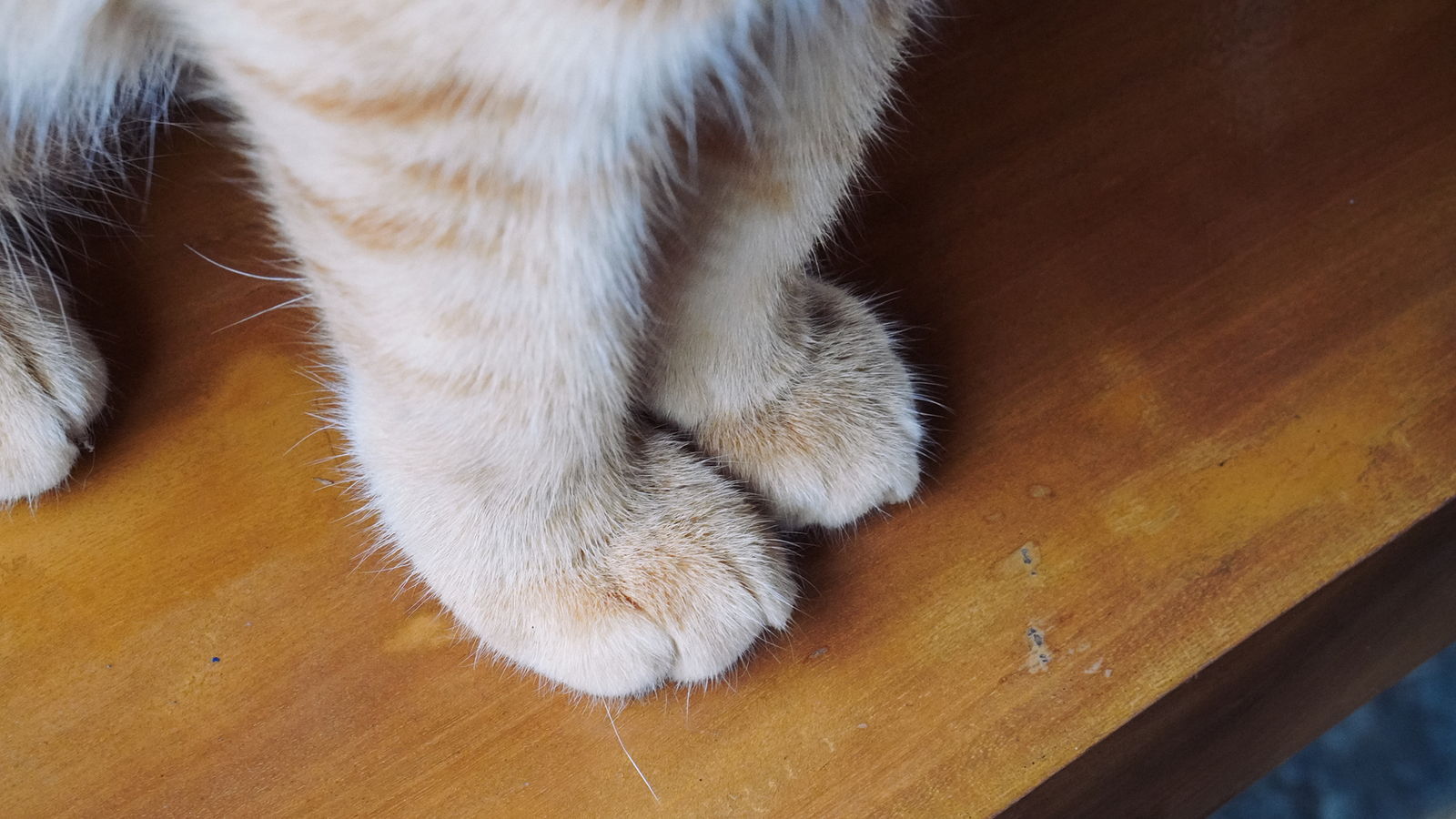
Cat leg whiskers, scientifically known as carpal vibrissae, are attached to their forelegs.
(Image credit: Future)
Facial whiskers help cats hunt when light is limited or when their vision is poor. Although cats are good at seeing distant objects, “cats can’t really focus on anything less than 10 inches (25 centimeters) from their eyes, so they use their whiskers to figure out where things are,” Jonathan Losos, an evolutionary biologist at Washington University in St. Louis and author of “The Cat’s Meow: How Cats Evolved from the Savanna to Your Sofa” (Viking, 2023), told Live Science.
In addition, cats have a tuft of whiskers known as superciliary vibrissae above each eye. These whiskers help protect the cat’s vision by triggering a blink when stimulated by anything that might fly into their eye, according to The Feline Patient.
Cats also have chin whiskers (mandibular vibrissae) and whiskers on each side of the head, between the ear and chin (genal vibrissae). These also help cats stay aware of the space around them.
Leg whiskers
Cats also possess a tuft of four to six whiskers on the back of each front leg, each about 0.8 to 1.2 inches (2 to 3 centimeters) long. These are known as carpal vibrissae.
“Carpal refers to the bones that, in humans, are in our wrists,” Losos said. “Carpal whiskers are attached to cat forelegs near the carpal bones.” However, in cats, the carpal bones are not located in the same place as the human wrist. Rather, they “are further up the leg, because cats essentially walk on their toes and not their palms,” he explained.
Cats are not the only animals with carpal whiskers. “Most carnivores have them, and many rodents do, as do lemurs and armadillos,” Losos said. “Dogs don’t have them, but other canine species do. Rabbits don’t have them either, nor do ungulates — that is, hooved animals, such as horses and cattle.”
The species that have carpal whiskers “tend to be the ones that either grasp things with their forelimbs or climb up trees,” Losos said. “The idea is that if it’s hard for the animals to see what they’re grasping, carpal whiskers can help supplement their vision. Perhaps cats have them and dogs don’t because cats can move their forearms laterally from side to side and put their palms together to grab things, whereas dogs can’t.”
It remains uncertain what role carpal whiskers play in cats, but they likely “guide locomotion — that is, safe forepaw placement — especially during complex locomotion, such as climbing,” Grant said. “They might guide prey handling too.”
How much of a cat fan are you? Find out by taking our cat quiz!
Science word of the day: Heliosphere Pronunciation: HEE’-lee-uhs-feer What it means: The heliosphere is the region around the sun that’s affected by the solar wind, a flow of charged particles emanating from the sun. Think of the heliosphere like a giant bubble encompassing the sun and planets, reaching out into space at three times the…
Back to Article List Today in the history of astronomy, a nine-year journey pays off. The New Horizons spacecraft flew by Pluto in 2015, gathering data on its surface, interior structure, atmosphere, and more. Credit: NASA/APL New Horizons launched in January 2006, and by July 14, 2015, it had reached its primary goal: Pluto. The…
Back to Article List This rich grouping of young suns shines brightly in Aquila the Eagle, ripe for observing just after sunset and before moonrise. Looking for a sky event this week? Check out our full Sky This Week column. July 31: Mercury brightening With the Moon rising later each night as it wanes, there’s a slightly…
Sign up to see the future, today Can’t-miss innovations from the bleeding edge of science and tech An eye implant that can help blind people see again is poised to hit the market — in Europe, at least. On Wednesday, the US-based Science Corporation announced that it had received approval from the European Union to…