Crypto Prices Today: Bitcoin Holds $63,000 as Hyperliquid and Privacy Coins Break From the Pack
The crypto market is doing something unusual today: almost nothing. Hourly moves across the top 15 assets sit within a few hundredths of a percent of flat, and 24-hour changes cluster between minus 2% and plus 3%. That is a market holding its breath rather than one finding direction.
Zoom out, though, and the year-to-date column tells a far harsher story. Bitcoin is down 28%. Most large caps have lost between a third and half their value since January. And exactly three assets in the top 15 are still in the green for 2026.
Here is where every major coin stands right now.
What Is the Crypto Market Doing Right Now?
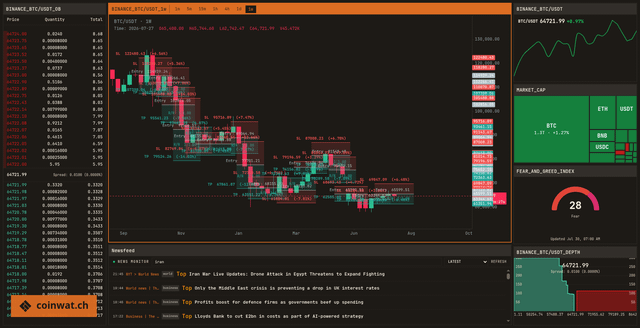
$Bitcoin trades at $63,018, up 0.06% on the hour, down 1.23% on the day and down 1.55% on the week. Market cap sits at $1.26 trillion against $22.73 billion in 24-hour volume.
That volume figure is the number worth pausing on. Turnover equivalent to roughly 1.8% of market cap in a day is thin for Bitcoin, and thin volume in a downtrend usually means sellers have stopped panicking rather than buyers have arrived. It compresses ranges, which is exactly what today’s price action shows.
$Ethereum is at $1,865, up 0.10% on the hour and down 0.90% on the day, but positive over the week at plus 0.48%. Its $225.07 billion market cap now sits at less than a fifth of Bitcoin’s. The year-to-date figure is where the damage shows: minus 37.14%, meaningfully worse than Bitcoin’s minus 27.99%.
That gap is the defining structural fact of this market. Ethereum has underperformed Bitcoin by nine percentage points in seven months, and the rest of the smart contract sector has done worse still.
Which Assets Are Actually Up in 2026?
Only three names in the top 15 are positive year to date, and they have nothing in common.
- Hyperliquid ($HYPE) at $52.03 is the outright winner, up 104.60% this year with a $13.13 billion market cap. It is also today’s biggest loser, down 4.89% on the day and 9.45% on the week. A perpetuals DEX token doubling in a market where Bitcoin fell 28% is a genuine outlier, but the current weekly slide suggests some of that outperformance is being handed back.
- TRON ($TRX) at $0.3274 is up 15.20% year to date, the only large cap outside HYPE with a meaningful gain. It is flat today, down 0.09% on the hour and up 0.36% on the day. TRON’s stablecoin settlement volume gives it a revenue base that is largely indifferent to speculative appetite, which is precisely why it holds up when speculation dries out.
- UNUS SED LEO at $9.75 is up 1.50% for the year, effectively flat. Note its 24-hour volume: $404,110 against an $8.97 billion market cap. That is an exchange token that barely trades, so its price stability reflects illiquidity more than demand.
Why Are Privacy Coins Holding Up Better?
Zcash and Monero are the quiet story in this table.
Zcash ($ZEC) trades at $463.33, up 0.70% on the day and down only 9.59% year to date. Monero ($XMR) sits at $362.83, up 3.39% on the day, the strongest 24-hour move in the top 15, and down 16.25% for the year.
Set those against Cardano at minus 48%, XRP at minus 42% and Solana at minus 41%, and the divergence is stark. Privacy assets have lost roughly a third of what the large-cap alt sector has given up.
Two explanations compete. The charitable one is that privacy demand is genuinely uncorrelated with risk appetite, so these assets have a buyer base that does not disappear when the Fed turns hawkish. The blunter one is that both have small floats, low volumes and shallow order books, so they simply move less in either direction. Monero’s $96.57 million in daily volume, the lowest of any non-stablecoin in the top 15 apart from LEO, supports the second reading.
Where Do XRP, Solana and Cardano Stand?
This is the damage zone of the 2026 market.
- $XRP at $1.06 is down 0.85% on the day, 2.54% on the week and 42.30% year to date, with a $66.39 billion cap. The psychological problem is obvious: the dollar level is now the story, and a break below it would be the first sustained sub-$1 period in over a year.
- $Solana at $72.79 is down 0.91% on the day and 41.52% for the year, with $42.29 billion in market cap and $1.22 billion in daily volume. Volume relative to cap remains healthier than most of this list, which means Solana is still being actively traded rather than abandoned.
- $Cardano at $0.1723 is the worst performer in the top 15 for 2026 at minus 48.23%. It is also, curiously, the best seven-day performer at plus 6.38%, up 1.44% on the day. That combination is typical of assets that have fallen far enough to attract mean-reversion buyers without changing anything fundamental.
- $Chainlink at $8.08 sits at minus 33.66% year to date, down 2.01% on the day. BNB at $579.68 is down 32.85% for the year but up 2.56% on the week, one of the few large caps with a positive weekly print. Dogecoin at $0.06975 is down 40.53% year to date and essentially flat today.
What Should Traders Watch Next?
Three things stand out from this snapshot.
First, compression. Hourly changes near zero across the entire top 15 rarely persist. Ranges this tight resolve, and the direction of that resolution usually follows the prevailing trend, which is currently down.
Second, the rotation pattern. Money that stayed in crypto through this drawdown went to assets with revenue (TRON), assets with a genuine product cycle (Hyperliquid) or assets with a use case detached from speculation (Zcash, Monero). It did not go to the 2021 generation of layer ones.
Third, the weekly greens. BNB at plus 2.56%, Cardano at plus 6.38% and Ethereum at plus 0.48% are the only meaningful positive weekly prints. That is a narrow base for any rebound thesis, but it is the first time in several weeks that anything outside the privacy sector has posted a positive week.
For Bitcoin specifically, the level that matters has not changed: the $60,000 to $62,000 band. Today’s $63,018 sits directly above it, and everything in the table above is ultimately a derivative of whether that floor holds.