AI Is Reshaping Startup Funding, Says PeakXV’s Rajan Anandan
The age of AI has changed the way PeakXV looks at seed funding and the time taken to scale. The era of compound startups in AI has led the venture capital (VC) firm and growth investor to redraw its cheque size as well as the go-to-market (GTM) strategy for companies which are part of its seed-stage investment platform Surge.
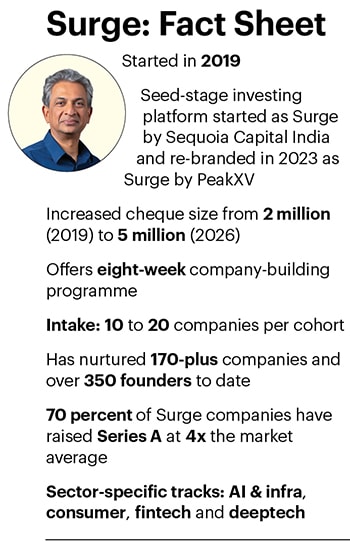
“We think of compound startups more due to the proliferation of AI. You can build a much deeper product, faster, and with lesser capital. What it has meant to us is to increase the cheque size from $500,000 to $5 million as the buy has gone up and the companies can do more,” says Rajan Anandan, managing director at PeakXV, who has been running the Surge platform since his appointment in 2019.
With the first seed fund in its seventh year, Surge has backed nearly 170-plus startups across India, Southeast Asia, Australia and other geographies. Key personnel movements aside, the programme which helps portfolio companies scale to the point of PMF (product-market fit) closed its last cohort in March, with 23 companies.
Anandan tells Forbes India how the programme has evolved in terms of the quality of founders, cheque sizes, and Surge’s approach to startup building. Edited excerpts from an interview:
Q. Since its inception in 2019 as Surge by Sequoia India, to its subsequent rebranding and now, what has changed at Surge?
Rajan Anandan: Surge is PeakXV’s seed stage investing platform, and we were never a separate firm. It has a dedicated investment team and continues to offer full-stack support through talent recruiters, operating team, support for marketing and external operators who work with our startups for their GTM strategy. We have had a few people leave the team.
Shailendra (Singh, managing director) and I continue to co-lead the seed, and I spend a lot of time with these startups and am on the board of some later stage companies.
What has changed though is how much we invest in startups from Surge. When we started in 2019, it was $1 million to $2 million, and around 2023, we revised it to up to $3 million, However a few months back we said we are going to invest from $500K to $5 million.
We continue to be an open architecture model where we don’t take a board seat in Surge companies and do not have super pro-rata rights. This makes it easier for companies to raise Series A round from other investors. Nearly 70 percent of our cohort in Surge on average raises Series A rounds, of which two-thirds are backed by external investors and only a third by PeakXV.
Q. Why did you decide to increase the cheque size for investment?
Anandan: The benchmarks companies need to hit today to raise Series A rounds have gone up dramatically. From a million in ARR (annual revenue rate), today a company has to have between $2 million and $4 million ARR, growing fast, which requires investments. Secondly, with AI, we see that companies are able to build faster, which we call compound startups. Even at the launch, these companies have a fully built-out prototype. The days of raising multiple smaller rounds to get to PMF are gone. Our goal is to set up the companies for success, and we do that by giving them enough capital to get to the required benchmarks and PMF stage.
Q. How do you evaluate that a platform like Surge is working out for the long term?
Anandan: There are multiple ways of answering whether Surge is working—firstly, we wouldn’t know till our first seed fund which we started investing in 2020 has been returned and becomes the best with actual returns. There are still three to four years to go for that. Secondly, we have companies which have scaled and raised follow-on rounds of funding. The third reason is that our founder NPS or Net Promoter Score (a metric for customer experience) across all our 11 cohorts is over 90, which is unheard of. Most of our founders are mature entrepreneurs. We bring the best in the world speakers, and the founders get unprecedented time with them. For the 2026-27 cohort, we are planning to bring Anthropic, and the founders will have unprecedented access to the leadership while they wrap up their immersion week at San Francisco. Which is why our NPS is at 90.
Also, Surge is now global, and the cohort is 50 percent Indian and the rest coming from other geographies. When we started, it was India, Singapore and Southeast Asia. Now we have founders from India, Asia, Singapore, Australia. Last cohort, for instance, we had a founder from the Middle East, and at another time, from London, apart from six to seven companies from the US.
With Surge, we are trying to increase the odds of the success of a company, and our goal is to figure out what it takes to build an enduring company. If you get to PMF, you will raise your Series A. Many of our companies today are national or global category leaders.
Q. How has AI changed the investing and selection at Surge?
Anandan: With AI, you can build a much deeper product in 12 months; what would have earlier taken you five years. So, we increased the cheque size.
Next, the average age of founders in our cohorts is late 20s and the ones building in deeptech, space tech, semiconductors, AI and AI infra have PhDs. We can’t teach them about AI, but they come to us to learn how to build a company, how to set up the GTM strategy, hiring the right talent, and so on. Not all of them are technologists, but they have deep insights into their space.
Amod Malviya, one of the co-founders of Udaan, started Pre6 and is part of Surge’s cohort. Karthik Gurumurthy, who built Instamart, built a consumer brand TEN X YOU with Sachin Tendulkar, who is not a technologist.
A defining characteristic of great entrepreneurs is that they are learning machines. You give them an opportunity to learn; they will. The best entrepreneurs don’t think they know it all. The best entrepreneurs are always looking for that edge.



![[Korean Startup Weekly News #129] Korea Goes Global](https://jobssz.com/wp-content/uploads/2026/08/Korea-Startup-Weekly-News-129-cover-image-1-768x432.jpg)