How do planets clear out objects on the other side of their orbit?
Over billions of years, a planet will have encountered all the small bodies in its vicinity enough times to clear its orbit of them.
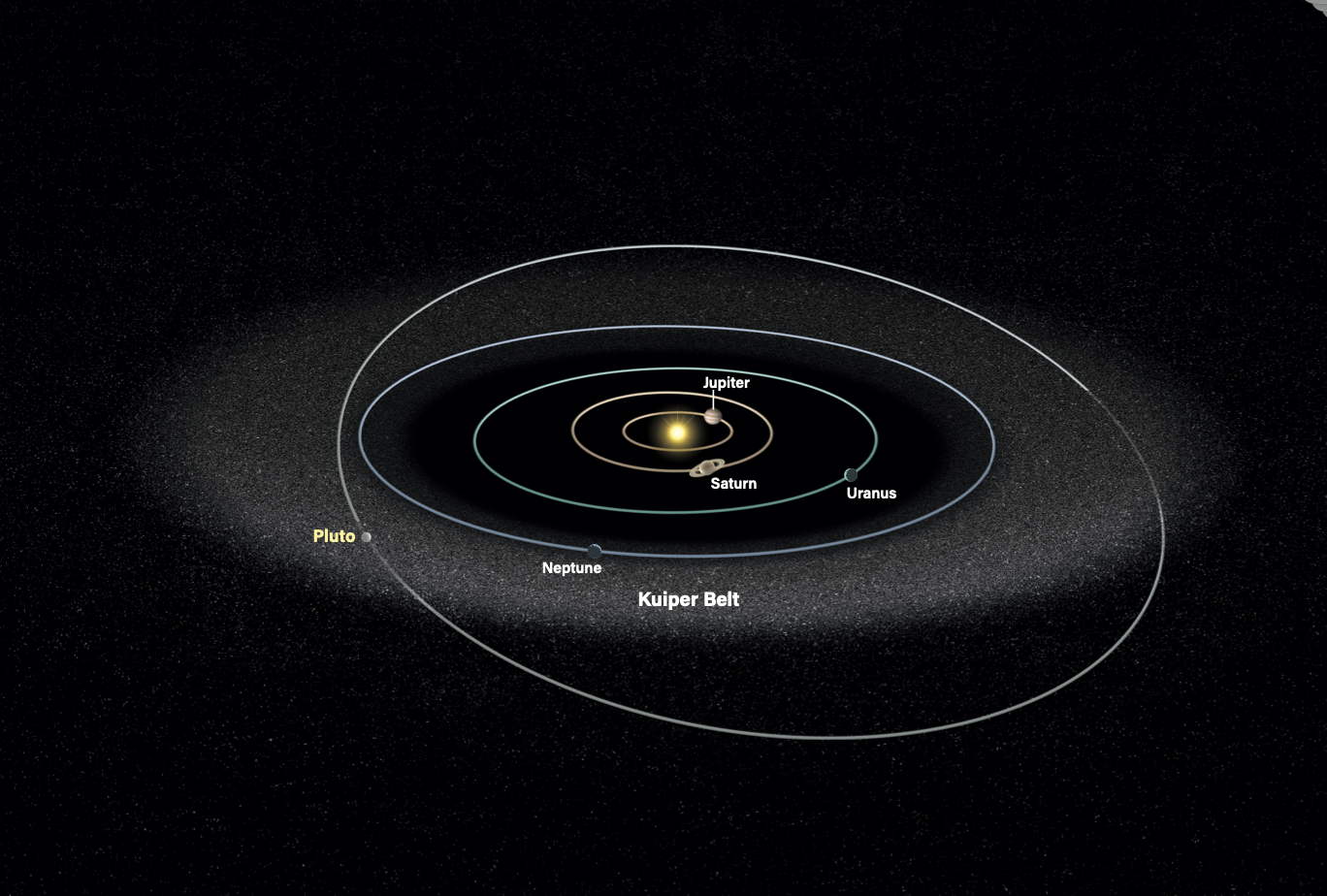
Pluto famously was demoted to dwarf planet because, with its location in the Kuiper Belt, it has not cleared the neighborhood around its orbit — one of the three requirements in the International Astronomical Union’s definition of a planet. Credit: Astronomy: Roen Kelly
To be a planet, NASA says an object must be big enough that its gravity has cleared away any other objects of a similar size near its orbit around the Sun. I can understand how something can clear objects close to itself, but how does it clear something 180° away in its orbit?
Rebecca Smith
Washougal, Washington
The solar system is a dynamic place, and objects located 180° from a planet don’t stay that far from the planet for long.
The reason is the differences in their orbits. Orbits come in all shapes and sizes: In particular, while the orbits of the eight planets of our solar system are nearly circular, smaller bodies are generally on more elongated (or eccentric) orbits. The size of an orbit also controls the time it takes for the object to orbit the Sun; smaller orbits take less time to complete than larger orbits. In addition, objects on eccentric orbits travel faster when they are near their closest point along their orbit to the Sun (their perihelion) and slowest when they are farthest from the Sun (at aphelion).
Imagine a planet on its nearly circular orbit and an asteroid on an overlapping slightly smaller and more elongated orbit, with the two objects at opposite points along their orbits from each other. As the two bodies move forward in the same counterclockwise direction, they will travel at different speeds because of the difference in their orbit size and shape. Eventually, over many orbits around the Sun, one object will catch up to the other and they will become close enough that the gravitational influence of the planet can change the orbit of the asteroid. Over millions and then billions of years, the planet will have encountered all the small bodies in its vicinity enough times to eventually clear its orbit of small bodies.
Sarah Greenstreet
Assistant Astronomer, National Optical-Infrared Astronomy Research Laboratory (NOIRLab)
Related: Is Pluto a planet? It depends.