I tested my USB-C cables with this free Mac app – some weren’t what they claimed

Follow ZDNET: Add us as a preferred source on Google.
ZDNET’s key takeaways
- USB-C cables look identical, but their specs can vary wildly.
- WhatCable reads cable specs for free on Apple Silicon Macs.
- My testing found several cables lying about their specs.
USB-C’s biggest flaw is that every cable looks the same, whether it’s a free charge-only cord that came in the box, or a $159 cable you bought specifically because it was rated for 100W and 40Gbps. You just can’t tell which is which by looking at it, and until now, the only way to find out was to use a dedicated hardware tester, or trial and error.
Also: Why leaving extension cords plugged in permanently is riskier than you realize
Now there’s an app for your Mac that can do all that. And it’s free (unless you want to unlock the advanced features).
What is WhatCable?
It’s a free, open-source Mac app that solves the problem I just mentioned: it identifies what a USB-C cable’s true specs are. To use it, you’ll need a Mac running macOS 14 (Sonoma) or later that’s powered by any Apple Silicon chip (so anything from the M1 all the way to the latest M5 chips).
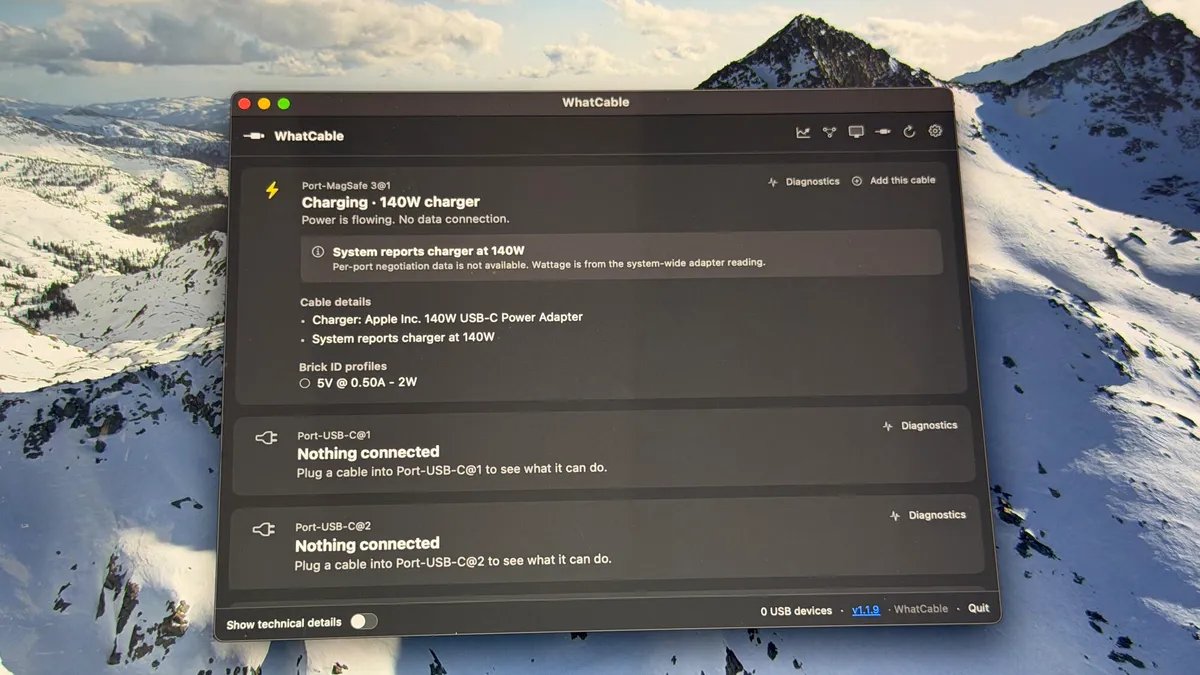
WhatCable can do a lot for a free app.
Adrian Kingsley-Hughes/ZDNET
It’s also privacy-focused, which is rare these days. No analytics, no tracking, and nothing about your cables leaves your Mac. Yes, it does a periodic GitHub version check to make sure it’s up to date, and there is the option to contribute diagnostic data to the WhatCable community, but the developer has taken steps to protect user privacy.
To get started, download it directly from the developer’s website at whatcable.uk, unzip it, and run it.
An alternative way to install it is to use the following Homebrew line in your Mac’s Terminal screen:
brew install –cask darrylmorley/whatcable/whatcable
Once it’s installed, it’ll show you what each USB-C cable plugged into your Mac can actually do, and let you diagnose things like why your Mac is charging slowly or why a connected storage drive is slow or a dock keeps cutting out. Just plug a cable into a port on your Mac, and the app will recognize it — even if it’s not connected to anything. However, accessing the full specs requires an active device on the other end, like a charger or dock.
What can WhatCable do?
The app seems simple enough, but there’s a lot to it, and it’s had me reaching for the online documentation a lot. For example, want to check for things like charging speedbumps or a cable having problems once plugged in? WhatCable can do that.
WhatCable can take a pretty deep dive into all things USB!
Adrian Kingsley-Hughes/ZDNET
And it’s not just USB cables; it can also figure out what’s going on with the MagSafe port on a MacBook, something I haven’t seen mentioned anywhere in the app’s documentation.
There’s also a pro version which costs £9.99 (the developer is in the UK, hence the currency, but this is about $14). This unlocks 16 pro features, from protocol-level event history, negotiation diagnostics and display diagnostics, and a neat live power meter.
One handy feature is that it can interrogate the liquid detection sensor on the ports so you can check to see if the liquid contact indicator has been triggered on any port. If a port is having an issue, this is definitely something to check.
WhatCable Pro is a very powerful tool.
Adrian Kingsley-Hughes/ZDNET
Activating a license also allows you to run the pro features on two Macs.
Some considerations
WhatCable is not perfect. I’ve had issues with some parts of the app not working, like the live power feature won’t work (and yes, I did wait a lot more than the requested minute for it to kick in), and sometimes I’ve had to disconnect and reconnect a cable to get the app to read it.
WhatCable is good, but it’s not perfect.
Adrian Kingsley-Hughes/ZDNET
But for a free app, it’s powerful. And I’m also more than happy to pay for a license to support the developer and get access to more features.
Is WhatCable better than a hardware-based cable tester?
It depends. As for capability differences between the app and hardware testers, it’s a huge field. At one end of the spectrum, you have a $13 tester like the ChargerLAB Power-Z CT001, while at the other end you have the $100 Power-Z KM003C. These standalone testers do a lot, and they’re not reliant on you having a Mac to test cables.
Another thing to bear in mind about standalone testers is that they test cables in isolation, without relying on other hardware. Technically a tester like the KM003C is a passthrough power meter, and isn’t standalone because you connect it to a charger, but it uses that for power, and all testing is synthetic.
Also: The best HDMI cables of 2026: Expert reviewed
Also, as someone who owns over a dozen such cable testing dongles, I can tell you from experience that it’s a lot easier to lose and misplace all of them than it is to lose my MacBook. I love that I don’t have to go scrabbling through a toolbox to try to find one of my testers, I can just plug the cable into my MacBook that I’m already working on.
For the home user, the free version of WhatCable is enough for them to sort out their cable chaos and sort the wheat from the chaff. I used WhatCable to go through a whole pile of cables I’d collected on and around my desk, and I found the process to be quick, easy, and quite therapeutic.
ZDNET’s buying advice
I found a couple of cables that were either damaged or defective because they were massively underperforming, and put them straight into the recycling bin. Also, there was one other that I’d been sent to test that was being deceitful in terms of its spec sheet. It claimed to be able to handle 240W of power, but never went above 100W. It was a no-name brand that I’d never heard of before, so I wasn’t surprised it was a dud.
WhatCable is free, so my suggestion is to give it a go. If nothing else, you might find it entertaining seeing what your cables can and can’t do, and chances are, you’ll find some that don’t live up to their advertised standards.