Startup working with University of Texas focuses on trapping small debris
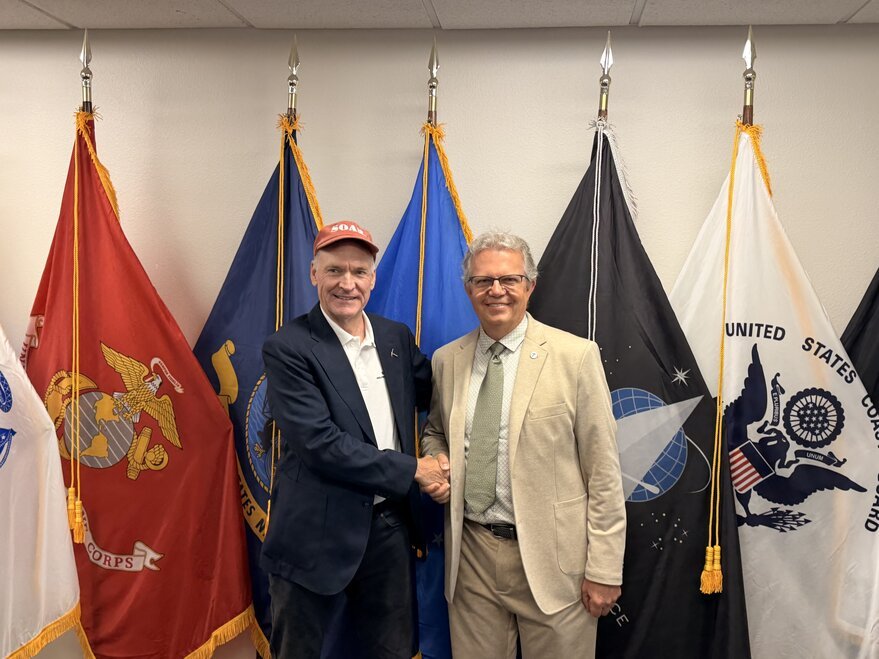
NAPA, Calif. – Florida startup Satellite Orbital Access and Removal (SOAR) announced a partnership July 15 with the University of Texas, El Paso, (UTEP) to develop a passive system to capture small space debris.
“The consequences of even small objects hitting a satellite can be catastrophic when they’re going 7,000 miles per hour or more,” Eric Felt, retired U.S. Space Force colonel and director of the UTEP’s National Security Institute, told SpaceNews. “Today the probability of a collision is still pretty low, but the risk is high because the consequences can be severe. We need to mature the technology to mitigate the impact of small debris before it becomes a crisis.”
SOAR was established in 2025 by Christopher Lee Jones, a retired firefighter and science-fiction author. Through his book, “Mars Mission I: Surviving the Kessler Effect,” Jones became acquainted with astrophysicist Donald Kessler, who predicted in 1978 that a growing population of orbital debris could cause a dangerous cascade of collisions. Kessler is a SOAR advisor.
SOAR seeks to intercept debris measuring 10 centimeters across or less with Passive Orbital Debris Removal System (PODRS), a rotating, multi-panel structure with layered, Whipple-style shielding. PODRS satellites will be equipped with sensors to record impacts, noting the frequency of strikes and momentum transfer.

Critical dependence
Since Kessler identified the hazard posed by small debris, the population of satellites in orbit has grown exponentially. Networks of space-based and terrestrial sensors, meanwhile, primarily track debris larger than 10 centimeters.
“As we put more and more objects into low-Earth orbit, we become more and more critically dependent on those capabilities,” said Felt, UTEP aerospace and mechanical engineering professor of practice and former head of the U.S. Air Force Research Laboratory Space Vehicles Directorate. “So, the consequences of losing the capability are much are higher than they’ve ever been before.”
UTEP’s National Security Institute is the lead designer for PODRS.
“Part of the analysis that UTEP and SOAR will be working on over the coming months is what is the right architecture to have an effective debris capture system with this technology,” Felt said. “You’re certainly not going to clean up all of the small debris in LEO. What you’re going to want to do is focus on specific orbits that are of high consequence and interest.”
Who pays?
In the past, an obstacle to space debris removal has been funding.
“The amount of debris in low-Earth orbit is only going to grow and the demand for small debris cleanup is going to grow with increased risks and collisions,” Jones said.
Once technology is available to solve the problem of small debris, “you figure out who’s going to benefit, Felt said.
“The Department of War is more dependent on LEO capabilities than it’s ever been,” Felt said. “If there were debris-creating events that occurred during wartime, like anti-satellite missile threats, that is a problem that is going to be of great concern to the Department of War and they are going to need an ability to do debris cleanup in order to continue to use space to protect our nation.”
European Space Agency models estimate more than 140 million objects in orbit are less than 10 centimeters across.