SpaceX Falls Below IPO Price for First Time: Lock-Up Cliff and AI Losses Test Bulls

TIMOTHY A. CLARY/AFP via Getty Images
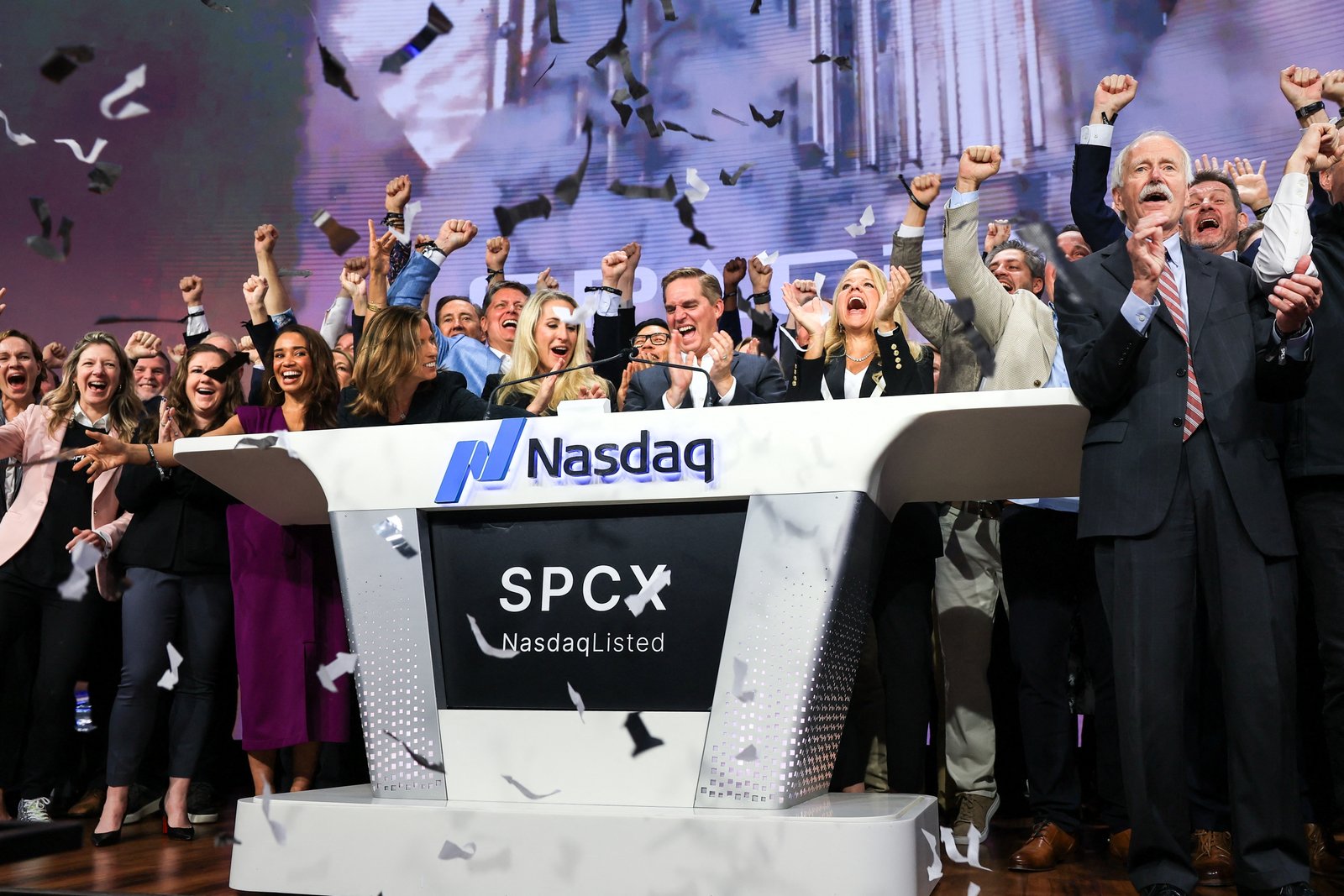
SpaceX (Nasdaq: SPCX) broke below its $135 initial public offering price for the first time Wednesday, touching an intraday low of $132.15 — a threshold that puts every investor who bought the world’s largest IPO at issue price in the red and opens a four-month countdown to the stock’s first major lock-up expiration. The breach came on the fourth consecutive session of declines, ahead of Thursday’s scheduled Starship Flight 13 launch, with no new catalyst visible to interrupt what Interactive Brokers chief market strategist Steve Sosnick called “a market that has simply stopped reminding itself why it bought SpaceX in the first place.”
SpaceX priced its record $86 billion IPO at $135 per share on June 11 and opened trading on June 12 at $150. Shares then surged to an all-time high of $225.64 on June 16 — the same day the company announced its $60 billion all-stock acquisition of AI coding startup Cursor — before a sustained retreat that accelerated through mid-July. From that peak to Wednesday’s low, SPCX shed roughly 41%, which at today’s approximate market cap represents more than $850 billion in market value erased in about a month.
What Broke the Rally: Structural Sell Pressure, Not a Single Shock
The simplest explanation for the slide is also the most structural: with approximately 95% to 96% of SpaceX’s total shares locked up and unavailable for trading, the publicly floated 4% to 5% is extraordinarily thin. At that float size, any meaningful selling by pre-IPO holders seeking liquidity can move the price far more than it would at a company with normal float levels. Fortuna Investments chief executive Justus Parmar put the dynamic plainly: early shareholders who accumulated positions in SpaceX’s private rounds are now seeking their first real exit window, and that selling pressure is structural — it does not end with a single bad trading session.
Capital.com senior market analyst Daniela Hathorn identified three overlapping forces: profit-taking by investors who bought before the IPO at lower private-market valuations; a reappraisal of whether SpaceX’s valuation — still roughly 90 to 100 times its 2025 revenue of $18.67 billion — is sustainable once the IPO enthusiasm settles; and the unwinding of speculative long positions that were built specifically around hype surrounding the blockbuster debut rather than the company’s underlying financials.
Those underlying financials give investors legitimate cause for concern. SpaceX posted a GAAP net loss of $4.937 billion for full-year 2025, reversing profitability it achieved in 2024, and widened that loss to $4.28 billion in just the first quarter of 2026. The company carries an accumulated deficit of $41.3 billion since its founding in 2002. Total capital expenditure in Q1 2026 reached $10.1 billion — of which $7.7 billion flowed into the AI segment comprising xAI, Grok, and the Cursor coding platform. That figure represents roughly 75% of the quarter’s total capex devoted to a business that posted a $2.5 billion operating charge in the same period.
Starlink Profits Cannot Cover the AI Burn Rate
The one division generating real returns is Starlink, the satellite broadband service that reached 10.3 million subscribers across 164 countries as of the first quarter of 2026 and produced $1.2 billion in segment operating profit in that quarter alone, at an adjusted EBITDA margin of 63%. Starlink revenue for full-year 2025 came to $11.4 billion, making it one of the most profitable broadband operations on the planet by margin.
That profit engine, however, is not close to offsetting what the xAI and Cursor AI segment is burning. The AI division posted a $6.355 billion operating loss for full-year 2025 and required $7.7 billion in capital expenditure in a single quarter of 2026. Morningstar equity analyst Nicolas Owens, who placed SpaceX’s fair value at $62 per share — less than half of today’s already-depressed price — described the xAI division as posing “a material threat of value destruction” and assigned only a 7% probability to the scenario in which Starship achieves rapid reusability and orbital data centers become commercially competitive by 2028, the two milestones the current valuation requires. The firm’s most optimistic scenario for SPCX values it at $169 per share, below where the stock was trading as recently as last week.
How Nasdaq’s Rule Change Created a Built-In Exit for Early Holders
One underappreciated contributor to the sell-off is structural to the index addition itself. On July 7, SpaceX joined the Nasdaq-100 — the fastest entry ever recorded for a major U.S. benchmark — thanks to a Nasdaq rule change that took effect May 1, 2026, reducing eligibility from a prior minimum of 90 days to just 15 trading days for companies ranked in the top 40 by market capitalization. The rule also eliminated the prior requirement that at least 10% of shares trade publicly; SPCX’s 4-5% float was accepted as sufficient.
JPMorgan estimated that approximately $4.3 billion in forced buying would flow into SPCX from index-tracking ETFs including the Invesco QQQ Trust — and that buying did arrive. What the bullish case on index inclusion overlooked is the mechanics of what happens to a thin-float stock when a large, price-insensitive buyer enters the market: it gives sophisticated pre-IPO holders a window to sell into demand that has no discretion about price. Of 35 Nasdaq-100 additions since 2022, data compiled by Investing.com found only 12 rose on their first day as index members. Palantir, added in December 2024, fell roughly 23% in the weeks following its inclusion.
SPCX fell nearly 6% on July 7, the day it joined the index — despite simultaneous release of 19 analyst reports, the majority bullish, as the 25-day IPO quiet period expired that same morning. Index inclusion, in this case, functioned as a distribution mechanism rather than a demand floor.
Why August Matters More Than $135
The dollar figure currently generating headlines is $135 — the IPO price — but the date that should be on every SPCX shareholder’s calendar is early August 2026. Under SpaceX’s staggered lock-up structure, disclosed in its SEC prospectus, the first major tranche of insider shares — approximately 20% of the 180-day lock-up block — is scheduled to become eligible for sale following the company’s first quarterly earnings report as a public company, expected in late July or early August.
The structure was specifically designed to prevent the single-event “lock-up cliff” common to simpler IPOs, spreading the potential supply across multiple release events through the end of 2026. Further time-based tranches are scheduled at approximately 70, 90, 105, 120, and 135 days from the listing, with an additional 28% of eligible shares potentially releasing after the Q3 2026 earnings call. The full 180-day standard lock-up expires December 9, 2026. Elon Musk’s personal lock-up, under a separate 366-day arrangement, does not expire until June 13, 2027.
A price-performance trigger also exists: if SPCX closes at least 30% above its $135 IPO price — above approximately $175.50 — on five of any ten consecutive trading days, an additional 10% of the eligible lock-up block can release early. With the stock now below $135, that trigger is not in play today.
Swissquote Bank analyst Silvia Ozkardeskaya warned at the time of Nasdaq-100 inclusion that SPCX’s entry “will increase the Nasdaq 100’s volatility, challenge its capacity to represent underlying economic and financial fundamentals, and potentially hurt its credibility” — a concern that now seems prescient given the index added the stock at a moment when subsequent weeks produced a string of all-time lows.
Starship Flight 13 Tomorrow: What a Successful Test Would and Would Not Change
SpaceX’s Starship rocket is scheduled for its 13th integrated flight test on Thursday, July 16, with a 90-minute launch window opening at 6:45 PM ET from Orbital Launch Pad 2 at Starbase, Texas. This is the second flight of the Version 3 configuration featuring Booster 20 and Ship 40, both equipped with Raptor 3 engines.
The mission profile was adjusted following the May 22 failure of Flight 12, in which Booster 19 was pushed into an unexpected position during stage separation, sustained heat damage, and then lost its boostback burn and landing burn when some engines failed to reignite. SpaceX engineers traced the anomaly to a defect in the engine ignition timing sequence during separation — causing the booster to deviate in the wrong direction at a critical moment — and redesigned the ignition sequence for Flight 13.
For Flight 13, Booster 20 will attempt a controlled boostback burn followed by a splashdown in the Gulf of Mexico, rather than a return-to-pad catch attempt. Ship 40 follows a suborbital trajectory. For the first time, Starship will carry payload: 20 next-generation Starlink V3 satellites, equipped to extend solar arrays and antennas and attempt high-capacity laser links with existing constellation members and ground stations in South Africa. Six of the satellites carry cameras to image Starship’s heat shield during flight — a diagnostic first. Because the satellites follow the same suborbital arc, they will re-enter the atmosphere shortly after deployment; this is a capability demonstration, not an operational deployment.
The technical significance of a successful Flight 13 is real — a clean boostback burn and water landing would confirm the ignition timing fix and extend the V3 envelope closer to the full return-to-launch-site profile Starship needs for commercial viability. Its stock significance is murkier. Sosnick noted that there is no obvious “new catalyst” available to remind investors of the original bull thesis, and a suborbital test flight that ends with a planned ocean splashdown, even a clean one, may not deliver the kind of moment that restarts a stalled narrative.
Wall Street Remains Bullish, but the Spread Is Extraordinary
More than 80% of the analysts covering SPCX carry buy or outperform ratings, and the consensus 12-month price target sits around $240 per share — roughly 80% above Wednesday’s trading level. The most optimistic published target comes from Raymond James at $800 per share, based on a long-horizon thesis covering Starship commercial dominance, Starlink expansion, and xAI’s eventual competitive position.
The $738 spread between Morningstar’s $62 floor and Raymond James’s $800 ceiling is not a normal range of analyst disagreement. It reflects fundamentally different probability estimates for whether SpaceX achieves two near-simultaneous engineering and commercial milestones — rapid Starship reusability and orbital data-center profitability — on the specific timeline the current valuation prices in. Morningstar assigns a 7% probability to that scenario. Raymond James assigns something close to certainty. A reader deciding whether to buy, hold, or sell SPCX today is not choosing between prices; they are choosing between probability models.
The Ripple Effect: Anthropic and OpenAI Are Watching
SpaceX’s post-IPO trajectory matters well beyond its own shareholders. Both Anthropic and OpenAI have filed confidential IPO prospectuses with the SEC this summer. Anthropic was most recently valued at approximately $965 billion in a May 2026 funding round; OpenAI is targeting a public debut as early as September 2026 at a valuation that discussions have centered above $1 trillion.
Goldman Sachs has projected total 2026 IPO proceeds could reach approximately $160 billion — roughly four times 2025 levels — with these three companies representing the dominant share of that volume. The institutional capital that flowed into SPCX is the same capital base being asked to absorb two more trillion-dollar AI company listings before year-end. A SpaceX that continues to drift below its issue price does not kill those offerings, but it signals to institutional allocators what post-honeymoon AI valuations may look like once the quiet period expires and real fundamental analysis replaces IPO-week enthusiasm.
How Long Does a Typical Tech IPO Take to Recover Its Price?
History is not uniformly encouraging. A 2024 analysis of large tech IPOs found that roughly half of those that broke their issue price within 90 days of listing recovered to that price within 12 months, and roughly a quarter remained below issue price at the 24-month mark. SpaceX is not a typical large tech IPO — its revenue multiple, its float mechanics, its accumulated deficit, and its lock-up structure all sit at extremes that have no direct comparable — but the pattern is worth noting for investors deciding whether $135 is a line worth defending or a level to watch break further.
Morningstar’s $62 price target implies the stock could fall more than 50% from current levels and still be in line with what one major independent research house considers fair value. CFRA currently carries a sell rating at a $115 target. The consensus, at roughly $240, requires a near-perfect execution of a multi-year business plan by a company that has never demonstrated GAAP profitability under its current structure.
Frequently Asked Questions
Why did SpaceX stock fall below its IPO price today?
Multiple structural factors converged rather than a single catalyst. Early investors who held SpaceX equity in private rounds have been exiting through the thin public float — with only about 4% to 5% of total shares available for trading, any meaningful selling pressure produces outsized price moves. Separately, Nasdaq-100 index inclusion on July 7 triggered roughly $4.3 billion in forced buying by passive ETFs, which sophisticated pre-IPO holders used as a distribution window rather than as a floor — a well-documented pattern in IPO-era index additions. Beyond the mechanics, investors have been reappricing the stock against its fundamentals: SpaceX reported a $4.28 billion net loss in Q1 2026 alone, with $7.7 billion of capital expenditure in that quarter flowing into the xAI AI segment, which generated a $2.5 billion operating charge. Those figures are hard to reconcile with a valuation above 90 times annual revenue.
When does SpaceX’s lock-up expiration happen, and why does it matter?
SpaceX uses a staggered lock-up structure rather than a single expiration date. The first significant tranche — approximately 20% of the shares in the standard 180-day lock-up block — is scheduled to become eligible for sale following the company’s first post-IPO earnings report, expected in late July or early August. Additional time-based tranches follow through autumn, with the full 180-day standard lock-up expiring December 9, 2026. Elon Musk’s personal lock-up runs until June 13, 2027. Lock-up expirations matter because they convert previously unsellable shares into potential supply. With roughly 95% of SpaceX’s total shares currently locked, even a fraction of those tranches entering the market would be large relative to the existing 4-5% float — which is exactly why the staggered design was structured to spread that supply over multiple events rather than a single cliff.
What is SpaceX’s analyst price target, and how much do analysts disagree?
The consensus 12-month price target among more than 20 analysts covering SPCX sits around $240 per share, implying roughly 80% upside from Wednesday’s levels. More than 80% of analysts carry buy or outperform ratings. However, the range of targets is extraordinary: Raymond James holds the most bullish published target at $800 per share, while Morningstar’s independent equity analysis places fair value at $62 — less than half the current price — and Morningstar’s most optimistic scenario comes in at $169, below where SPCX was trading as recently as a week ago. CFRA carries a sell rating at $115. This spread reflects fundamentally different probability estimates for whether SpaceX achieves rapid Starship reusability and xAI commercial profitability on the timeline the current valuation requires — not a disagreement about what SpaceX’s current financials say.
What is the significance of Starship Flight 13, and could it change the stock’s direction?
Flight 13, scheduled for Thursday evening from Starbase, Texas, is the second test of Starship’s Version 3 configuration. Its primary engineering significance is as a validation of the ignition-timing fix applied after Flight 12’s booster loss on May 22, when a defect in the engine sequence during stage separation caused the booster to deviate in the wrong direction and fail its boostback burn. A clean Flight 13 — boostback burn executed, controlled water landing achieved — would confirm the fix and advance the program toward the fully reusable launch system SpaceX needs for Starship to generate commercial returns. The flight will also attempt the first deployment of Starlink V3 satellites, equipped with high-capacity laser links for the constellation. For the stock: a successful launch removes a near-term risk but does not itself create the “new catalyst” that would need to reintroduce buying momentum. A partial failure or anomaly, on the other hand, would add technical uncertainty to an already-stressed narrative heading into the first lock-up release window.