A former NOAA employee is rebuilding the government-run climate change response site that President Trump forcibly shut down.

The National Oceanic and Atmospheric Administration (NOAA) , an agency of the U.S. Department of Commerce, operated the climate change website ‘Climate.gov.’ However, the Trump administration suddenly shut down this site, putting a risk of losing valuable climate-related information accumulated over 15 years. Former NOAA employees are now rebuilding Climate.gov.
Trump dismantled the NOAA climate website. These women rebuilt it.
https://19thnews.org/2026/07/noaa-climate-data-website/
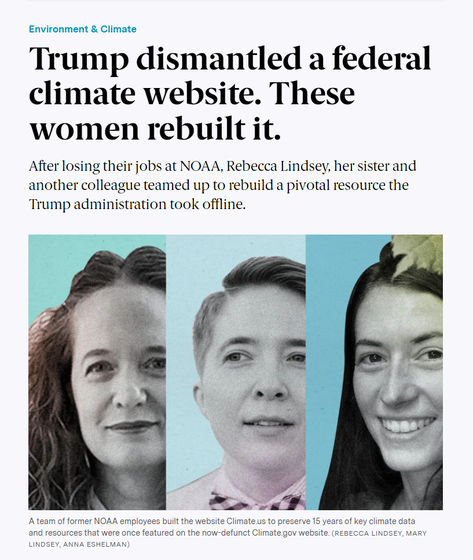
In 2025, the Trump administration shut down Climate.gov, a climate change action website operated by NOAA. Furthermore, the Trump administration laid off approximately 280,000 government employees, many of whom were NOAA staff. Note that at the time of writing, accessing Climate.gov redirects you to NOAA.
One of those laid off NOAA employees is Rebecca Lindsay. She, along with Anna Eschelman, who was also laid off from NOAA, and her sister Mary Lindsay, launched Climate.us, a replacement for the shut-down Climate.gov. They are working to preserve important climate data and documents that have been recorded for over 15 years. Rebecca Lindsay stated that the purpose of Climate.us is ‘reliable climate information should not disappear, even as political situations change.’
Climate.us Home
https://www.climate.us/
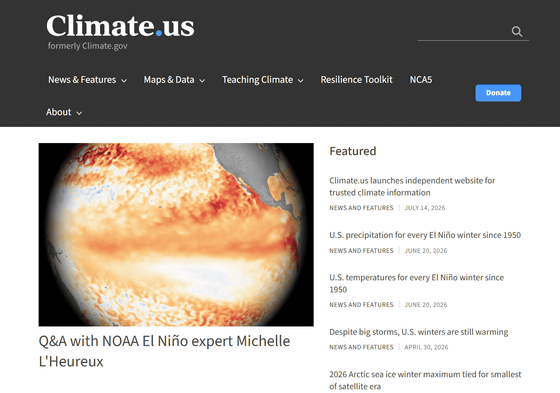
The materials preserved by Climate.us include important maps, educational materials, and climate indicator reports, as well as the Fifth National Climate Assessment Report (NCA5), which was removed from Climate.gov. NCA5 is the most comprehensive analysis of climate change ever conducted by the U.S. government, and ‘was in danger of being lost without ever being seen by the public,’ according to news outlet The 19th News .
According to Rebecca, Climate.gov has been a go-to source for decades, translating complex climate science data into accessible information for the general public, providing over 15 million website visitors annually with essential tips ranging from how to weather heatwaves to explanations of El Niño’s impact on hurricanes. Climate.gov was funded by the government, but the Trump administration reversed course and funding was abruptly cut off. ‘It was shocking,’ Rebecca said.
Rebecca spoke about the current state of the climate community, saying, ‘The current state of climate communication and climate journalism is not good. We feel it is really important to have a mature, robust, and inclusive online platform that can act as a hub. We feel that we need a foundation, a base, that others can build and grow on,’ and spoke about the need for Climate.us.
As of the time of writing, Rebecca is the editor-in-chief of Climate.us, Eschelman is the lead designer, and Mary is the lead data visualizer. Prior to being laid off from NOAA, Rebecca was a program manager at Climate.gov, Eschelman was an artist on the Climate.gov team for over four years, and Mary worked at Climate.gov for 13 years as a visualization specialist.
Rebecca said, ‘We are communicators, not climate scientists. Climate.us will be a bridge between scientists and the general public.’
Since its launch on June 23, 2026, Climate.us has raised over $400,000 (approximately 65 million yen) through crowdfunding and individual donations. Rebecca explains that while the long-term outlook is uncertain, they have enough funds to continue the project until early 2027.
According to Rebecca, Climate.us aims to continue growing and updating while maintaining the most noteworthy parts of the site. ‘What we have now is not the complete Climate.gov, but we feel it’s worth it. This is an achievement, and we are doing our best to keep the most important parts of the site up to date,’ Rebecca said.
Climate.us is run by three people: Rebecca, Eschelman, and Mary. However, they estimate that they will eventually need around 10 to 12 employees for sustainable operation. Although they only have three employees, more than 80 scientists volunteer to review the content to ensure scientific accuracy.