TuxBot v3: The IoT Botnet Built With AI
TuxBot v3: The IoT Botnet Built With AI – Bugs, Disclaimers and All

 July 16, 2026
TuxBot v3, an AI-built IoT botnet for 17 architectures, shipped with LLM bugs and safety disclaimers the developer never removed.
Palo Alto Networks’ Unit 42 identified a previously undocumented modular IoT botnet framework called TuxBot v3 Evolution, and it comes with an unusual detail: the developer used a large language model to write significant portions of the code, and the LLM’s safety disclaimer ended up in every compiled binary. Sixty-one C source files each carry an identical header warning that “this code is for educational and authorized security research only.” The developer shipped it without removing a single line.
“The malware authors leveraged an LLM to assist in their code development, yielding mixed results. While the AI complied with their request to generate botnet code, it included a safety disclaimer that the developer failed to remove before shipping.” reads the Unit 42’s report. “Although the LLM clearly aided in constructing the botnet, several functions in the analyzed samples failed to work correctly. While a manual code review could have easily resolved these errors, the authors neglected this step. “
The LLM’s raw chain-of-thought reasoning was also left verbatim in source file comments throughout the codebase, including gems like “// I created them so I should know?” and “// Wait, where is the command?”, an LLM narrating its own confusion to itself, preserved for posterity in a working botnet.
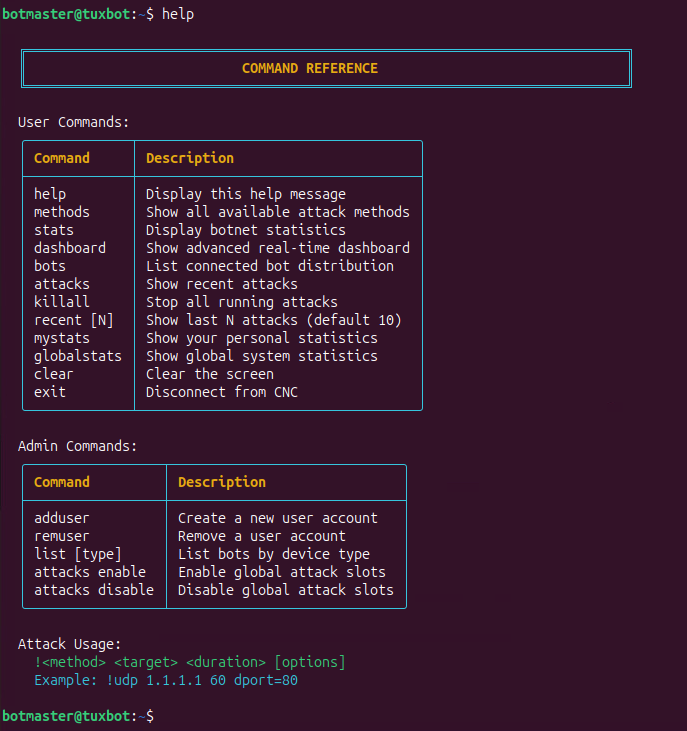
The framework is substantial. It cross-compiles a C-based bot agent for 17 architectures, including ARM, MIPS, PowerPC, RISC-V, and x86_64. It includes a Go-based command-and-control server with a DDoS-for-hire panel, a custom exploit virtual machine, Docker-based test infrastructure, and an automated build system.

The bot brute-forces Telnet access with 1,496 credential pairs and contains exploit code targeting more than 30 IoT device families.
“The TuxBot framework we recovered and analyzed is approximately 70% functional. The core infection flow (scanning, credential brute-forcing, persistence, primary C2 setup and DDoS execution) works.” continues the report. “The Telnet, SSH, HTTP and Android Debug Bridge (ADB) scanners all operate correctly. Furthermore, with its 1,496 credential pairs, the Telnet scanner remains a viable infection vector.”
The parts that don’t work trace almost entirely to bugs introduced by the LLM.
The most consequential LLM failure is in the C2 authentication module. The developer asked for Argon2id password hashing. The LLM couldn’t import the right library, fell back to SHA256 loops, but kept the Argon2id comments, constants, and output format, including a return value formatted as “$argon2id$v=19$…” that contains nothing of the sort.
“Despite its use of PKBDF2 for password hashing, the LLM formats the output to look like Argon2id anyway:
return fmt.Sprintf("$argon2id$v=19$m=%d,t=%d,p=%d$%s$%s", ...)
The LLM hallucinated that it implemented Argon2id but actually fell back to SHA256 loops while keeping the Argon2id comments, constants and output format.” states the report.
There’s also an XOR key mismatch that breaks the IRC fallback channel, four exploit payloads, and HTTP polling. The custom exploit VM never fires because the Go compiler writes the file magic as “TUXE” while the C runtime expects “EXPL.” Sixteen exploit functions are compiled as dead code that never get called. Seventy-eight attack vectors mapped to six handlers, all HTTP application-layer methods silently redirected to TCP SYN floods.
“During our research, we were able to fix these issues with a handful of LLM-assisted prompts. We reconstructed the correct table entries and fixed the IRC C2 channel with a few targeted prompts.” states Palo Alto Networks. “Given that the operator already has the source code and has been actively deploying binaries (six new samples in April 2026), we can reasonably assume that a version with some or all of these fixes already exists in the wild.”
Unit 42 found six new samples in internal telemetry in April 2026, compiled with GCC 14.2.0 production builds across multiple architectures. The C2 infrastructure at 209.182.237[.]133 has been active since at least March 2026.
The developer’s Git log leaked their workstation hostname pointing to an Iranian-hosted machine, and the parent domain digikalas[.]online resolves to Iran’s Arvan Cloud CDN. Shared dropper infrastructure at 185.10.68[.]127 on FlokiNET links TuxBot to Kaitori v3.9 and AISURU tooling, separate codebases that all converge on the same bulletproof host, placing the operator within the Keksec ecosystem.
The development timeline starts in January 2025 with the developer cloning the open-source MHDDoS DDoS toolkit from GitHub, with 254 automated benchmark reports generated in early January 2026 and the first VirusTotal submission appearing January 20. Somebody spent a year building this. The AI helped with most of it, introduced most of the bugs, and nobody caught them because the generated code reads cleanly on the surface.
“Shared infrastructure with Kaitori v3.9 and AISURU tooling places the TuxBot operator within the Keksec ecosystem. This group is known for running multiple IoT botnet variants in parallel. TuxBot appears to be another variant in that portfolio. It’s one that aims to go beyond the usual Mirai fork with its encrypted C2, its DGA and a modular exploit system, even though that system does not work yet in the version we recovered.” continues the report. “The broken features can be fixed. We demonstrated this during our analysis by reconstructing the IRC C2 channel and decrypting the mismatched table entries with a few targeted LLM prompts. “
Follow me on Twitter: @securityaffairs and Facebook and Mastodon
(SecurityAffairs – hacking, TuxBot v3)