Your First AI Agent Decisions Determine the Platform’s Fate
Don’t Build the Cathedral First

By Pankaj Gupta
Building AI-native platforms with agentic AI is one of the most consequential architecture decisions a team makes, and most teams make it too late.
Twenty agents from now — what do you have?
Most teams can explain what each individual agent does. Very few can explain what twenty agents become together. That gap, between building agents and building a system that compounds is the question that reshapes how you design from day one. The teams that ask it early build something fundamentally different from the teams that ask it after their fifteenth agent.
The patterns described here draw from our experience building in a regulated, workflow-intensive domain, one of the most operationally complex in healthcare. But we have deliberately kept the framing generic enough to apply across any regulated industry. This is a snapshot of in-progress thinking, not a finished blueprint.
Somewhere in your organization, a team spent the last eighteen months building workflow automation on a foundation that was never designed for learning. The agents work. The throughput numbers look good. And now someone is asking what it would take to make the system actually get smarter over time: to compound on what it’s observed, to capture expert judgment as signals, and to pass a compliance audit on a decision made fourteen months ago.
In most cases, the answer is start over. Not because the team made bad decisions. Because the decisions that determine whether a platform can learn are made in the first few weeks of design, before anyone is thinking about compounding intelligence. By the time the question is asked, the architecture has already answered it.
This post is for the teams who haven’t hardened yet. Part 1 lays out the North Star: what an AI-native platform actually is in a regulated environment, and what it architecturally requires. Part 2 is a field guide for teams building point solutions right now, under real delivery pressure, covering the specific decisions that preserve the path to the North Star instead of paving over it.
PART 1: The North Star — What an AI-Native Platform Actually Is
The mistake hiding in the phrase “AI transformation”
Ask ten organizations what their AI strategy is and nine of them will describe an enhancement layer. A smarter intake parser. A predictive model for case routing. A dashboard that surfaces risk flags. The underlying architecture, the data model, the orchestration logic, the audit trail, who owns which decisions, stays exactly as it was. The intelligence sits like a coat of paint on top
This approach has a trap door built into it. The intelligence doesn’t compound. The system never gets holistically smarter. And when a compliance representative asks what the system knew when it made a specific decision fourteen months ago, someone has to go spelunking through logs for two weeks to produce an approximation. That’s not an AI-native platform. That’s traditional software with AI features bolted on.
The distinction worth naming explicitly: AI-Assisted puts intelligence on top of existing workflows. Each agent solves a step and stops there. Context resets at every handoff. Expert corrections vanish. The platform stays reactive. AI-Native means every agent is designed to make deposits, so the system learns from every interaction, every decision, every expert override, whether or not you are actively building. The difference is not incremental. It is architectural.
The real shift, the one most transformation programs are underestimating, isn’t from no AI to AI. It’s from software systems to learning systems. Traditional software executes predefined logic. An AI-native platform, built correctly, gets better with every case, every decision, every exception handled by a human expert. That difference isn’t incremental. It’s architectural.

Why regulated environments make this harder, and more important
In consumer tech, you can iterate fast and fix later. In regulated industries: healthcare, financial services, insurance, government, you don’t have that luxury. Every decision must be safe, auditable, explainable, and governed. The consequences of getting it wrong aren’t measured in cycle time. They’re measured in patient harm, regulatory action, or financial exposure.
This creates a tension most AI platform designs don’t grapple with honestly: how do you build a system that learns continuously without becoming a compliance liability? The answer that reshaped our architecture came from a single conversation.
I can defend a wrong answer if I can explain the reasoning. I can’t defend a black box, even if it’s usually right.
– Compliance representative, regulated healthcare
That sentence is the design brief for AI-native platforms in regulated environments. It pushes you away from optimizing for model accuracy and toward building what we’ve started calling trust infrastructure: the audit trails, decision records, and frozen context snapshots that make every determination explainable before anyone asks to explain it. This is not a constraint on intelligence. It is the thing that makes accelerating intelligence safe to deploy.
Five beliefs that define the architecture’s center of gravity
These aren’t aspirational statements. Every architecture decision either supports them or works against them.
Belief 1: Intelligence Compounds. Every case processed is training data. The platform running for eighteen months isn’t the same platform it was at launch: it’s measurably smarter about your specific workflows, edge cases, and domain patterns. If your platform isn’t demonstrably smarter over time, you haven’t built an AI-native platform. You’ve merely built more software.
Belief 2: Data Is the Moat, Not the Models. Frontier models are increasingly commoditized. A competitor who starts two years later can buy the same model. What they cannot buy is your governed operational data: real case outcomes, real expert overrides, real domain-specific behavior, classified correctly and fed back under domain authority. The moat is in the learning loops, not the inference layer.
Belief 3: Human Decisions Are Signals, Not Overhead. When an expert overrides an AI recommendation, the person is generating ground truth. The interface they use, the reason they document, whether they followed the suggestion or departed from it. All of it is the highest-quality training data the system will ever see. Most systems let this disappear the moment the case closes. The UX is a data collection architecture, not just a workflow surface.
Belief 4: Proactive Intelligence Beats Reactive Automation. A system that waits for a step to trigger and executes it faster is an automation tool. An AI-native platform reads the case before it runs it, surfacing the right information, flagging the right ambiguity, routing to the right expert before anyone has to ask.
Belief 5: Governance Makes Compounding Intelligence Safe to Deploy. Without governance, a learning system in a regulated environment is a liability. With it, every improvement cycle is defensible to a compliance representative and a regulator. Governance is not the brake on intelligence. It is what lets you accelerate with confidence, and it’s the piece most AI platform designs leave out until it’s too late.
Three layers every AI-native platform needs
When these layers are clean and separated, the system is governable and scalable. When they blur, when configuration logic leaks into orchestration, or agents start managing their own retries, you get brittleness that’s hard to diagnose and expensive to fix.

The Control Layer: Policy & Governance. Safety constants that no runtime system can reach. Versioned configuration that domain experts, not engineers, author and own. Autonomy thresholds per agent class. Compliance controls and audit policies. Safety constraints live in a physically separate store with no programmatic edit path from runtime systems. Changes require a formal process: documented request, compliance sign-off, architecture review, mandatory freeze period. Configuration is not code. Policy changes belong to domain experts, not engineers.
The Execution Layer: Workflow & Intelligence. A durable orchestration engine is the spine. It handles retries, idempotency, and failure recovery, ensuring no case is ever lost, duplicated, or unreplayable. Agents are coordinated through a directed graph, each receiving a pre-resolved context snapshot and executing a bounded reasoning task. The hardest-won principle: AI cannot manage its own reliability. The separation between “agents reason” and “the spine manages” must be enforced by design, not convention. Autonomy operates in tiers: RECOMMEND → PROPOSE → APPROVE → EXECUTE, earned through demonstrated accuracy, not deployment dates (see Levels 0 – 3 in Part 2, which govern how far an agent may advance through this pipeline unsupervised).
The Data Layer: Truth & Learning. Immutable case snapshots, the frozen context each agent works from, preserved permanently for audit. Structured decision records written before any state mutation executes. A governed learning pipeline where every expert override is classified before it touches training: policy change, data gap, corpus issue, or genuine reasoning failure. Each triggers a different response. Monthly governed cycles, not continuous retraining.
The ten design commitments
The principles that have survived the most scrutiny: architecture reviews, compliance challenges, and stakeholders asking uncomfortable questions. We have listed them all, but three are worth sitting with longer than the others: canonical context, structured decision contracts, and config-driven governance. Everything else is important. Those three are load-bearing.
- Safety is structural, not configured. Hard rules live outside the learning system. Always.
- Configuration is the human-to-platform interface. Policy changes belong to domain experts, not engineers.
- Intelligence runs inside a durable spine. Agents reason. The spine manages. Never blur these.
- Autonomy is earned in tiers. Tie it to demonstrated performance, not deployment dates.
- The system reads before it acts. A planning layer for novel cases before a single step runs.
- Decisions are made against frozen context. Immutable snapshots, not live queries. This one is non-negotiable in a regulated environment: the agent must reason from the same context snapshot that will be presented in any future audit. If the agent reads live data, you cannot reconstruct what it saw. And if you cannot reconstruct what it saw, you cannot defend what it decided.
- The audit answer exists before the question. Structured decision records, not just logs. There is a difference between a log that records what happened and a decision record that captures what the agent knew, what it recommended, why, and what a human did with it. Only the second one answers an auditor’s question without reconstruction.
- Every override is classified before training. Not all feedback is equal. An expert judgment override and a data quality override are different signals requiring different responses. Classify before they touch training.
- The interface is training infrastructure. UX captures expert judgment as signals.
- Governed data is the moat. Your competitive advantage will be your learning loops, not your models.
The question worth asking before the architecture hardens
The most important shift isn’t technical. It’s in what questions you are asking.

PART 2: Building Point Solutions That Don’t Close the Door
The honest case for point solutions
Most organizations cannot build the North Star platform described in Part 1 in one move. The legacy systems aren’t sunset, the APIs are unconfirmed, the budget approval is incomplete, and the team has nine weeks and four parallel workstreams. The right response is not to abandon the vision. It’s to build point solutions in a way that preserves the path toward it, where the artifacts, contracts, and data generated today become pluggable agents in tomorrow’s architecture, rather than liabilities to unwind.
There’s a version of “move fast” that produces working agents in a few weeks and orphaned technical debt in month twelve. There’s another version slightly more disciplined, no more complex, that produces working agents and a portfolio of canonical data shapes, output contracts, tribal knowledge, and accuracy baselines that plug directly into the AI-native platform when it arrives. The difference is not in how fast you build. It’s in a handful of decisions made before the first line of code.
Identify where your use case sits on the capability spectrum
Not every point solution needs to be a fully autonomous reasoning agent. Over-building here is one of the most common sources of delivery failure. Before designing anything, identify which type of agent the use case actually requires.

An AI Assistant that summarizes a case brief needs different architecture than an Agentic Workflow coordinating across three systems. Conflating them produces either an over-engineered assistant or an under-governed agent. Levels 0–3 describe how far an agent may move through the RECOMMEND → PROPOSE → APPROVE → EXECUTE pipeline without a human gate, not a separate progression. Level 0 (Shadow) generates a full recommendation that no one acts on. Level 1 (Assist) surfaces a proposal for a human to shape. Level 2 (Recommend) delivers a recommendation for human approval before execution. Level 3 (Act) is the only level where the agent executes without human confirmation, and it requires explicit compliance and leadership approval. Target Levels 0–2 for initial delivery; autonomy is earned through measured shadow accuracy, not delivery timelines.
What a point solution agent actually is
An agent is a goal-oriented, reasoning system that iteratively uses context and tools to make decisions and take actions until the goal is achieved, blocked, or escalated. It has a purpose, not just a trigger. It decides what to do next based on current context. It knows when it’s blocked and escalates with enough context for a human to decide.
Traditional software fails loudly. Agents fail quietly. An agent consuming incomplete data does not crash, it produces a confident-sounding output that may be wrong. Designing for this failure mode is what separates a working demo from a trustworthy production system.
Every agent has a bounded context: an explicit definition of its goal, the data it can perceive, and the actions it is permitted to take. Everything outside that boundary is off-limits by design. The Do Not list is as important as the capability Do list.
The decisions that determine portability
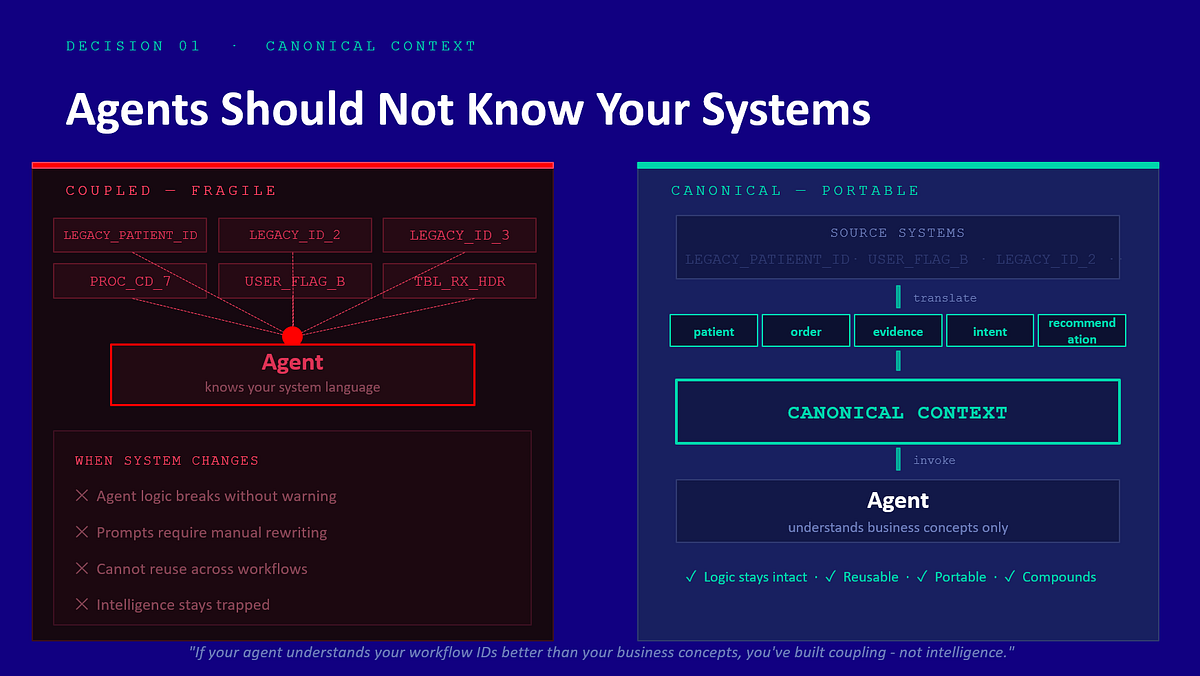
Decision 1: Canonical Context. Never let source-system constructs leak into agent logic. They show up in three places.
This is the single design decision that most directly determines whether your point solution is portable to a next-generation platform or has to be rewritten from scratch. It has three coupling surfaces, not one:
- Agent logic: no source system column name or internal code ever appears in agent reasoning or state.
- Prompts: prompts that reference system names or workflow steps couple the agent to the current environment. Correct framing: “Using the scheduling context provided, propose the best available slot options for human confirmation.” No system knowledge. No workflow encoding.
- Tool names: getCaseContext() not getLegacySystemCase(). Tool names are part of the agent’s mental model.

The implementation is simpler than it sounds: one translation function per source system, twenty to forty lines of code that converts the raw legacy response into a shared canonical shape before the agent sees anything. The agent operates only on canonical data. In practice this is a single function that knows your legacy language so your agents never have to. When upstream systems change, and they always do, you update one function, not every agent.
The test: can your agent be described entirely in terms a domain expert would understand, with zero reference to a system field name? If not, you have built coupling. Not intelligence. And coupling compounds technical debt, not learning.
Log any unavoidable deviation in a portable Debt Register: documented, owned coupling with a remediation plan is acceptable; undocumented coupling is not.
Decision 2: Token Budget. Token budget is a design constraint, not an infrastructure concern.
An agent built without an explicit token budget will run fine in development and fail unpredictably on complex production cases, silently truncating context, producing confident-sounding outputs from incomplete data, with no error signal. Before design begins, allocate the budget explicitly across four components: system prompt, canonical context, tool call results, and output. Log token usage in every output contract from the first shadow run. If budget exceeds 80% on more than 20% of shadow runs, fix it before promoting to any higher autonomy level. One important rule: only reference data, rules, mappings, lookup tables, is safe to cache. Operational context must be freshly fetched on every invocation. State changes. A decision based on stale data is a risk with no error signal.
Decision 3: Structured Decision Contracts. Make the output contract the bridge, not the afterthought.
Every agent produces output conforming to a shared contract. It is also the most valuable thing the point solution phase produces for the platform phase, because the human feedback fields are the highest-quality training signal the future AI-native platform will see.
The contract captures the case identifier, confidence score, missing data flags, token usage, autonomy level, and a human feedback block containing the decision, reason code, and override reason. The reason code field is the most operationally valuable: it tells you not just that an expert disagreed, but why. That distinction is what turns an override into a learning signal, rather than a lost correction.
A systematic pattern of incomplete-data overrides points to a canonical gap. Rule-incorrect overrides point to a config file that needs updating. Context-missing overrides point to canonical types that need expanding. Expert judgment overrides, the most important signal, indicate the agent is operating at the boundary of its intended scope. That is a bounded context problem, not a model problem. Every clinician override captured with a reason code is a labeled training data point. In the AI-native platform, that is the governed learning pipeline’s primary input. In the point solution phase, it is the accuracy baseline and the compliance audit trail. The same artifact serves both phases. That’s not an accident, it’s how you design a bridge.
This is also the moment to think about what each agent leaves behind, not just what it produces. The output contract is not the end of an agent’s job. It is the deposit into the shared layer that makes the next agent smarter. A fulfillment agent that captures a structured decision record is not just completing its task, it is writing into the institutional memory that a downstream agent will read from. Agent ten knows what happened at agent three not because anyone told it, but because agent three deposited correctly. That discipline, applied from the first sprint, is how point solutions become a platform.

Decision 4: Config-Driven Governance. Externalize rules as config, not prompts.
Business rules, decision criteria, and escalation thresholds belong in a versioned config file, not buried in prompts, not hardcoded in agent logic. Compliance can read and sign off on a JSON file. They cannot audit a prompt string. When rules change, updating config requires no code deployment, and every config change should trigger a full behavioral evaluation run before deployment. The language model’s role is to explain the structured result in natural language, the thinnest possible layer above the rule engine. The config file of today is the Config Registry entry of tomorrow.
The portability map: what survives, what gets retired
Set this expectation with your teams before they build anything: code reuse is not the target. Pattern reuse, canonical shape reuse, contract reuse, eval datasets, and knowledge reuse are the target. The eight highest-signal items:

The point solution phase’s primary legacy is not the agent code. It’s the data: the accuracy baselines, the classified overrides, the tribal knowledge externalized and validated. That data is the fuel that makes the AI-native platform’s learning loop credible from day one instead of it cold-starting from scratch.
The pitfalls worth naming, including the ones that look like success
Most implementation pitfalls fail loudly and get caught early. The more dangerous failures are the anti-patterns that look like success at first, and surface slowly as rubber stamps, scope drift, or shadow modes that never end.
Confidence theater. The agent returns HIGH confidence consistently. Acceptance rate looks good. Then in production, override rate is higher than expected. The agent wasn’t actually confident: it had no mechanism to express uncertainty. Fix: confidence must be code-enforced against missing data reported, not prompt-instructed. If missing data is non-empty, confidence cannot be HIGH. This is a hard constraint in routing logic, not a guideline for the model.
The shadow mode comfort trap. Shadow mode runs beyond its planned window. Acceptance rate is below threshold. More data doesn’t increase the rate. Months later, the agent is still in shadow. A related version: acceptance rate looks fine, but nobody analyzes the distribution of reported reason codes. A meaningful percentage are expert judgment, signaling the agent is operating outside its intended scope, invisible in the acceptance rate alone. Fix: shadow mode has a fixed maximum duration defined before it begins. At the end, make one decision based on evidence: promote, descope, or rethink. Track reason code distribution weekly, not just acceptance rate.
The human-in-the-loop rubber stamp. After a few weeks, the human accepts outputs without reviewing the evidence. Acceptance rate reaches 95%. A subtle rule evaluation error goes undetected. When a human stops engaging with the agent’s reasoning, you have effectively deployed a higher-autonomy agent without the governance that autonomy requires, and it happens faster than teams expect. Fix: decision agents must surface evidence per recommendation, not just the recommendation. A declining override rate is a warning signal, not a success signal. Schedule periodic independent audits.
The trojan horse prompt. System names, workflow steps, or field references appear in agent prompts. “Review the claims system data and determine…” The source system and current workflow have entered the agent’s mental model. When either changes, the prompt must be rewritten even if canonical data shapes are perfect. Fix: if a system name or workflow step appears in a prompt, it’s a coupling violation. Enforce prompt review the same way you enforce canonical boundaries in code.
The six faster-to-fix pitfalls:
- Legacy constructs in agent logic, prompts, or tool names. Three surfaces. All three matter.
- No token budget before build. Shadow mode on complex cases will surface this painfully.
- Shadow mode without human feedback capture. Logging agent outputs is the easy half. Capturing human decisions after, is the half teams miss.
- Behavioral evals built after shadow mode starts. 100% pass rate on 20–30 cases required before the first shadow run. Build them before, not after.
- Rules config changes without a regression eval run. Every config change triggers a full behavioral eval before deployment.
- Scope creep past the bounded context. Any addition requires a formal bounded context update, not a prompt edit, plus extended evals and recalculated token budget.
Shadow mode: the discipline that connects point solutions to the platform
Shadow mode has two halves. Agent output logged: the easy half. Human feedback captured after: the half teams miss. Without the second half, shadow mode is observation, not validation, and you have no basis for any autonomy promotion decision.
Run shadow mode with the agent producing outputs that humans never see, while humans complete their normal workflow unchanged. Capture their decisions afterward via whatever mechanism fits your system. Shadow accuracy is accepted cases divided by total cases. Define the threshold before shadow begins. Track reason code distribution weekly alongside acceptance rate: the two together tell you things that neither tells you alone. Without the human feedback capture mechanism in place, do not start shadow mode.
Closing: The cathedral doesn’t have to come first
The North Star described in Part 1 is the right destination. The path to it runs directly through the point solutions described in Part 2, if those solutions are built with the North Star clearly in view — the core argument of this post.
What makes the path work is not heroic engineering. It’s a set of discipline decisions, the kind that feel optional in sprint one and become mandatory at sprint ten. Canonical data shapes agreed before design begins become the platform’s data contract schemas. Output contracts logged from day one become the learning pipeline’s primary training signal. Rule config files maintained throughout become Config Registry entries. Shadow mode accuracy baselines become the evidence for autonomy expansion. Tribal knowledge externalized and validated becomes the knowledge layer’s first corpus. The eval suites built before shadow mode begins become the equivalence tests when the platform rebuilds an agent.
None of this requires a platform team to exist before you start. It requires the discipline to make these decisions before the first line of code, and to hold them through the delivery pressure that will inevitably push against them.
The teams that do this will look back at agent ten and see a platform emerging. The teams that don’t will look back and see a collection of agents that cannot talk to each other, cannot learn from each other, and cannot be fixed without starting over
The cathedral comes later. The foundation is built now, in the decisions made before the first line of code.
The future of regulated platforms is not about processing faster. It’s about getting better with every case, where using the system is the act of improving it.
We’ve built enough of this to know what the hard parts are. We haven’t built all of it, the manifesto has a version number for a reason. If you’re building AI-native systems in a regulated environment: healthcare, financial services, insurance, government, the design tensions described here are real and the decisions are consequential.