Crisis or opportunity? AI semiconductor stocks enter a bear …
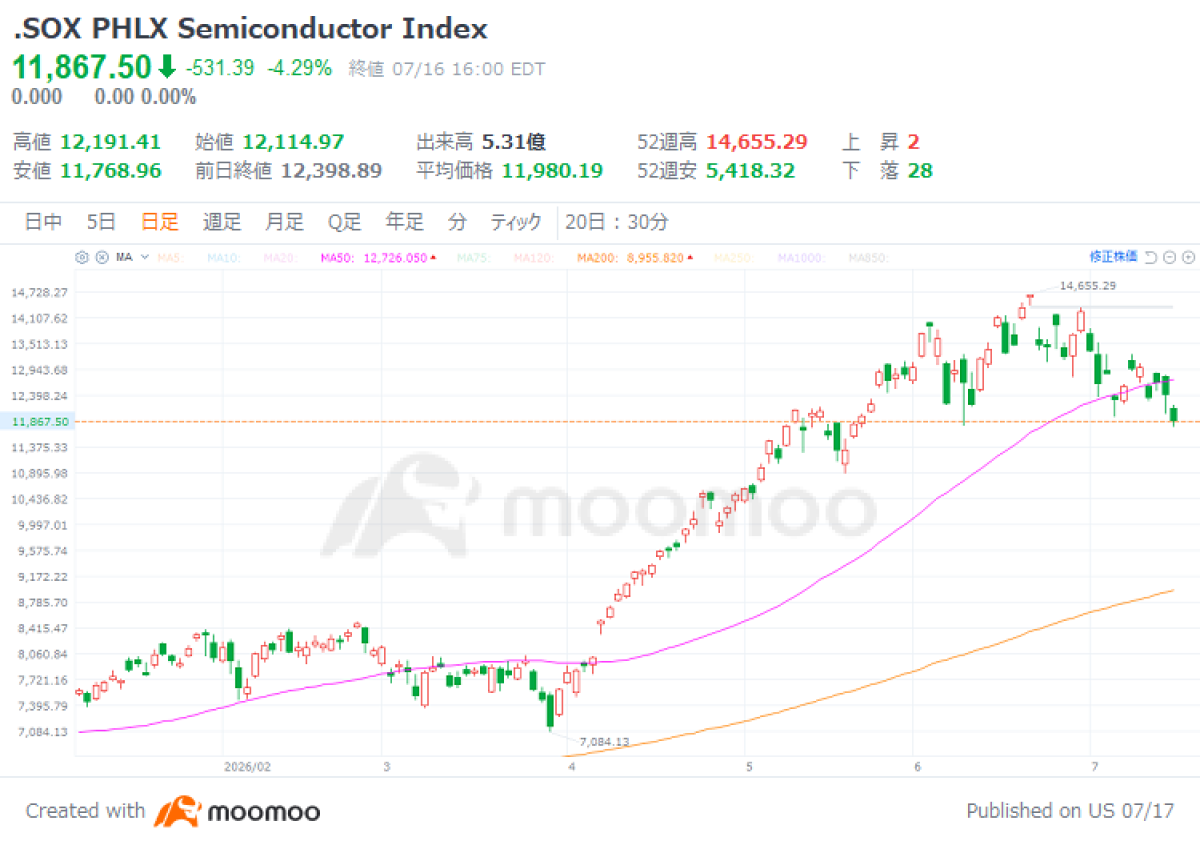
Recently, the sharp decline in semiconductor stocks has been especially noticeable.

However, setting aside the short-term deterioration in sentiment, this sell-off does not signal a reversal in the fundamentals of the AI industry. Rather, it represents an inevitable deleveraging and valuation reassessment as capital markets usher in the next phase of AI investment—characterized by polarization and dispersion.
 AI semiconductors have entered a bear market! But is the issue really with fundamentals—or merely the unwinding of ‘overheated trading’?
Has the stock market truly collapsed?
● Three micro-level factors behind the sharp decline
First,profit-taking pressure had built up excessively. Since the beginning of the year $SanDisk (SNDK.US)$、 $Western Digital (WDC.US)$ 、 $Micron Technology (MU.US)$ rose by 500%, 170%, and 200%, respectively. When gains of this magnitude exist, even minor negative news can immediately trigger profit-taking sell-offs.
Secondly,The yield on the 10-year US Treasury note remains elevated at 4.56%, and this high-rate environment continues to weigh heavily on richly valued tech stocks.
Moreover, the core selling pressure is stemming from mechanical deleveraging.。
In the Korean market, forced liquidations of leveraged single-stock ETFs and spot selling have created a vicious cycle. Regulators have responded by urgently halting new issuances of leveraged ETFs linked to Samsung Electronics and SK Hynix and tripling the minimum margin requirements.
Meanwhile, today also marks the monthly options expiration for US equities, and hedging or rolling over positions in semiconductor and large-cap tech stocks could further amplify volatility.
● JPMorgan: ‘AI Deleveraging Is a Healthy Reset’
According to JPMorgan Chase research, the current deleveraging within the AI ecosystem represents a healthy valuation reset—not a bubble burst. During the dot-com bubble, leverage ratios reached 230%, whereas today’s comparable ratio stands at only around 40%, indicating sound balance sheets.
At the same time, large language models (LLMs) continue to evolve, and hardware production capacity constraints are expected to persist through at least late 2027 to 2028. In other words, what’s being corrected are inflated valuations and overcrowded positions, while underlying industry demand remains solid.
What the Post-Earnings Decline in AI Semiconductor Stocks Reveals About the Next Phase of AI Investing: ‘Expansion’ and ‘Selection’Why couldn’t strong positive catalysts from ASML or TSMC lift the broader semiconductor sector?
Under normal circumstances, strong earnings from both companies—key pillars of the supply chain—should have provided positive confirmation. However, the market chose a broad sell-off. Underlying this reaction are four key mismatches between expectations and reality.
• At elevated valuations, the market no longer accepts ‘merely solid results’ but demands performance that exceeds even the most optimistic forecasts.
• The market has already begun stress-testing the sustainability of cloud providers’ capital expenditures for 2026–2027.
• There was a need to cool down excessive speculative fervor stemming from extremely crowded and concentrated trades.
While the earnings reports triggered profit-taking, a closer analysis reveals that industry leaders are still sending clear signals of robust structural strength.
● Taiwan Semiconductor Manufacturing: Breaking cyclical norms and reaffirming its role as critical infrastructure
$Taiwan Semiconductor (TSM.US)$ The core signal this quarter is TSMC’s absolute confidence in leading-edge processes. Management significantly raised its full-year U.S. dollar revenue forecast for AI accelerators to ‘over 40%,’ securing visibility into orders through 2027–2030.
Moreover, it broke from its past practice of halting capacity expansion once a specific node reaches volume production, and is aggressively continuing to expand 3nm (nanometer) capacity.
At the same time, its capital expenditure outlook was substantially revised upward to $60–64 billion.
The historical nightmare in the semiconductor industry has been ‘blind capacity expansion driven by consumption cycles, leading to overcapacity.’ However, TSMC’s actions demonstrate that current AI demand is not a temporary consumption-driven impulse but rather a long-term ‘infrastructure cycle.’ What is truly constrained is advanced manufacturing capacity—not generic wafers.
●ASML Holding: Synergy between ‘full utilization of existing equipment’ and ‘new capacity expansion’
$ASML Holding (ASML.US)$ also contains critical information that cannot be ignored in its earnings report. The company’s service and upgrade revenue reached €2.76 billion, accounting for nearly 30% of total revenue. This directly confirms that downstream wafer fabs are operating their existing tools at maximum capacity, indirectly validating the ‘true supply shortage’ in advanced processes.
At the same time, ASML forecasts memory demand in 2026 will surge by 75%, indicating that high-bandwidth memory (HBM) is completely reshaping the traditional memory cycle.
Additionally, high-NA (numerical aperture) extreme ultraviolet (EUV) lithography systems—each costing over $350 million—have $Intel (INTC.US)$ entered mass production on manufacturing lines. This signifies that the arms race among wafer fabs for leadership in advanced process technology is not only ongoing but intensifying.
How should investors prepare for the ‘second half’ of AI investment?As we enter the second half of AI investment, market logic is shifting from chasing ‘narratives’ to pursuing ‘profits,’ and from broad sector-wide rallies to intense internal bifurcation. While the AI supply chain continues to expand, the profit elasticity, order visibility, and valuation risk across different segments have already diverged significantly.
One is assuming the AI semiconductor rally is entirely over due to short-term pullbacks. The other is continuing to chase high prices while ignoring valuations and positioning, solely because the long-term trend remains intact.
While industry trends continue to rise, stock prices may undergo gradual corrections. Even high-quality companies are not necessarily worth buying at any price.
Investors should decouple fundamentals from price and focus on the following two types of assets.
① High-certainty assets – Watch for medium- to long-term entry opportunities after corrections
These companies possess strong barriers to entry and extremely high-quality customer bases. While they may lack short-term explosive price performance, they serve as anchors of stability within a semiconductor portfolio, allowing investors to patiently wait for valuation digestion post-correction.
・ ASML and TSMC (dual monopolies in manufacturing and lithography equipment):
Visibility into orders for 3nm and 2nm processes is high, and the core risks are limited to fluctuations in valuation and the high costs of overseas fab construction.
Furthermore, ASML’s upward revision of its outlook indirectly reinforces the strength of advanced process demand for TSMC. The foundation supporting capital expenditures toward 3nm and 2nm remains intact, and visibility into orders from AI-related customers is extremely high.
• NVIDIA and Broadcom (the twin pillars of computational power):
• Applied Materials (a reliable ‘pick-and-shovel’ play):
② High-beta assets: Watch for order-backed fundamentals and earnings recovery
These companies exhibit higher volatility, and as the AI boom spreads into more specialized segments, such assets could experience a sharp earnings rebound once they reach an inflection point in the cycle.
• Micron Technology and Lam Research: Memory cycle recovery provides tailwinds
・KLA and Teradyne: The ‘quality inspection backbone’ addressing yield concerns and complex testing needs
・Marvell Technology: A High-Sensitivity Stock in Optical Interconnects and Custom Networking
Summary: A stock price decline does not equate to a loss of intrinsic valueWhen markets fall into extreme panic, investors tend to reinterpret all fundamentals solely through short-term stock prices—embracing technological advantages during rallies but suddenly doubting every capital expenditure as wasteful during sharp sell-offs. However, TSMC’s leadership in advanced semiconductor processes won’t vanish overnight due to a market crash, nor will major cloud providers’ data center strategies collapse because of a few days of stock price corrections.
When assessing a company’s long-term value, focus on four key aspects: Is there a genuine reversal in customer orders? Are profit margins and cash flow outlooks being repeatedly revised downward? Has the core technological edge been compromised? And finally, does the current valuation fully front-run all future value?
If a sharp decline occurs despite strengthening fundamentals and ongoing orders—driven instead by sentiment or leverage-related selling—it resembles a valuation reset within a bull market rather than the end of an industry trend. Conversely, if fundamentals are genuinely deteriorating, one must not justify poor decisions under the guise of ‘long-term investing.’
In today’s highly volatile markets, it’s dangerous to make impulsive bets like ‘liquidating all positions at once’ or going ‘fully invested’ while in an emotional state. Key strategies for navigating panic-driven markets include building positions over time, maintaining liquidity, and avoiding excessive concentration in any single sector. In the long-term battle to build AI infrastructure, ultimate success will be determined by confidence grounded in objective data, disciplined position management, and professional judgment that remains unswayed by emotions—even in the most challenging moments.
-moomoo News Sherry
This article uses partial automatic translation.