Albo’s AI FOMO – Startup Daily
Time will tell where prime minister Anthony Albanese’s Very Big Vision on artificial intelligence (AI) will end up on the Albo Delivery Scale™.
At one end of the ADC spectrum is the broken promise of the current capital gains tax changes. At the other, the PM’s trademark delay/defer/dilute/drift approach – think gambling ad reforms, religious and LGBTQI protections, environmental law reforms.
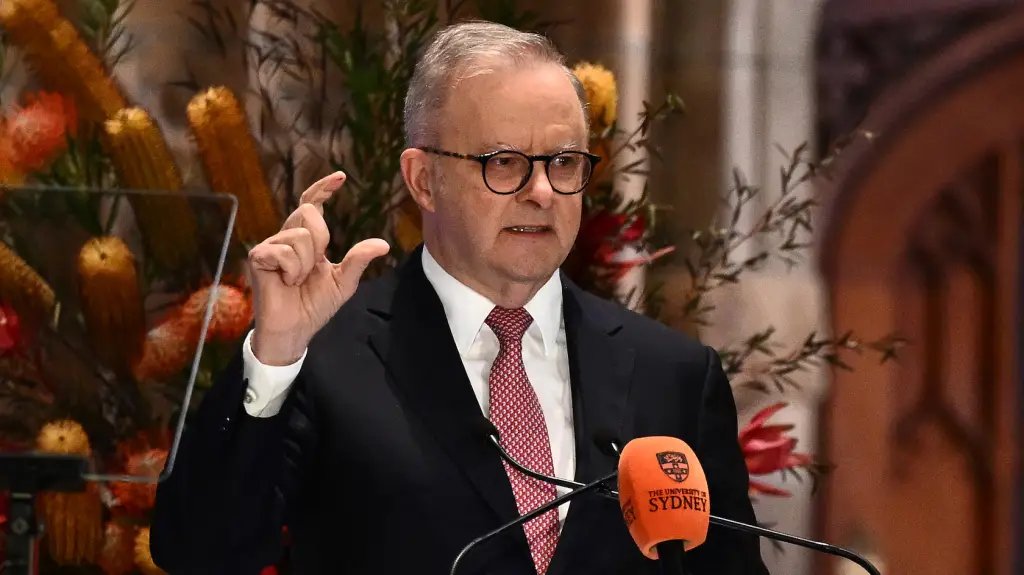
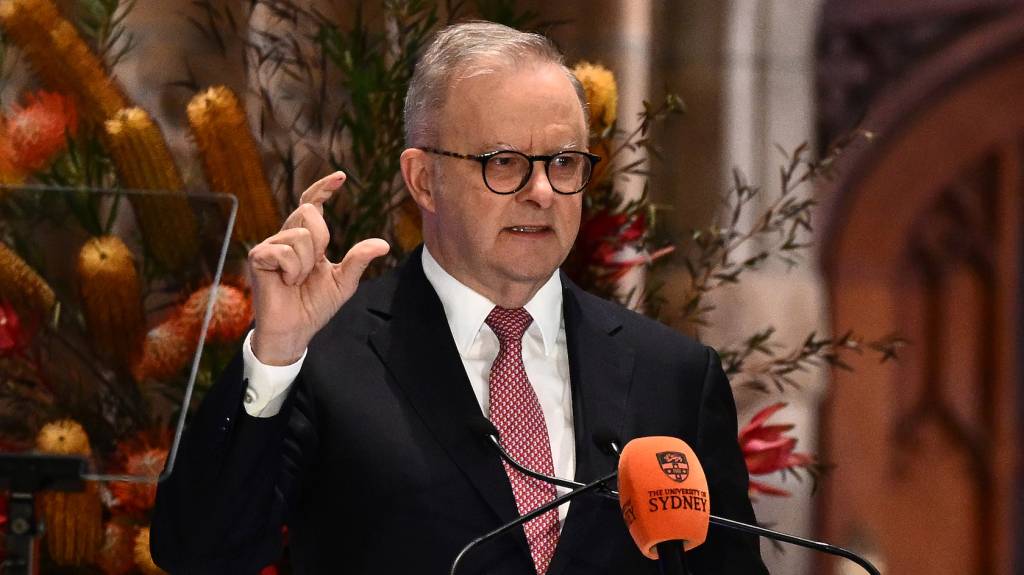
Wednesday’s carefully stage-managed address at the University of Sydney, including the pre-speech media briefings, appeared to be a soothing balm for growing unease among voters that the AI revolution will see workers being guillotined by tech royalty alongside a vigorous push – and community pushback – for data centres around the nation.
Albanese was keen to paint an inspirational tale of national interest where the government has everyone’s back and is in control when it comes to foreign tech titans and the relentless disruption that’s halved the value of local tech heroes such as Atlassian and Xero in the last 12 months.
Perhaps someone gave him Dr Spencer Johnson’s 1990s bestseller Who Moved My Cheese?, before the speech. That always-look-on-the-bright-side-of-life parable, beloved by business execs, is about embracing change when you’re hit by the disruption bus.
Albo’s talk kicked off with a football, meat pies, kangaroos and Holden cars vibe, placing an AI future amid previous landmark government initiatives such as the minimum wage, eight-hour day, superannuation and his own under-16 social media ban.
AI AI AI OI! Oi! Oi!
Albanese accepts the inevitability of AI, but positioned it as an opportunity for national sovereignty, rather than fatalism.
The government wants frontier AI companies and data centre investors here, but to repurpose a popular political phrase: we will decide who comes to this country and the circumstances in which they come.
Something for everyone
A national framework for AI data centres is coming next month, with the legislation in place in 2027. The rules will address the costs and demands around energy and water, as well as placement. Timeliness matters, given regional community foment is already underway.
Firmus cofounder Tim Rosenfield was at the PM’s announcement before shooting through for a public meeting with South Australians in the Murray River town of Tailem Bend, where his $15 billion infrastructure company wants to build one of its AI factories. There’s also growing resistance to their Tasmanian government-backed projects too.
While the framework Albanese outlined is a positive start, a many discovered post-budget, the devil is in the detail of Labor legislation. What the PM offered was general direction rather than execution.
Nonetheless, placing the Office of AI inside the PM’s department is wise both strategically and politically. It not only creates a single desk for government interactions, it also makes sense given the data centre push involves multiple government departments as well as end-user portfolios, from defence to education.
And it can also act as an early-warning radar on voter sentiment shifts as AI implementation gathers momentum.
The government’s broad intent is good. Albanese is keen to stave off the nation becoming a digital quarry, with cheap power and water, where the world’s Googles, Anthropics and OpenAIs mine data and export the profits, leaving Australia as the “last link of the digital supply chain”.
The Labor leader also had a message for the creative community: we’re not “a data warehouse for AI products made overseas” and “not everything produced in Australia is up for grabs”..
It followed reports that Anthropic had effectively linked its proposed $16 billion investment to Australia’s copyright settings.
Albanese’s response was what the arts sector wanted and needed to hear: they’re not an all-you-can-eat Sizzler buffet for Silicon Valley.
“No company should use Australian books, music, art or news to build or train AI without the artist’s control,” he said.
“That includes the artist’s control of the price and value of their work. Anything less, is theft.”
It was a speech where everyone heard what they wanted, without having to think about everyone else.
The hyperscalers were served up Australia’s open for business; creatives heard permission and payment; and communities were told data centres on our terms.
Everyone’s a winner baby, but someone, somewhere is going to disappointed.
A strategy for startups
What’s missing, yet again, is a clear strategy for local startups.
AI shouldn’t be like Facebook, where those who build a business reliant on the social media platform suddenly found they were in a hostage situation and had to pay Meta ransom to stay alive.
Australia needs to develop something akin to the UK’s AI Opportunities Action Plan, which backs local innovation through a range of measures spanning sovereign compute, AI Growth Zones, and the unlocking of public datasets as well as wielding the power of government purchasing decisions in favour of domestic companies.
Singapore has a similarly strong AI strategy with practical applications around AI literacy, and government adoption, underpinned by the S$150 million Enterprise Compute Initiative so companies can access to cloud compute, tools, training and engineering support.
They’re all issues skimmed over in Albanese’s vision. Letting 100 data centre flowers bloom is not that same as ensuring Australian startups get affordable GPU access. Token bill shock is already starting to give CFOs heart palpitations and all we’re really getting is a Bunnings warehouse full of foreign-owned chips and models where the lowest prices are not the beginning.
Meanwhile, there’s no clear message on a government as first customer procurement plan. That matters most for startups.
If areas such as health, defence, agriculture, education, climate adaptation and public services are national AI priorities, then the Commonwealth needs to develop challenge-based procurement pathways – a model Victoria implemented with some success – so startups can nab government business without being beaten down by risk-averse departments and months/years-long assessment processes.
And while the PM’s speech played to the arts crowd, it needs to get down and dirty with high-value datasets, which it says it’s exploring alongside pilot AI use cases, but the sector saw what happened with CDR, another reform that soon lost wind and ended up becalmed. Licensed national datasets in sectors such as health, agriculture, climate, energy, education and public admin are needed – and could even bring AI into the mix to reboot CDR.
Meanwhile, we need to talk about the billion-pound gorillas in the room. There’s already a well-worn path to Canberra by US AI execs and Australia knows all too painfully well what it’s like living with oligopolies. The OECD’s already flagged competition issues around AI infrastructure, from chips to data centres, and networking. Energy’s already at ground war in US communities. Policy settings that encourage competition are keen and Albo’s grand dream needs to tackle the fine print around cloud lock-in, interoperability, model portability, API pricing, and infrastructure or things will end up looking like Sydney toll roads.
The challenge for the government is this: after successive administrations over the decades fucked up the national dividend for Australia’s resources and energy reserves, any AI infrastructure deal scoring faster approvals, grid support or national-standard certainty needs to deliver a local innovation win.
A social/affordable housing-style quota of reserved compute at affordable pricing is what’s needed startups and researchers.
There’s a lot more for the Office of AI to say about a way forward that will put marrow in the bones of the Backbone of the Australian economy™, as politicians love to describe small business (which includes startups).
The question now is does the Albanese government have the backbone to deliver?
Anyone can get generative AI to deliver nice words.