New open-weight AI from China is toppling the best of OpenAI and Claude Fable
China’s Moonshot AI has launched Kimi K3, a massive 2.8-trillion-parameter model built for coding, research, reasoning, and visual tasks. Moonshot admits K3 still trails Claude Fable 5 and GPT 5.6 Sol overall. Even so, its benchmark results put it surprisingly close to both, and it finishes ahead in several tests.
How close is Kimi K3 to the best closed models?
K3 scored 77.8 on Program Bench, narrowly beating Fable 5 at 76.8 and GPT 5.6 Sol at 77.6. It also led BrowseComp with 91.2 and SWE Marathon with 42.0, ahead of both rivals.
Other results show there is still some distance to cover. K3 scored 67.5 on DeepSWE, compared to 70.0 for Fable 5 and 73.0 for GPT 5.6 Sol. Moonshot also says the overall user experience remains behind both proprietary models.
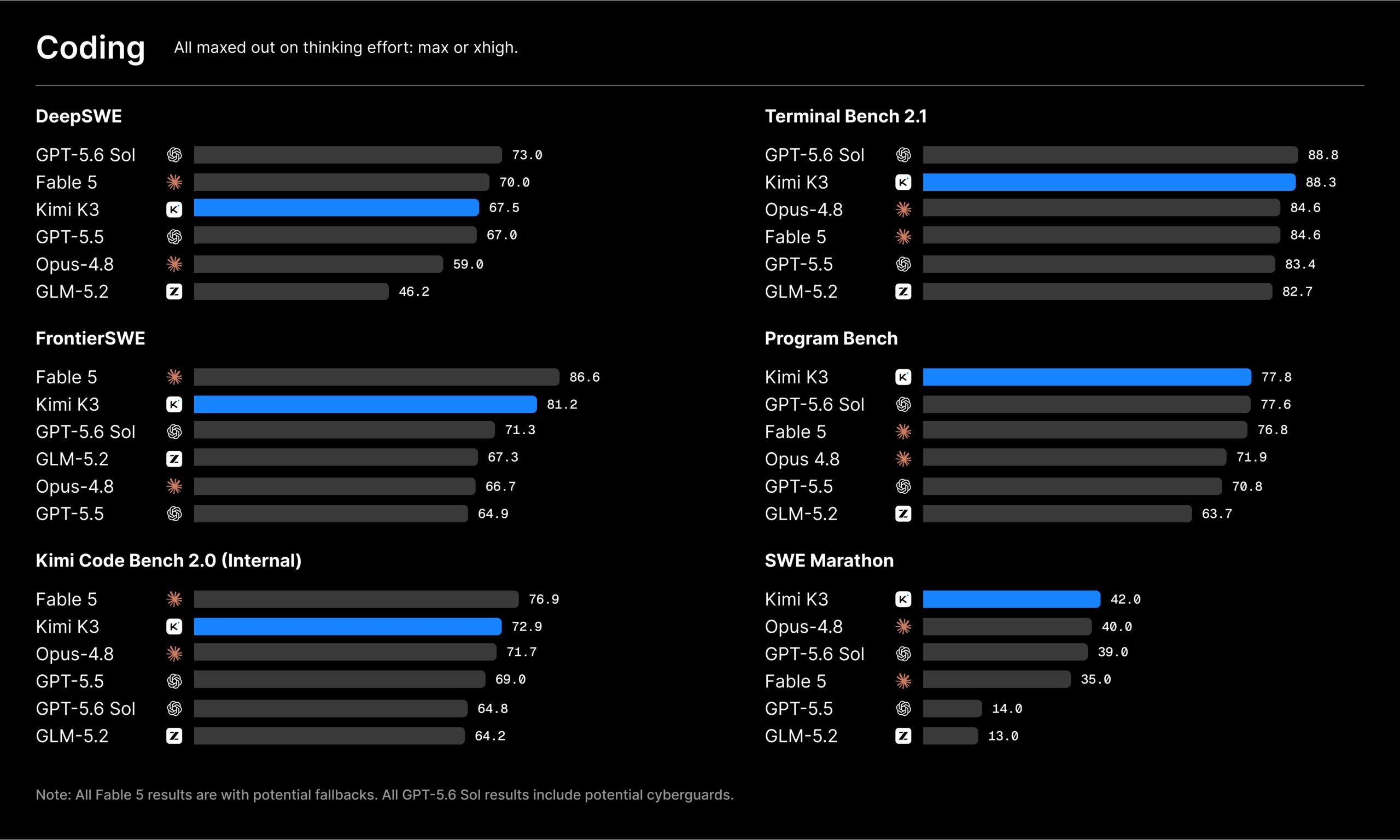
These comparisons also come with an important caveat. Moonshot says all Fable 5 results may include fallbacks to another model, while GPT 5.6 Sol results may include cyberguards that restrict certain responses. In other words, the comparison is useful, but it is not perfectly even.
Open weights put pressure on OpenAI and Anthropic
The most important part of K3 may be its open-weight release. Moonshot plans to publish the full model weights by July 27, meaning you can download and run K3 locally, provided you have the hardware to handle a model this large. Developers will also be able to modify and fine-tune it for specific tasks.
K3 is cheaper than the premium U.S. models it competes against, but it is not unusually affordable by Chinese AI standards. Its API pricing is $0.30 per million cached input tokens, $3 for uncached input, and $15 for output, putting it closer to Anthropic’s mid-range models than to the heavily discounted prices associated with earlier Chinese releases.
Chinese AI models are often far cheaper than their U.S. counterparts, and that gap is already pushing some American startups to adopt them to cut costs. Kimi K3 is not among the cheapest Chinese models, but its near-frontier performance at a lower price still puts pressure on OpenAI and Anthropic to justify their premiums.