1.3 Billion Years Vanished From the Grand Canyon’s Rock Record — a Cold Case That Has Puzzled Geologists Since the 1860s
Three boats came crashing down the Colorado River in 1869, through the carved valley of the Grand Canyon. Geologist John Wesley Powell and eight other men desperately tried to navigate the rapids, shooting past sharp rocks as waves slammed against them. Suddenly, a breaker capsized one of the boats, sending several men overboard. But they managed to cling to it and climb back on.
During this chaotic ride, Powell and his men had no idea what awaited them ahead. They constantly listened for falls and watched for rocks, but now and then, they stopped to “admire the gigantic scenery,” as Powell would recount in his book The Exploration of the Grand Canyon and Its Canyons.
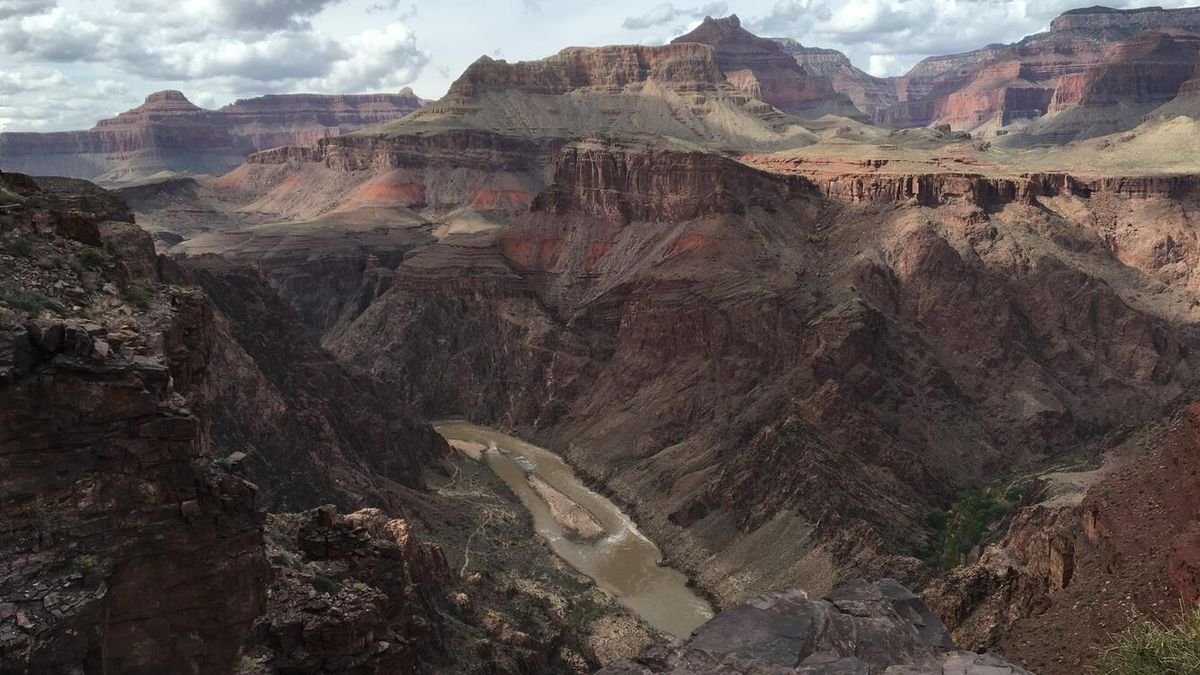
Looking up the canyon’s walls, Powell saw that they were split into three main sets of rocks, separated by age. But at one point, he noticed something odd about them: The ages of the rock sequences didn’t line up, creating mismatched layers. Time, Powell soon realized, was missing between these layers.

The Great Unconformity.
(Image Courtesy of Dr. Rebecca Flowers)
Powell’s harrowing journey lasted from May 24 to Aug. 30, 1869, and would become the first scientific expedition of the Grand Canyon. And over 150 years later, the layers’ outlandish alignment still has geologists scratching their heads.
The Grand Canyon’s layers are like chapters of the Earth’s geologic record, stacked together to form one rugged storybook. But just like a handful of pages torn right out of a book, the Grand Canyon is missing crucial chapters that account for around 1.3 billion years of history, which Powell recognized in his observations. This gap in time describes one of Earth’s greatest mysteries, the Great Unconformity.
Today, geologists like Karl Karlstrom are working tirelessly to crack this geologic cold case. They’ve long grappled with unconformities, which, according to the United States Geological Survey (USGS), occur when an older rock formation has been deformed or partially eroded before a younger rock layer, usually sedimentary, is laid down, resulting in mismatched rock layers.
It’s no surprise that unconformities — though not always the easiest to spot with the untrained eye — make for some of the juiciest mysteries related to Earth’s history.
“The reason the unconformities are so important is that the rock record is one way to think about time, but that’s never complete,” Karlstrom, currently a distinguished professor at the University of New Mexico, told Discover.
Finding out what happened to the missing time in the Great Unconformity isn’t simply about geologists on a chase for long-awaited closure; the 1.3-billion-year-long gap in the geologic record is critical knowledge that can help us understand what the Earth has been through in the past. And since humans are a living part of this planet’s history, it’s important for us to know how the Earth was shaped geologically, Karlstrom said.
While the Great Unconformity might seem like a cryptic, faraway concept, according to Rebecca Flowers, a professor of geological sciences at the University of Colorado Boulder, it manifests all over the U.S. and around the world; it’s just the Grand Canyon is the premier spot to study it.
“Many people have the Great Unconformity right outside their back door,” Flowers told Discover. “If we want to understand how the Earth works […] and the effects of modern climate change and how we respond to them, it’s important to understand how the larger climate system operates, not only over short time scales, but over long time scales.”
A Layered Mystery of the Great Unconformity
Like many geologists who grew up out west, Karl Karlstrom found himself drawn to the Grand Canyon from a young age. After all, he says, it’s “one of the best museums of geology that you’ll see anywhere.” Once he learned about the rock layers of the Grand Canyon, Karlstrom said, he never looked back.
“The inexplicable beauty of the Grand Canyon attracts people on its own. And that leads to questions. How did it form? Why is it here? What do those different colors mean? And things like that […] surround [the] Grand Canyon all the time,” Karlstrom said.
When it comes to the Grand Canyon, Karlstrom has pretty much done it all — over 150 research trips and counting, and studies of the lower rocks, the upper rocks, and everything in between. Fortunately, his trips are not quite as life-threatening as Powell’s pioneering 1869 expedition, but the blisters and sore muscles he earns from them prove that even in the modern era, Grand Canyon research is still no walk in the park.
Despite the hardships of Powell’s journey, including surviving near-drownings and starvation, the geologist still found the time to help identify the Grand Canyon’s three layers, which have since been given their own name.
Today, we call the bottom layer the Vishnu Basement Rocks. These primarily metamorphic rocks were laid down about 1.8 billion years ago during an era called the Proterozoic, back when volcanic islands had collided with the continental landmass that would eventually become North America. Going up one set, sedimentary rocks make up the middle layer, the Grand Canyon Supergroup, which was deposited between 1.25 billion and 729 million years ago.

The Grand Canyon, showing the Great Unconformity.
(Image Courtesy of Carl Bowman, NPS Telling Time at Grand Canyon National Park, Karlstrom, K.E., Crossey, L.J., Mathis, A, and Bowman, C., 2021, Fig. 19)
Finally, Layered Paleozoic Rocks that formed between 530 million and 270 million years ago comprise the top layer of the Grand Canyon, or its upper two-thirds, depending on the location. When you think of the Grand Canyon, these rocks are almost certainly what come to mind, epitomized by the striking red cliffs often seen in images.
The Paleozoic strata, notably, are rich in fossils of ocean-dwelling creatures like trilobites and molluscs that emerged during the Cambrian Explosion that began 538.8 million years ago, when the canyon was a nutrient-rich sea.
While observing these layers, Powell described two unconformities. One is lower down — between the Vishnu Basement Rocks and the Grand Canyon Supergroup — and represents 500 million years of missing time. This would become known as the Great Nonconformity.
The other unconformity, which is higher up where the Layered Paleozoic Strata sit directly above the Grand Canyon Supergroup, represents 750 million years of lost time, according to the National Park Service (NPS). This would become known as the Great Angular Unconformity.
Imagine these two unconformities as two lines — the Great Nonconformity as a slanted line sloping up to the left and the Great Angular Unconformity as a straight line above it. As the two lines travel, they eventually meet — this meeting spot becomes the Great Unconformity, where the 510-million-year-old base of the Layered Paleozoic Strata sits directly above the 1.75-billion-year-old Vishnu Basement Rocks.
The intermediate layer of rocks that should be comfortably sandwiched between these two layers vanished long ago, meaning a total of around 1.3 billion years is missing from the geologic record.
With Powell’s discovery came a question that scientists are still trying to understand 157 years later: Whatever happened to the missing rocks?
Read More: This Hidden Water System Helps Keep the Grand Canyon Alive — but Climate Change Could Put It at Risk
Ancient Erosion Events
Karlstrom, Flowers, and a determined crew of other geologists have taken the torch from Powell, with hopes of gradually filling in the holes strewn throughout the geologic record.
“There’s an old analogy that the geologic record is like a fisherman’s net. There are more holes than strings in a fisherman’s net, yet they still catch fish. So, we still understand a lot about Earth’s history with only the strings, but the more we can understand, fill that net in, we’ll have a better understanding of the deep time aspects that we’re all kind of seeking,” said Karlstrom.
Geologists know that for the younger rocks to sit right atop rocks that are over one billion years older, erosion must have occurred, wiping away around 1.3 billion years in the geologic record. The problem is they can’t unanimously agree on how this erosion happened.

Karl Karlstrom at the Grand Canyon.
(Image Courtesy of Karl Karlstrom, by Laurie Crossey)
At one point, the most popular theory seemed to be that the missing rocks were erased during a period known as the “Snowball Earth,” around 710 million to 640 million years ago, when ice was thought to cover the whole planet. The Snowball Earth theory of the Great Unconformity proposes that ice sheets carved miles of rock, according to the Geological Society of America, only for rising seas to swallow the flattened land and deposit new sediment layers atop it in the following years.
Proponents of the Snowball Earth hypothesis believe that during this period alone, glaciers did most of the work eroding rock around the whole world. Karlstrom doesn’t buy it.
Karlstrom’s view of the Great Unconformity, instead, revolves around the idea that missing time didn’t just disappear from a synchronous, global event like Snowball Earth. Instead, he argues, it disappeared due to multiple erosion events scattered across geologic history. This view also warrants a small title change: The Great Unconformity is made up of many Great Unconformities, according to Karlstrom.
“For all of these things, my philosophy […] is that there’s usually multiple causations that come together,” Karlstrom said. These causations, he describes, make “the perfect storm” for the events that have played a role in erasing the Earth’s rocks.
Karlstrom said the origins of the Vishnu Basement Rocks provide insight into the heavy-duty erosion needed to form the Great Unconformity.
Looking at the Vishnu Basement Rocks, we see the roots of what used to be an ancient mountain range. Its base came from 12 miles deep within the Earth’s crust; the rest of the mountain range above it was once uplifted and then eroded over hundreds of millions of years. So, according to Karlstrom, 12 miles of mountains had to be shaved off before the Vishnu Basement Rocks could be blanketed with much younger rocks, as seen in the Great Unconformity.
“That is the removal of an ancient mountain belt. And that’s the key. It took a long time […], and that’s what makes Great Unconformities,” Karlstrom said.
But glaciers during the Snowball Earth, Karlstrom said, wouldn’t have been effective at deep erosion of basement rocks.
“We can’t rule out that there was some erosion during that time period. But the question is, how much? In general, if you look at ice erosion under Greenland or under Antarctica, ice sheets erode high mountains, and they make cirques and beautiful climbing areas, but they don’t cause beveling of continents,” Karlstrom told Discover.
Glaciers may have played a supporting role in eroding rocks, but they’re likely otherwise just one chapter in a broader anthology of erosion events throughout history. In recent years, tectonic forces involved in the building of the supercontinent Rodinia have gained more traction as a potential explanation for the Great Unconformity.
How Lost Time Can Be Found
The notion that the Great Unconformity is defined by multiple erosion periods is something that Flowers would agree with, too. The challenge, however, is knowing when and how these erosion events may have occurred throughout ancient history.
Geologists are gradually making progress on the Great Unconformity with thermochronology, a method used to date the cooling of rocks based on the decay of unstable “parent” elements, which creates stable “daughter” elements that then help untangle rocks’ temperature history.

Grand Canyon research.
(Image Courtesy of Dr. Rebecca Flowers)
Flowers’ lab has looked at the decay of uranium and thorium to helium in minerals. This decay is always happening, but helium is lost in crystals at extreme depths due to elevated temperatures. For example, the mineral apatite, taken from around 6 miles deep, would yield an age of zero because there’s no helium preserved in the crystal, Flowers said.
But as rocks move from deep in the crust to shallow in the crust, minerals cool off and start retaining the helium. Geologists study the parent elements (like uranium and thorium) and their daughter elements (like helium), and with knowledge of the decay rate that happens over time, they can obtain a date.
“That date gives you information on when that rock cooled as it moved through the upper few kilometers of the Earth’s crust and ultimately reached the surface where we sample it today,” Flowers said.
Flowers said there are multiple thermochronological models, each incorporating different minerals or different temperature sensitivities. Some of these models may work better in one location compared to another based on the type of rock or its thermal history.
The utility belt of thermochronology tools is necessary for geologists, considering the Great Unconformity is present all over the world. And not all locations display the Great Unconformity in the same way as the Grand Canyon.
Research at the Grand Canyon has shown unconformities pre- and post-Snowball Earth, while evidence up in central and eastern Canada points to post-Snowball erosion in those particular regions. Flowers focuses on erosion at Pikes Peak in Colorado, where evidence shows that pre-Snowball erosion took place approximately 717 million years ago.
Flowers has also encountered unusual rocks at Pikes Peak called “sand injectites,” which are Snowball Earth in age, yet have been buried deep in basement rocks. These rocks used to sit at the surface, but when ice sheets covered Earth, overpressure caused the sandy structures to be injected deep into older rocks.
The sand injectites may indicate that the basement rock had already been eroded before the Snowball Earth, potentially adding support to the view of multiple erosion events held by Flowers and Karlstrom.
Making Gradual Progress at the Grand Canyon
Answers to the Great Unconformity may seem out of reach, but Karlstrom and Flowers are both confident that with ever-evolving thermochronological tools, continuing progress is guaranteed.
“We’ll get there,” Karlstrom said. “We’re never going to understand everything, but we can get to the fundamental story. We’re already, I think, getting closer to the fundamental story in many places.”
Powell contemplated this same story as he gazed upward at the Grand Canyon’s walls back in 1869. To him, the ancient cliffs jutting out above were like the “stony leaves of one great book.”
These features chronicle not just the Grand Canyon’s history but Earth’s history. Reflecting on the canyon’s past, Powell concluded: “Thus ever the land and sea are changing; old lands are buried, and new lands are born, and with advancing periods new complexities of rock are found; new complexities of life evolved.”
The Great Unconformity remains a lost segment of this overarching story, one that geologists are still toiling to recover. Yet, it has real meaning for everyone on Earth, not just geologists: It helps us understand how we all came to be on this planet.
“Geology is all about time, right? This idea of a 4.5-billion-year-old planet of which humans have been on for a very short amount of time,” Karlstrom said. “But we need to understand the history of the Earth in order to figure out how we can fit into it.”
Read More: The Atlantic Ocean May Have Its Own Grand Canyon — and It Might Be Even Bigger
Article Sources
Our writers at Discovermagazine.com use peer-reviewed studies and high-quality sources for our articles, and our editors review for scientific accuracy and editorial standards. Review the sources used below for this article: